Posted tagged ‘Obama’

DAYLIGHT BETWEEN BUFFETT AND OBAMA

November 7, 2011

Sorry about the six weeks of silence. Been busy. First, let me clean up some unfinished business on Warren Buffett and what he thinks about taxing “high earners” much more.

Billionaire Mayor Michael Bloomberg’s media operation has outed Warren Buffett’s real views concerning the need to raise taxes on the wealthy. Do you believe you already know them? Who exactly does he think should pay more in income tax? Have a look for the answer to this question.

Now, have you heard of the Buffet rule? The millionaire surtax? The Occupy Wall Street rule — “Let’s Eat the Rich”? Each of these ideas seems to be supported by the president. First, let’s see about the millionaire surtax idea. The democratic party’s own senate majority leader has proposed a 5.6 surtax on all income above $1,000,000 in order to fund the president’s job program. A permanent tax of this type, of course, would fly directly in the face of Mr. Buffett’s position as stated in the clip above that people who already pay tax at the ordinary income rate should not see their taxes raised. Reid, though, proposed this when he saw that the president’s taxing proposals to fund his so-called jobs bill weren’t going to fly.

How about this Buffett rule? What is that? The Buffett Rule is a rule which would make the tax rates levied upon dividends and capital gains up to the level applicable to ordinary earned incomes. Remember Buffett’s secretary? Yeah, it would actually do what Buffett says he wants. You’ll remember that I blogged about Obama’s hesitance to do this very thing back in April.

Well, this is what Mr. Obama said last month to a CNBC reporter in response to a question as to whether he would support the surtax proposed by the senate majority leader:

So, the approach that the Senate is taking, I’m comfortable with in order to deal with the jobs bill.

We’re still going to need to reform this tax code to make sure that we’re closing loopholes, closing special interest tax breaks, making sure that the very simple principle, what we call the Buffett Rule, which is that millionaires and billionaires aren’t paying lower tax rates than ordinary families, that that’s in place.

This gets really confusing. In April Mr. Obama’s proposed tax plan did not include a return the Reagan Rule of taxing all incomes equally. In fact of the three players, Rep. Ryan, the president and the Debt Commission, it was only the Debt Commission which did that. Now, however, Mr. Obama says something which sounds a lot like he is adopting at least the taxation part of the Commission’s proposal. Is there any indication that he is serious about this? Shouldn’t this be touted by the press as big news? A change in the president’s position vis-a-vis taxes on capital gains and dividends? Why isn’t this big news?

I propose to you that it is not big news precisely because it is just a big fudge (I would have said something else but look at the abuse Joe Wilson got when he said something unkind about the president’s health care bill which apparently is turning out to be a reality). Even the rosy glass wearing news media sees it as a fudge and therefore is just not interested in reporting it as a change in position. Wouldn’t the famously liberal media prefer that taxes on the “paper rich” be raised to at least the level of the “working rich?” All this is confusing if you pay attention to what is being said but watch what is being done on this score when the “super committee” which is tasked with reducing the budget reports in the day before Thanksgiving. That will be action, not words. By the way, isn’t Thanksgiving Wednesday the least important news day of the year. Everyone is traveling or cooking. Can you imagine anyone paying more than just passing attention? Why did they set this day for issuing their report? Washington is such a strange place. And we have a strange president who first rails against the mega-rich both directly and through his OWS surrogates but perversely won’t raise their taxes. He even seems to prefer their company (i.e. Martha’s Vineyard) to the company of his old ChiTown crew.

Bravo Mr. Buffett!! At least you cleared up the ambiguity in your own position. On the other hand, even if the President is ignoring your sage advice on this score apparently you’re still bundling lots of money for him. What do you think that this might be about? I know, I know, I’m may be a bit too cynical about a really nice man like Mr. Buffett.
RAISING TAXES VS. BUDGET CUTS

July 1, 2011

As I write this the Debt Ceiling talks are on life support. The president has become involved in order to revive the talks. Although the nominal focus of the talks is upon raising the borrowing limit, the nuts and bolts actually concern budgetary reform.

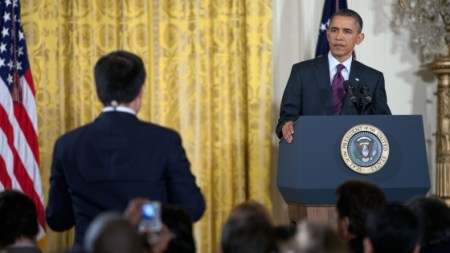
A few days ago Republican talk participants withdrew. The withdrawal was apparently caused by the insistence of Democratic members on raising taxes. The president met with congressional leaders from both sides. At his press conference Wednesday he chastised the Republicans for being unwilling to raise taxes on some, including jet owners, in order to pay for things like student loans and other high priority federal government programs.

June 29 Press Conference (Courtesy WhiteHouse.gov)

Just before the 2008 Democratic landslide election it was Fox News’ resident liberal, Juan Williams, who said, and I paraphrase, if the Democrats win this election in the numbers it appears that they will (and they did) there is one thing that won’t matter — the deficit. How prescient was Williams? The question is, though, do the deficit and the federal debt really matter?

To answer this question you must first understand what a dollar is. We all know that a dollar is a unit of value. It is the unit which we use to facilitate our economy. How does this work in practice? It is only paper after all. It works because on every dollar bill there is the legend, “This note is legal tender for all debts, public and private.” In that phrase is the value. By federal law you use the dollar as the means of paying your debts. But what if the transaction doesn’t involve dollars at all, though, what is the role of the dollar then? How is the dollar involved?

Let me give you an example, what if you and I agree to trade my Kawasaki dirt bike for your 1994 Ford Thunderbird. After the transaction, under IRS rules, the the party which received the vehicle with the greater market value in dollars must report that as a gain on his Form 1040 and pay income taxes denominated in dollars on the gain. But let’s suppose that one of us backs out of the exchange, what happens then? The one wishing to perform takes the other one to court. In the typical court proceeding the judge will not order the physical exchange to occur but will issue an order that the party refusing to perform must pay the performing party the difference in market value between the two vehicles plus, in many instances, attorneys fees, all of which are reckoned in dollars. Hence, even in situations not involving dollars per se, the dollar is ever present.

What then backs our dollars? Where do they come from? Is it just a big secret or a fiction we all agree on or does it really have something to do with the real world?

FDIC "Teller Sign"


Our dollars, at least the greater part of them which are in banks, are backed by the full faith and credit of the USA through a federal agency called the FDIC. FDIC provides deposit insurance to bank depositors. This insurance says that if the bank goes bust that the vast majority of dollar deposits will be made good by the federal government. If the bank doesn’t have the money then the FDIC will stand good for their debt to you which is represented by your deposit in the bank (up to $250,000 per depositor).

Where does the FDIC get it’s money? It gets the money first from premium payments by banks and when reserves from those premium revenues fall short the FDIC can draw on the borrowing power of the USA and if the borrowing power of the USA falls short the Federal Reserve Bank will simply print the money (although the Fed will receive a federal bond in the amount of the cash created like it did during QE and QE2) and the FDIC will in turn give it to the disappointed depositors. Problem solved?

As our president is finding out, however, the ability to print bonds and dollars does not mean that you have unlimited wealth. You cannot print them at will and in any amounts you wish without consequence. The government may have access to dollars (through an increase in the national debt limit which is simply the ability to print more bonds) but the actual value is not in the ability to print bonds and inject the dollars into the system. That process is clearly limited only by the availability of paper and ink. The real value of the dollar relies in a very real sense on the resolve and dependableness of the USA to make the hard choice of choosing to pay it’s creditors first out of it’s income and consume only what is left. A reputation for dependability in seeing that creditors are paid is what gives the dollar it’s value.

In seeking to raise the debt limit the government is not showing the world we are as dependable as we have always been. We are not seeking to pay our creditors out of our income. We seek to borrow some more in order to pay our creditors back. In seeking to raise the debt limit today the government is really just putting off the day when the dependability of the USA will really be tested. And ideally for this government, that ultimate test will happen only after the current crop of debt-increasing politicians has left office. Now, after a bit, we get to the real point of this post.

How is it possible that passing a resolution to create more federal debt, basically just printing more greenbacks, indicates that the US is a dependable nation? It simply doesn’t. It shows nothing but a devil may care attitude towards being dependable and hence towards the value of the dollar itself.

Well then, how is it that the US can show that it is a dependable nation? How do we demonstrate that the value of the dollar should be relied upon now and in the future because it is backed by our full faith and credit? We must do something which is hard. We must show that we can endure the pain of taking responsbility for the debt. We must make what the president calls the “hard choices.”

Showing dependability cannot be achieved to any great extent by extending the depreciation schedules for jet plane owners, or by “making the tax code more progressive” or by taking itemized deductions away from all those who make $250,000 or more. Raising taxes, while possibly being helpful in reducing the debt, will actually be counterproductive to the idea that the majority of people in this country have the resolve to do something hard. It will demonstrate that a majority are not interested in giving but are interested only in taking!!!!

That the top 10 per cent of income earners in the US already pay around 70% of all US personal income taxes is well known. What is not so well known is that a trememdous part of the US government’s budget is made up of “transfer payments.” Transfer payments are payments which are made without the government getting anything valuable (except a vote I guess) in return. Federal transfer payments make up these percentages of the total federal budget: 20% in social security payments; 21 % in medicare, medicaid and CHIP payments; and, 14% in safety net programs.

If we do not show a willingness to fundamentally change ourselves by rejecting the idea that the federal budget should predominately be a vehicle for transfer payments, we will simply not show that we are willing to accept hard choices. We will give evidence that we are a people who want someone else to pay our bills and are not, therefore, very dependable at all except in our wants. We will show that we are willing to raise the taxes of a few in order to pay the bills of the many. Perhaps raising taxes, an outcome apparently desired by the president, will help balance the books in the short run however it will do nothing about the long run problem of a country which is interested in living at the expense of someone else. Unless we show that we, as a people, reject the belief that our federal government is mainly a vehicle for transfer payments, we will prove that our full faith and credit is just not worth very much and the dollar will eventually be valued accordingly.

A cynic might say, ‘what other decision would one expect from a form of government which has no effective protection for the property right of the minority in their own income?’ This nation has been exceptional so far and I fervently hope that it will remain so by debunking this voice of the cynic. In fact our country must debunk the cynic or risk allowing the entire idea of self-government to perish along with the value of the dollar.

Happy July 4.

HERE COMES THE PREDICTABLE PRESIDENT

April 13, 2011

It is widely believed that the Obama “budget plan” to be announced today will call for an increase in tax rates on the “wealthy.” Wow, what a difference four months makes. As readers of this blog know there are two forms of income received by the “wealthy.” Ordinary income, obtained through personal work and effort and “capital gains and dividend” income, obtained through investments. A fellow blogger, Chad Aldeman of “The Quick and the Ed Blog,” has analyzed the effective tax rates of US top 400 income earners for 2007. This is what he reports:

. . . . [T]hat the super rich have been paying smaller and smaller portions of their incomes to taxes*. The chart below shows the effective tax rate for the richest 400 American filers from 1992 and 2007. The blue line represents the highest income tax bracket, the red line is the tax rate on long-term capital gains, and the orange line is the average tax rate that the richest 400 filers actually paid.

There are two important things to note from this chart. The first, and most visually apparent, is that the tax rates of the rich are far more closely linked to the capital gains taxes than income taxes. Salaries and wages, the source of income taxed at the blue line, represented only 6.5 percent of these filers’ income. Nearly two-thirds of their income comes from capital gains, and this is why you see a much tighter coupling between the orange and red lines.

As provided by the Tax Foundation, taxfoundation.org, in 2008 the total Adjusted Gross Income for all filers with incomes above $380,000 (the top 1%) was $1.685 Trillion dollars. These people already pay about $392 Billion in income tax. Therefore, even if we took 100% of all the money earned by everyone in the top 1% of filers, we would still have a deficit of about $400 Billion for FY2011. As with the effective rate figures for the top 400 income earners in the chart above, the effective income tax rate for the top 1% is far below the 35% maximum rate. In fact it was 23.27% for the entire top 1% in 2007. This is less than halfway between the capital gains/dividend tax rate of 15% and the top income tax rate of 35%. In fact it is only 40% of the way.

What these facts mean, I believe, is that we need to look at increasing the capital gains tax rate (as well as limiting the exclusion from taxation for municipal bond interest) as a means for increasing the government’s take. There is a lot of room here for higher taxes, don’t you think? This is especially true when you understand that higher wage earners pay, in addition to income tax, 12% social security tax on the first $110,000 of earned income and 3% medicare tax on everything they earn from personal work. On the other hand, the capital gain/dividend crowd, the truly wealthy, pay 0% in either “entitlement” category.

I wonder what President Obama is going say about taxes. Maybe he’ll go for goring the capital gains/dividend crowd by 5% more, from 15% to 20%. Well, La Dee Dah. How about proposing that this preferred tax rate rise to it’s Reagan era level of 28%? Or might this proposal hurt Obama sponsors like Mrs. Heinz Kerry, Mr. Soros, Mr. Buffet, Mr. Gates, or even Mr. Gore? Therefore, I doubt very much that Mr. Obama will suggest that the capital gains tax rate should rise to more than the Clinton era’s level of 20%. This, it should be noted, is in stark contrast to the words of candidate Obama who declared that increasing capital gains tax rates was a “fairness” issue. I, of course, would advocate heavy congressional scrutiny of any proposal to increase anyone’s taxes to make sure the increase is not self defeating for the country, however, if we are going to consider raising taxes on the wealthy, let’s consider more than a single aspect of the “taxing the wealthy” issue.

DEAL-MAKING BETWEEN GOVERNMENT AND BUSINESS

April 1, 2011

I have a question. Is it easier to make a living by competing against other hard nosed competitors for the success of having the best and most economical product or by forming “partnerships” with the federal government furthering the government’s purposes in exchange for a share of the pie guaranteed by government power? The latter has the additional advantage of raising the prestige of the corporate power players. I think I know the answer. Let’s see how it works in real life.

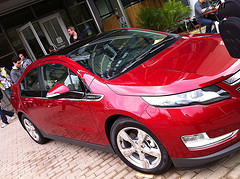
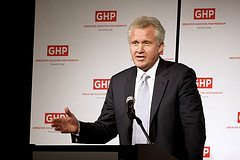
Did you hear how many Chevy Volts have been sold by GM dealers in the last three months? It seems to be about a thousand or so and this is with a very generous federal government subsidy of $7500 per vehicle. Did you also hear recently that GE’s Jeff Immelt has agreed to purchase either 25,000 or 50,000 GM hybrid products over the next two years, including Volts.

Chevy Volt courtesy Swirlspice

That’s quite a jumpstart for a car that seems to be having some trouble getting into people’s garages. Perhaps the trouble for consumers is the price tag of over $40,000. Perhaps even more important than the premium price tag is the fact that Consumer Reports found a few significant problems with the Volt when they tested it and published their review. In any case it is undisputable that the public has yet to catch on to the benefits of owning a Volt.

Enter GE, stage right. The GE purchase from GM (government motors) is a big deal for all concerned. I wonder why it happened? Maybe GM has given GE real special pricing (like 30 or 40% off) or maybe something else has happened? Is it possible that GM and GE are now secret partners of some kind? Or is GE just somehow dumber than the ordinary consumer spending his own money and reading Consumer Reports. Or is GE’s Immelt perhaps just way smarter than those consumers who resist the $7500 tax incentive, after all GE’s Immelt was recently named Chairman of Mr. Obama’s Economic Advisory Board. From this vantage point at the top of Washington’s business heap, I’m sure Immelt sees information which tells him that the price of oil is going up (but uh oh, on the other hand, what will happen to the economics of this purchase if the price of electricity goes up along with the price of oil)? It’s hard to figure what real economic benefits GE receives for making this nearly $2 Billion purchase and GE isn’t letting us in on Immelt’s thoughts.

Is it possible, though, that the real source of the impetus for this purchase lies in the fact that GM and GE are both closely connected with federal government–otherwise known as the source of all power and largesse in the universe, and that these two behemoths of industry have found this to be a compelling interest they have in common?

Are GE and GM cooperating because they are being operated as subsidiaries of the federal government? Remember GM is still owned to a large extent by the feds. Remember also that GE is real big into green energy technologies. GE is in the business of making wind generators. They also make all sorts of high tech electrical devices as well as the lowly lightbulb and are positioned to rake in vast profits in any federal subsidy or mandate program designed to support the green energy industry. Such mandates and subsidies might even be designed by the government to target products in which GE has the advantage. It is also true, as you may recall NBC, the formerly GE owned network, constantly beat the political (public education) drum for green energy. Are these things just coincidences?
Can this be the interest which both of these giant companies have in common?

Remember Mr. Obama’s “business friendly” statement during his state of the union address:

Clean energy breakthroughs will only translate into clean energy jobs if businesses know there will be a market for what they’re selling.

In Washingtonese this means that if the public is forced or induced to buy GE’s products, this will encourage and profit GE to make those products. In this way the government can create an unlimited market for “inventions” whether the public would willingly buy them with their own money or not. This statement had to be music to the ears of GE and Jeff Imelt, it’s CEO, since you may know that in the last five years the stock price of GE has fallen over 40% and was at one point in 2009 down over 70%. In that regard, it seems that President Obama at his State of the Union addressv was preaching to his choir, Immelt and GE.

Jeff Immelt, CEO of GE

Even before the President’s speech, but after the 2010 midterm election victory by Republicans, Immelt publicly suggested that he would be willing to use the economic clout of GE to support other companys’ high tech inventions when he said:

Business backing for new technology such as advanced autos is going to be more important as government spending wanes.

What use does a business like GE have for “backing [the] new technology” of other companies for the technology’s own sake? Aren’t corporations like GE in business to make profits for their own shareholders? Can it be true that Immelt and other corporate power players are just adding to their own prestige as deal-makers with stockholders’ money? Or is it possible that their main motivation is to lay the groundwork for important future “public private partnerships” where the government can lay the competition low through it’s regulatory and taxing power?

Whether this is just synergy in business or corporatism Mussolini-style is not unambiguously clear but it does bear close watching. In view of the price tag and the report by Consumer Reports, one should look skeptically at the idea that GE acted because it found the Volt a compellingly efficient piece of equipment rather than because it saw the opportunity to make a deal with the current interventionist administration.

THE IMPERATIVE OF POWER

March 9, 2011

Libyan Dictator Gaddafi

It is clear to me as I watch the pressures increase on President Obama to somehow become militarily involved in the Libyan “civil war” that at this time in history this is only one in a long line of uniquely American situations. The US is the indispensible nation in every sense. Britain, France and Italy, together or in any forseeable combination with others including China and/or Russia, could not project force into the region in sufficient quantity and quality to impose a “no fly zone” or to deploy and supply land forces to intervene in this part or any part of northern Africa. Hence, the decision as to what to do with Col. Gaddafi is ours and ours alone.

What mounting pressures? First, there are the news stories of the dictator Gadaffi’s airplanes attacking civilians and images of the injured. Second, there is the economic problem of the potential interruption of exports of Libyan crude and natural gas which is causing a spike in oil prices. Third, there is the Hitler problem, i.e. this idea is that leaving a brutal dictator in power is a bad thing, if he can be removed, since the dictator is, by definition, brutal. The fact that leaving him in power may not be the worst thing that could happen is disregarded or never even entertained. Last, there is the political pressure applied by John McCain and others on the President to “do something.” The political benefit of the latter’s course is that after having come out publically for a “no fly zone,” in subsequent days if the President does nothing and anything bad happens in Libya, it can politically be spun as being the “President’s fault.”

As the American public we simply must become less idealistic and more realistic. First, American armed forces are not and should not be used as the policemen of the world. They have been raised and are supported by us to advance the interests of the United States. If the mere fact of their existence creates irresistable political pressure for them to be deployed unwisely and in ways not directly related to the interests of the United States of America, then it might very well be better if they did not exist in the first place. In short, as the father of a soldier, I suggest that it may be better to be France which has no power to do anything so they can simply sit back and criticize and complain which ever way it turns out.

As Strafor’s George Friedman observed recently:

It should also be remembered that the same international community that condemned Saddam Hussein as a brutal dictator quite easily turned to condemn the United States both for deposing him and for the steps its military took in trying to deal with the subsequent insurgency. It is not difficult to imagine a situation where there is extended Libyan resistance to the occupying force followed by international condemnation of the counterinsurgency effort.

As much as I may disagree with President Obama on many things, I do not envy him his job. He has no way to go where he will not be castigated and criticized for what he does or doesn’t do. He simply cannot win. There is no outcome, other than full fledged western-style democracy, which will unambiguously please everyone and that is very unlikely indeed.

It reminds me of discussions I have had with friends and acquaintances about the wars in Afghanistan and Iraq. Some of them criticize former President Bush for going into these wars, others criticize him for mishandling them but almost no one refrains from criticizing him under the philosophy that “he did his best to do what was right for the US” and leave it at that. They also refuse even to engage in the “hypothetical situations” which I pose. Usually they simply snort and act as if my hypothetical and indeed any such hypothetical is ridiculous. An example, assume that President Bush failed to take aggressive military action against those who attacked us from Afghanistan, what further mischief would those miscreants have been encouraged and enabled to inflict and who would have been blamed? Would Osama Bin Laden have been able to take up the mantle of Salladin, having defeated and humiliated the obviously weak infidel enemies, and been able to earlier and even more thoroughly radicalize south Asian and north African Muslims in their opposition to the West. Would Mubarak have fallen earlier? Where did the Bush go who promised no “nation building” and a humble foreign policy when the crap hit the fan?

Obviously, it is far too complex an exercise for a 10 minute conversation to rerun history with all it’s moving parts possibly moving differently. The problem is, however, that we prefer to act (and vote) as if the one variable that we would like to modify would have been the only change in the entire situation and that if our preferred choice had been made ‘things’ would have obviously turned out better. We like to think only about the opportunity costs of the roads not taken without giving any credit to the beneficial effects of the road actually taken.

This same kind of analysis could be applied to the folks who opposed the Obama stimulus. They don’t like to talk about the probability that without it the US and much of the world could have been plunged into a rather lengthy depression with attendant deflation with far more unemployment for a substantial period of time. They simply assume that the last two years would have been the exactly same (or maybe even better) except we wouldn’t have borrowed 3 trillion dollars. This is a ridiculous assumption. On the other hand, the pro-stimulus group prefers to leave to later the question of the future costs of having borrowed trillions to provide the present liquidity which has kept transactions happening and prices from falling. That this may very well cause a Japan style lost decade or worse is dismissed out of hand by the gogo-stimulus crowd (namely Paul Krugman) as being unthinkable. The opponent in Krugman’s mind is a repeat of the Great Depression and anything is better than that. The only possible problem with borrowing these trillions in Krug-world is that you may not borrow enough to keep everyone happy until the bandwagon starts rolling again.

I guess what I am really saying is that the existence of power–whether to project substantial military force into Libya or the power to borrow and spend trillions of dollars–creates it’s own imperative to use that power and let the future care for the future. It may be better policy in the long run to have our leaders constrained by laws and other circumstances which do not allow them the freedom to engage in the “big thing.” As it stands, our leaders, rather than being subject to a future of being second guessed as to what the world would have looked like if they had used the power they had, they are very likely to be overtempted to simply use it and see what happens.