I’ll bet that you’ve noticed that oil prices and gas prices have been increasing lately. The president and his Republican potential opponents have noticed too. Not surprisingly the president and the Republicans disagree about solutions. The president proposes a bold-sounding “all of the above” strategy which involves government intervention on multiple levels and a free hand for government to pick economic winners and losers. The Republicans on the other hand generally propose a much greater role for the free market in their strategies although they are also far from eschewing all government intervention in the free market. In response to the Republicans’ free market arguments the president suggests that the free market strategies are as mythical and fallacious as the idea of a flat earth.* Hear he is (yes it’s a pun).
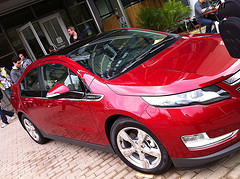
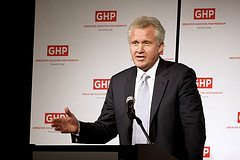
The president’s “all of the above” strategy includes loans and guarantees for solar companies like Solyndra and the latest bankrupt, Beacon Power Corp. He likes wind power, as provided by the windmills his policies subsidize which are produced by his buddies like Jeff Immelt at General Electric. He also likes the Chevy Volt, which made by Government Motors, which is now subsidized by a $10,000 federal tax credit and which has been purchased in quantity only by his friend Jeff Immellt at General Electric.
If you haven’t heard of it I would like to introduce you to a discipline called public choice theory or public policy economics. It deals with political choices made about economic matters when it appears that the “market fails.” Rather than actually describing it for you, I’d like to leave it to Dr. Mark Pennington to talk about public choice theory and the idea that the manner in which politicians and voters engage in public policy decision-making often results in outcomes which are counter-productive.
The president’s “all of the above” strategy is nothing other than embracing the idea that the government should deeply involve itself in economics and markets in ways which will definitely affect outcomes for us all. He, of course, believes, that the free market in energy has ‘failed’ or is at least in the process of ‘failing.’ He also apparently believed this even before the recent spate of gasoline price rises.** Following his heart he has tried his hand at passing carbon trading (cap and trade), fostering green “start ups” like the aforementioned Solyndra and getting on the bandwagon for the electric car. He may very well believe in what he says he believes in, but even if the government is right that the market has in some ways failed, public choice theory asks the next logical question, why should we believe that the government should effectively take over all or a majority of the decision-making about this issue? At least one outcome, probably the highest probability outcome, is that government will only end up spreading the costs of these policies among all citizens and inhabitants and focusing the benefits of the government’s action upon those who are supporters of the politically powerful, like the CEO of Solyndra and Jeff Immelt and the union members of GM whose pension plans are still being funded while the common stockholders of GM lost their entire investment.
Let’s go a bit farther about the president’s idea of flat earthers. Flat earthers saw that the ground around them appeared to be flat, hence they reasoned that that flatness continued on ad infinitum. Was this rational? Yes. Was it correct? No.
The president and his ilk believe in macroeconomic planning. They know that people can make plans, like plans for a house, and that those plans usually work out, more or less. So, is it rational for them to believe that they can make a plan to achieve what is best for everyone in the country? I’d give them a very questionable yes on this only because not to do so would be too cynical even for me. Are they right about it though? No. Why are they wrong? There are several reasons. The first and easiest to understand is that the world is simply too complex to effectively plan for, because it has at its most simply understood level six billion moving parts. Beyond the sheer complexity of macroeconomic planning, how does Dr. Pennington see the effectiveness of government intervention in economic issues versus private decision-making?
I hope you’ve found the idea of public policy theory at least interesting if not wholly persuasive. The rest of Dr. Pennington’s talk at the Adam Smith conference in 2010 is on Youtube and I hope you’ll take a few minutes to become more familiar with these common sense theories.
*I do agree that there is a limited amount which the president can do to alter the pricing structure of gas at the pump for the near term. Interestingly, however, while the president as a candidate argued that what was necessary was a long term energy strategy to wean us off foreign sources of oil and increase use of green energy alternatives. at almost every turn this has meant that he has acted to slow down the development and exploitation of existing and newly discovered sources of hydrocarbon supply. Unfortunately (or it could be fortunately for the deficit) it appears that much of the potential for future exploitation and development is under government land or water over which the government has supervision and stands to make money. It is also curious that the president while at the same time touting his green energy strategy also touts the fact that he the US is actually producing more of its own energy resources than at any time in the last eight years due I might add to nothing of his doing. In fact his go slow strategy will only bear its own bitter fruit over the next half decade.
**Of course, Pres. Obama’s energy secretary Chu has previously been on record saying that he wants U.S. gasoline prices to increase until they reach those paid by the citizens of Western European nations, currently about $10 a gallon. In fact, the President himself has said that he doesn’t mind increasing gas prices, he just doesn’t want them to increase “too fast.”
 Short and Sweet Blog