Posted tagged ‘GM’

THE REAL MEANING OF BANKRUPTCY

August 20, 2012

I think that bankruptcy must be a misunderstood concept. In the Joe Soptic commercial (the commercial about how Bain Capital and Romney closed Soptic’s steel plant after siphoning out all of the money leading to the death of Soptic’s wife) bankruptcy and the idea of plant closing are conflated by focusing on the plant being “loaded up with debt” causing the plant to shut down. A permanent plant closing should be based upon whether the plant has value as a going concern, not whether the owner has accumulated debt. In other words, if a plant can produce and sell its products at a profit, there should be a mechanism for capturing this value. This is bankruptcy. Under bankruptcy rules the insolvency of the owner will not end its economic life of the plant but merely transfer ownership. What bankruptcy essentially does is shift ownership of assets, like factories, from an insolvent debtor to the debtor’s creditors or to others who buy the business from the bankruptcy court. This is the very idea of bankruptcy including the oft heard term ‘Chapter 11.’ When the value of a business as an ongoing concern exceeds the value of the same business when sold for its constituent parts, bankruptcy allows an orderly transfer of the underlying business in a way which protects its value for the benefit of the owner’s creditors. What happened with Soptic’s plant was that it was closed because it was no longer economically viable even if it is true that excessive debt was incurred by the company owner’s, including Bain, in the years leading up to the end.

As an example, see what happened to GM after its pre-packaged bankruptcy. GM went through bankruptcy and is now making “record” profits. It is once again number one in the world. But how can this be possible, the old owners of GM stock lost all of their equity, their stock certificates became worthless. Well, creditors like the US government* got 61% of new GM for about $50 Billion advanced. The unions got 17.5% for $20 Billion owed by old GM to their medical care trust fund. The bondholders got 10% for the $27 Billion that they loaned. Other creditors, including the people injured by GM products manufactured by the old GM got a percentage as well but they lost any right to sue the GM which emerged from bankruptcy. This is what bankruptcy is about. There was a small difference, though, between GM and other Chapter 11 bankruptcies. Notwithstanding the GM bankruptcy its union contracts remained intact. Contracts of any type can be broken or modified by the bankruptcy judge if it is in the best interest of the new company. The “loser” with the broken contract becomes a creditor of the old company, as with the $20 Billion owed to the UAW’s health care trust. But in this case, the union contracts were left intact to follow the new GM. And in fact, in 2011, the GM union contracts were even extended by agreement with the management of new GM, including the US government. But, even if the GM bankruptcy was unfair to bondholders and overly generous to the old GM’s unions, the effect of bankruptcy was that the new owners replaced the old owners and the company continued as a going concern. And that’s what I’m talking about.

*Of course, there was a enormous bailout from the US government involved in GM’s bankruptcy. Bailouts are unusual, notwithstanding President Obama’s campaign touting of the GM model, and such bailouts are really unnecessary in most cases. Other buyers were interested in GM but not in its union contracts. If businesses are economically viable after the bankruptcy judge eliminates burdensome contracts and debts, they can continue. In the GM bankruptcy it was the unions which were bailed out (the collective bargaining contracts were hardly touched) but the equity of the stockholders was destroyed. New GM was created to ‘buy’ the business of old GM but with collective bargaining agreements in place to carry on the business. And so it goes.

LAUDING AN INTELLECTUAL OPPONENT

September 18, 2011

Let me recommend for the contrast of ideas a blogger who disagrees with me on many, if not most, ideas on political economy. Steve Attewell is a fellow WordPress blogger at the Realignment Project. He has written much more than I have and is a very accomplished

Steve Attewell's Bio Pic

blogger. He is a very bright and articulate Ph.D. student in the history of public policy at UC Santa Barbara. Steve is a progressive by his own definition, a definition which can be found in the archives of his blog. Lest one believe that there is a lack of good faith on the other side of economic and political debates of our time, Steve’s blog shows this to be a demonstrably false notion. People of intellectual integrity, thoughtfulness and good will do exist on all sides of the debate (assuming that he would consider me and others of like mind as having the equivalent qualities) and I am happy to say, Steve is obviously a man possessing them. This is a pre-requisite for fruitful and informative discussion of any issue.

He recently wrote a blog post, ‘Living in the Age of Magical Austerity Thinking.’ He argues that those who believe that austerity is the answer to our current economic problems are incorrect. He can be forgiven if he goes a bit over the top when characterizing his intellectual opponents as those who feel, “. . . solicitude of the have-muches, distaste for redistribution, fear of state capacity, and fear for the rights of the managing classes . . .” since his economic thinking is largely informed by Nobel Laureate Paul Krugman. Krugman’s own ideas go beyond Steve’s tepid castigation, calling austerity adherents and their political representatives the equivalent of sadists. Some of my own ideas concerning austerity can be found here.

I recommend Steve to anyone who reads this blog as a balance to my own ideas. Incidentally, I admit to being McCurious, Steve’s interlocutor in the comments section of his Magical Thinking post. I also appear in the comments section of his post on GM’s ‘recovery’ as being indicative of the success of “Industrial Policy.”

I’ll be on vacay for a couple weeks. This is unfortunate because there is so much to talk about with the President’s jobs bill, the new “minimum tax on millionaires” and the Republican search for a presidential candidate in the air. I particularly look forward to seeing how the millionaire tax does in the Senate where there are so many wealthy paragons among the Democratic majority. Forgive my cynicism for doubting that they will pass this measure even while many of them will give strong lip service to it. They’ll prefer to attack the House, trying to put the “blame” on the Republicans for being shills for the ultra-wealthy. I hope that this is going to be the fight. I would like full hearings in Congress which investigate the underlying question: the real benefits of taxing capital gains at a lower rate than ordinary incomes.

Rep. Paul Ryan Courtesy SpeakerBoehner

I normally like Representative Paul Ryan’s take on things but this morning on the Fox News Sunday public affairs program is an exception. When defending the tax rate differential for capital gains Ryan could only fall back on the saying that, “when you tax something more you get less of it.” Exactly what does that mean in this context? Why doesn’t the same adage apply to all incomes????? Wouldn’t increasing all incomes be good? Why the advantage for capital gains? Let’s have the question of benefitting capital gains in relation to ordinary income put to the test out in the open meeting rooms of capital (pun intended) hill with C-Span covering the full proceedings. Ryan, who I believe has previously described himself as a Ronald Reagan Republican, will need to explain to the viewers why Ronald Reagan’s tax reform pegged the top marginal rate on all incomes, whether capital or ordinary, at 28%. Did that make economic sense then? Why not now? That’s the sort of political fight that I’d like to see.

At least the President is finally being true to his campaign position that taxing capital gains like ordinary incomes is a “matter of fairness.” You may remember my previous posts on the President and Warren Buffett’s view of the appopriate tax rates which should be applied to capital gains and dividend-type income, here, here, here and here. See you in a couple of weeks.

DEAL-MAKING BETWEEN GOVERNMENT AND BUSINESS

April 1, 2011

I have a question. Is it easier to make a living by competing against other hard nosed competitors for the success of having the best and most economical product or by forming “partnerships” with the federal government furthering the government’s purposes in exchange for a share of the pie guaranteed by government power? The latter has the additional advantage of raising the prestige of the corporate power players. I think I know the answer. Let’s see how it works in real life.

Did you hear how many Chevy Volts have been sold by GM dealers in the last three months? It seems to be about a thousand or so and this is with a very generous federal government subsidy of $7500 per vehicle. Did you also hear recently that GE’s Jeff Immelt has agreed to purchase either 25,000 or 50,000 GM hybrid products over the next two years, including Volts.

Chevy Volt courtesy Swirlspice

That’s quite a jumpstart for a car that seems to be having some trouble getting into people’s garages. Perhaps the trouble for consumers is the price tag of over $40,000. Perhaps even more important than the premium price tag is the fact that Consumer Reports found a few significant problems with the Volt when they tested it and published their review. In any case it is undisputable that the public has yet to catch on to the benefits of owning a Volt.

Enter GE, stage right. The GE purchase from GM (government motors) is a big deal for all concerned. I wonder why it happened? Maybe GM has given GE real special pricing (like 30 or 40% off) or maybe something else has happened? Is it possible that GM and GE are now secret partners of some kind? Or is GE just somehow dumber than the ordinary consumer spending his own money and reading Consumer Reports. Or is GE’s Immelt perhaps just way smarter than those consumers who resist the $7500 tax incentive, after all GE’s Immelt was recently named Chairman of Mr. Obama’s Economic Advisory Board. From this vantage point at the top of Washington’s business heap, I’m sure Immelt sees information which tells him that the price of oil is going up (but uh oh, on the other hand, what will happen to the economics of this purchase if the price of electricity goes up along with the price of oil)? It’s hard to figure what real economic benefits GE receives for making this nearly $2 Billion purchase and GE isn’t letting us in on Immelt’s thoughts.

Is it possible, though, that the real source of the impetus for this purchase lies in the fact that GM and GE are both closely connected with federal government–otherwise known as the source of all power and largesse in the universe, and that these two behemoths of industry have found this to be a compelling interest they have in common?

Are GE and GM cooperating because they are being operated as subsidiaries of the federal government? Remember GM is still owned to a large extent by the feds. Remember also that GE is real big into green energy technologies. GE is in the business of making wind generators. They also make all sorts of high tech electrical devices as well as the lowly lightbulb and are positioned to rake in vast profits in any federal subsidy or mandate program designed to support the green energy industry. Such mandates and subsidies might even be designed by the government to target products in which GE has the advantage. It is also true, as you may recall NBC, the formerly GE owned network, constantly beat the political (public education) drum for green energy. Are these things just coincidences?
Can this be the interest which both of these giant companies have in common?

Remember Mr. Obama’s “business friendly” statement during his state of the union address:

Clean energy breakthroughs will only translate into clean energy jobs if businesses know there will be a market for what they’re selling.

In Washingtonese this means that if the public is forced or induced to buy GE’s products, this will encourage and profit GE to make those products. In this way the government can create an unlimited market for “inventions” whether the public would willingly buy them with their own money or not. This statement had to be music to the ears of GE and Jeff Imelt, it’s CEO, since you may know that in the last five years the stock price of GE has fallen over 40% and was at one point in 2009 down over 70%. In that regard, it seems that President Obama at his State of the Union addressv was preaching to his choir, Immelt and GE.

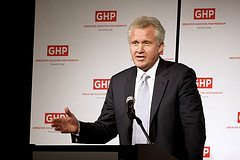
Jeff Immelt, CEO of GE

Even before the President’s speech, but after the 2010 midterm election victory by Republicans, Immelt publicly suggested that he would be willing to use the economic clout of GE to support other companys’ high tech inventions when he said:

Business backing for new technology such as advanced autos is going to be more important as government spending wanes.

What use does a business like GE have for “backing [the] new technology” of other companies for the technology’s own sake? Aren’t corporations like GE in business to make profits for their own shareholders? Can it be true that Immelt and other corporate power players are just adding to their own prestige as deal-makers with stockholders’ money? Or is it possible that their main motivation is to lay the groundwork for important future “public private partnerships” where the government can lay the competition low through it’s regulatory and taxing power?

Whether this is just synergy in business or corporatism Mussolini-style is not unambiguously clear but it does bear close watching. In view of the price tag and the report by Consumer Reports, one should look skeptically at the idea that GE acted because it found the Volt a compellingly efficient piece of equipment rather than because it saw the opportunity to make a deal with the current interventionist administration.