U.S. vice president, Joe Biden, a practicing Roman Catholic, said something in “prepared remarks” during his China visit on Tuesday which I have difficulty understanding.
“But as I was talking to some of your leaders, you share a similar concern here in China. You have no safety net. Your policy
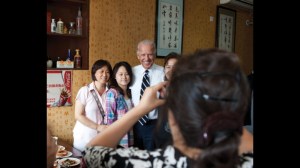
Biden in China Image Courtesy of Whitehouse.gov
has been one which I fully understand — I’m not second-guessing — of one child per family. The result being that you’re in a position where one wage earner will be taking care of four retired people. Not sustainable. So hopefully we can act in a way on a problem that’s much less severe than yours, and maybe we can learn together from how we can do that.”
Under that country’s “one child policy” the Chinese are restricted to having small families. In urban areas they are permitted a single child. In rural areas they are permitted two, but only if the first is a girl.
The vice president’s office responded to the growing controversy concerning these remarks through its spokewoman, Kendra Barkoff.
The Obama administration strongly opposes all aspects of China’s coercive birth limitation policies, including forced abortion and sterilization. The vice president believes such practices are repugnant.
All of this made me think. Assuming the office of the vice president is correct in saying that he views these practices as repugnant, how could he have been so deaf to the implications when delivering his prepared remarks on this issue?
I think that it is very clear, though he may find forced abortions personally abhorent, that Mr. Biden really more deeply believes that the Chinese Communist government has the legal and rightful power to inflict this policy upon it’s own people. I admit that, on examination of my own conscience, this is also the basic flawed mind-set under which I have been operating.
We need to spend a moment examining the conflict here. This is no small problem, a forced abortion occurs in China, according to a panel of experts, astoundingly every 2.4 seconds. Phillips, M. (2010/06/02), Women forced to abort under China’s one child policy. Washington Times. http://www.washingtontimes.com/news/2010/jun/2/women-forced-abort-under-chinas-one-child-policy/. That amounts to millions per year. Can this be true? If it is true, isn’t this entire controversy really about the inviolability of national sovereignty and the virtually unlimited authority of governments over their own people? Is it also about our government or perhaps any government’s right and, perhaps even, obligation to be values neutral in setting policy? Do ends in this case justify means? Are the ends, a smaller population of humans, an unfettered good thing? If so, what government policies can be tolerated in a civilized world even for the sake of achieving this good? Where is the line which cannot be crossed between governmental authority and personal human reproductive rights? Is it different for different countries? Do the citizens of one country have the obligation to try to effect change in the policies of another country if they violate personal human rights? What is the role of the government of one country vis-a-vis protection of the citizens of another country against the cruel or inhumane use of power by the government against citizens of that other country? Is this a legal issue or a moral issue?
I am thrust back into my youthful self-debates about national sovereignty and when and under what circumstances it should yield to other ideals. What burdens should be borne for those not of our own nation? Should we have forcefully confronted Germany on behalf of defending the Jews before most of those European Jews were murdered? Would that intervention have been legal? Should our government give much more in foreign aid to prevent starvation and poverty around the world? Can we use force against governments which refuse to take this aid on our terms, i.e. giving directly to the people of that nation bypassing the, usually corrupt, government? Or is the obligation to intervene more of an individual moral obligation animated by individual religious faith or other moral conviction? I am reminded of the woeful response we made to genocide in Rawanda. Should we have sent our military to prevent this genocide? How long would they have had to stay? At what cost in lives and treasure? Wouldn’t we be accused of being colonialists? And our military, is it intended to be used only in situations of threats which at least theoretically involve the United States? If not, and if it is seen as a vehicle for righting wrongs, shouldn’t we tell those in uniform that they are signing up for a job which is not solely protecting their country, but to be the world’s policeman? Should we, as a nation, at least embargo trade with China to try to end this repugnant “one-child policy”, as we did in an attempt to end apartheid in South Africa and communism in Cuba? This would obviously cost all of us in terms of the increased prices we would have to pay for things we now take for granted as being cheap or cheaper. The Chinese government would try to get back at us though using the trillion dollars worth of U.S. Treasury bonds that they hold. Is this a risk which is incumbent on the U.S. government to take or should we be left to taking individual steps against this abhorent Chinese policy? If we firmly believe that forced abortion is among the most repugnant and inhumane acts which can be committed regardless of who the perpetrators are, are we obligated to agitate to impose these potential burdens and risks on our fellow U.S. citizens who don’t share our view of morality or of human dignity? After all we are ultimately doing so in order to give women, Chinese women, the right to control their own uteruses. Sort of seems like a strangely reversed Roe v. Wade, doesn’t it? Is it a matter of the dignity of life for which the United States, in my own view, should always stand? But what of the lives of the Tutsi in Rawanda? Were the Tutsi blameless victims? Did we owe them a duty of protection? If so, why did we let them down? And then what of our own country, the right to life and the dignity of the fetus as a potential human person is not exactly respected here either, what of that contradiction? What is the moral difference between having a policy of forced tonsilectomies and a policy of forced abortions? Aren’t they both, under the theory of abortion used in this country, simply forcing women to render a bit of their own tissue?
I know the debate over the right to abortion in this country has scarred me. It has apparently scarred the vice president as well. He has pushed it down inside himself so far that the implications of what he was saying didn’t even occur to him. Bringing this issue of forced abortions in China out of the shadows will lead to an even more emotion laden debate between us and within us. It’s probably not what the vice president had in mind, but it is very a good thing. When we push it down and leave it out of our everyday thoughts and prayers, it just festers inside us. One thing I know is true and this is the point from which I will start, human dignity is human dignity regardless of the sovereign country in which the persons involved reside or of which they are citizens.
 Short and Sweet Blog