I want to share a thought I’ve had but is not yet fully cooked. I look forward to hearing from you if you have any insights or criticisms.
It is my hypothesis that in the last eight decades and particularly in the last four, the US has actually undertaken policies which have encouraged and subsidized current consumption on the basis that this is “good” for the economy. The corrollary is that saving is bad for the economy. Can this non-intuitive argument hold water?
Check out Chris Matthews spouting the party line and the commonly held belief about the economics of public policy.
In following the preferred economic policies of Chris Matthews and his “well informed” (those who took economics in school) brethren U.S. economic and job growth has been retarded and following this prescription over a number of years has led, albeit not obviously or intentionally, to the current financial meltdown we are experiencing.
First I should define my terms. Wealth means any thing which is valued primarily for it’s capacity to create a future stream of income in a competitive economic environment. Consumption means any thing which is valued primarily for the physical or psychic benefit of the creator or purchaser rather than for it’s capacity to create a future stream of income.
Everything which can be labeled either wealth or consumption is created by the application of human ingenuity or skill to the environment or context in which they live. Consumption is required to continue life. Wealth is built when there is excess over and above what is needed to maintain life and that excess is put to the creation of wealth. In the hunter gatherer societies, wealth may have been created by inventing and building a bow and arrow or a ladder for picking fruit from high branches. Whoever owned these tools could use them to create a stream of income in the future, income in terms of additional food animals and fresh fruits unavailable to other humans. The inventors of these products had to have had a bit of time to work on their ideas which was not absolutely required for subsistence activities. This “extra time” is something which, at it’s basic level, can be seen as savings. The results of these inventions created yet greater savings since it increased the productiveness of the people who used them and made still more time available to invent other things. Wealth (at least by this definition) and savings, in whatever form they may appear, are clearly inextricably intertwined.
As to savings, why do modern people, if they do, spend less than they make? First, they believe in saving for a rainy day. Second, they want to save because they would like to buy something in the future. Third, they desire to be free of having to live on current earnings, i.e. living from hand to mouth, and would prefer more leisure or other consumption in the future, i.e. luxury and/or retirement.
What do modern folks do with that which they don’t spend? First, they put it at interest with a bank. Second, they invest in businesses owned by them or people they know. Third, they invest in financial instruments. Fourth, they put it under a mattress or it’s equivalent, buying gold or government debt.
What do the first three of these have in common. They represent an investment in or purchase of productive capacity which amounts to wealth. Putting money in the bank has this effect because it is loaned out (or is used to support loans) to others who, at least sometimes, purchase productive capacity. The fourth, “putting money under the mattress,” is an attempt to the preserve the value of their savings when there appear to be unacceptable (to them) risks or disincentives in following the other alternatives.
Since the New Deal we have decided to make it government policy to increase consumption which it is my contention amounts to a decrease in wealth building which would have otherwise occurred. It is a trade off. In this undertaking the government decided to subsidize or otherwise advantage consumption over wealth building. This has led to predictable results which we all see.
It is understandable that the Roosevelt administration focused on the problem of deflation because once begun it becomes a sort of self fulfilling prophecy for “negative economic growth.” People wouldn’t spend money today because what they want to buy will be even cheaper tomorrow. This is true of both consumer items and wealth. People were trying to keep what they had because they were afraid of what was going to happen next. They thought it might be impossible to replace what they had. The “sure thing” in the minds of many was that over time their money would be more valuable tomorrow. The longer it went on the more fear there was and consequently the more reticence to spend money. Remember old FDR’s “The only thing we have to fear is fear itself” speech? FDR concluded that a government remedy was needed, as if the government hadn’t begun it in the first place, which would force or subsidize people into spending money. Enhancing consumption was good then, in the 1930’s, and this idea has persisted as the economic gospel for decades.
The first of the permanent government policies begun by the FDR administration was the social security system. In keeping with Matthews’ view and as explained by FDR in the following quote this was but a toe dipping foray into forced spending, to wit:

The Social Security Act offers to all our citizens a workable and working method of meeting urgent present day needs and of forestalling future need. It utilizes the familiar machinery of our Federal-State government to promote the common welfare and the economic stability of our nation.
The Act does not offer anyone, either individually or collectively, an easy life–nor was it ever intended to do so. None of the sums of money paid out to individuals in assistance or in insurance will spell anything approaching abundance. But they will furnish that minimum necessity to keep a foothold; and that is the kind of protection American’s want.
1938 FDR Address on the 3rd Anniversary of the SSA.
Okay, what am I complaining about? What incentives and disincentives did Social Security introduce with encouraging the spending of money? It had several effects on the Rational Economic Actors (REA) among us. First, it factually shifted the economic burden of providing an income to retirees from the retirees themselves to their children, grandchildren and great grandchildren. Second, it removed some of the economic benefit of having and raising children because it required those children etc. to pay a percentage of their incomes to people who had not borne the vast majority of the burden of raising them. Third, it tended to change the perception of children from necessities to secure old age into expensive luxury items provided to the public. Acknowledging this subsidy for the childless, the Rational Economic Actor [REA] tends to have fewer or no children. The REA will also reduce their personal savings during their working years in proportion to what their social security benefits are expected to provide. With this need for savings reduced the tendency of the taxpayer will also tend to more consumption. Furthermore, the government did not invest any of the funds obtained from working Americans in the form of current taxes in creating wealth for the future. If it were an insurance company from which a policy of old age insurance was purchased, the company would have had to invest the “premiums” paid by its customers in order to be able to pay the future claims for benefits. On the other hand, the social security administration received govenment IOU’s for the excess of taxes over expenditures which actually reduced the need for raising other taxes to defray day to day government expenses, hence further enhancing what was available to consume. As opposed to the requirement that an insurance company must save and invest to pay future benefits, the government simply raised taxes in order to defray any shortfall between “premiums” and “benefit claims.” When fewer children are born, as the REA reacts to the government’s subsidy, even more consumption is available to the parent. In short, there is nothing in the effects of this law which increases savings and the creation of wealth although it does reach it’s goal of subsidizing consumption.
The extension of the social security system from a supplemental income system to a rather more full pension system has increased the perverse incentives over time. The, in FDR’s words, “American” desire for a minimalist approach as indicated in the quote above, has morphed over time. None other than Frances Perkins, Secretary of Labor under President Franklin Delano Roosevelt, noted this in 1960.

“When I saw this bill adopted by Congress with a large majority of the votes of both parties and when I saw after a few flurries of opposition in later years, both parties to continue to improve it and to broaden it’s coverage and to make more generous it’s benefits, I have come to realize that not only was it the crowning act of my working life, but that it was perhaps one of the most useful blessings time has brought to the American people.”
As noted by Perkins, over time the social security system benefits were enhanced. In this, it is clearly the way of all government entitlements. They constantly evolve and grow. Their constituency becomes more organized and single issue motivated and their opposition becomes, effectively, politically suicidal. With every new benefit the incentive to save, invest and have children is reduced. Over time payroll taxes to pay the increased benefits are raised but since that tax money is not saved but is spent to pay ongoing government bills there is more consumption.
Then came the great Medicare benefit of Lyndon B. Johnson.
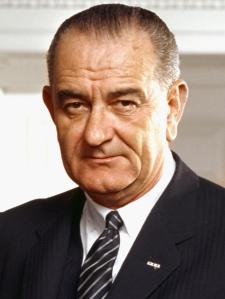
Even as late as 2004 additional benefits were added to Medicare in the form of Part D, a system of drug benefits paid for out of general revenues, i.e. with no new taxes to pay for it. And this was in a Republican Congress with a Republican President. How much clearer can this be? We are buying drugs now and the future tax payers are going to have to pay for them. This increases current consumption but does nothing about paying for it. Can it really be free?
The creation of the Medicare entitlement had the same effect as social security and it was based on the same funding mechanism, payroll taxes. The presence of Medicare emphasized the freedom from the need to save for a rainy day and actually enhanced the consumption effects created by social security and for the same reasons. It reduced the necessity of embracing the gift of children who, if they were raised them right, might pay for our future health care. About this aspect of Medicare President Lyndon Johnson said:
And through this new law, Mr. President [referring to President Truman], every citizen will be able, in his productive years when he is earning, to insure himself against the ravages of illness in his old age.
And in fact President Johnson specifically noted that government requirement would replace the filial bond between the generations, to wit:
No longer will young families see their own incomes, and their own hopes, eaten away simply because they are carrying out their deep moral obligations to their parents, and to their uncles, and their aunts.
Concluded LBJ in a speech in 1966 on the eve of Medicare’s debut:
Medical care will free millions from their miseries. It will signal a deep and lasting change in the American way of life. It will take it’s place beside Social Security and together they will form the twin pillars of protection upon which all our people can safely build their lives and their hope.
He was certainly right that it would forever change the American way of life. Perhaps not in positive ways, but certainly deeply and lasting.
And there is the creation of a trillion or more in underfunded liabilities in state and local public pension systems to say nothing of the federal system. According to Pew Charitable Trust:
All told, states already have set aside about $2 trillion to meet their long-term obligations. But they still need to come up with about $731 billion—a conservative figure that does not include all costs for teachers and local government employees.
How does this idea of underfunded public employee pensions work into my hypothesis? Well it works the same way. A public pension is a promise by a public entity to pay money for current services at some time in the future. When the public entity is not saving and investing enough to make the agreed upon future payment, the public entity is actually consuming more in public services than it can afford to pay for currently. Therefore future tax payers, largely different people, will have to make payments even though the previous and current tax payers have received the benefit of the services provided by the public employees. We have, in this way, enhanced current consumption (in terms of increasing government services) and not set aside enough money to pay the future costs of the retired workers who have provided or are providing those services. In a way, by making an unfunded promise, we have actually found a way of having our cake and eating it too.
Likewise, something which has been discussed extensively on this blog, tax policy has been favorable to current consumption. High wage earners have been taxed at the highest rates for both payroll and income taxes. Hence, the excess which the high income earners would have had available to save and invest was taxed away and made into current consumption by way of government spending. The larger the house which is purchased, the greater tax benefit from the mortgage interest deduction, which is another incentive to consume. The high wage earner sees what is actually nothing but consumption as a way to save on his taxes and buy something which is likely to appreciate in value (up until recently that is). It works the same way for second homes. The second home’s mortgage interest is deductible and hence subsidized by the tax code. It appeared for years to the REA that it was more likely that she would receive a big pay off when she sold her home or second home than if she would have paid the taxes on the mortgage interest and invested the difference in productive assets. This was particularly true when the tax law permitted appreciation on a home, up to $500,000, to be received totally tax free without requiring the money to be reinvested in a new home. Deductions such as the charitable deduction also tends to direct spending towards current consumption (what the charity will do with the money) over long term after tax savings and investment. The only tax benefit which favors savings and investment are the reduced rates for those who receive dividends or create profitable asset sales in the form of a 15% cap on taxes paid on dividends or long term capital gains. But given the rather small amounts left after most people, even high wage earners, have paid their federal taxes, only those who already have a great deal of wealth and savings to invest are the only real beneficiaries of this law. And of course, when such individuals die their estates are generally taxed at large percentages, thus converting savings into consumption. So there are clear limits on the actual benefit to saving and investing of the current capital gains law.
And then there is our preferred manner of keeping us out of “depression” which amounts to no more than borrowing huge amounts of money from future Americans in order to keep the “economy moving now.” As Chairman Bernanke said recently of his latest Quantitative Easing [QE] program (QE just amounts to buying government debt with money freshly off the printing press) and after the government has already issued more than 5 Trillion in public debt in just the last two years:
“By easing conditions in credit and financial markets, these actions encourage spending by households and businesses,” Bernanke said. “A wide range of market indicators suggest that the Federal Reserve’s securities purchases have been effective at easing financial conditions, lending credence to the view that these actions are providing significant support to job creation and economic growth.”
Emphasis added.
There is example after example of the public policies of this country directed at consumer spending at the expense of savings and wealth buidling. This has built a country which is focused on the here and now and completely forgets about the long term effects of anything. Even the idea of a depression is unthinkable. We’ve had a significant number of depressions in this country’s economic history and only one lasted more than a few years. And that depression is called the Great Depression because it was greatly extended by nearly every public policy initiative undertaken in a vain attempt to halt it.
Government has little power to affect the economy as a whole in a way which creates only winners. Our understandable aversion to short term pain has created a governmental policy which has limited our country’s creation of productive assets and wealth in favor of ever more consumption. The focus has been on consumption, Starbucks, luxury housing, second homes, expensive cars, and gadgets for everything has been the result. This means when it comes time to hire people to make and do things, there has been little invested in productive assets which would give them something to make or do. We haven’t applied a large amount of our wealth to create more wealth, we’ve consumed it. It’s been spent. All those luxury houses which have been foreclosed may never be used. Even maintaining and paying the utilities on them may be too much of a strain on our much poorer nation. Jay Carney, White House spokesman, is the poster boy for the idea that debt doesn’t matter, thwarting savings and increasing consumption is the RIGHT THING to do.
In the same way I suppose that riots are the RIGHT THING to do since they create damage which must be repaired. Maybe this explains his thinking on a whole range of destructive and freedom destroying government policies. Hey Jay, there is no such thing as a free lunch, somebody always has to pay.

 Short and Sweet Blog