First let me disclaim any intention to argue, in this post, for the rightness or wrongness of the tax policies advocated by democrats or republicans or the administration or the congress. I am willing to start from zero in arguing about the best tax policy for our country. All I am trying to do in this post is to clear away some of the politically loaded debris involved in talking about taxes. Taxes are, after all, a given of life. About taxes we all believe in the saying, “Don’t tax you and don’t tax me, let’s tax that fellow behind the tree.” However, tax policy, as opposed to tax politics, ought to be based upon a wise and articulable basis as to why it is best to fund government by imposing upon some in different proportions than others. It may very well be that taking money from some and leaving it with others is good for the country but that is what we should be talking about. We should ask questions like, what would you or people like you do with the money which might otherwise be taken in taxes?” Is one person’s consumption better than another’s? Is there a societal benefit derived from investing wealth? Should it be subsidized? If so, is there a societal benefit in allowing people to accumulate wealth to be invested? When we refuse to enter into this debate we are being disingenuous and expedient. We are refusing to look at how this country actually operates and what makes it successful and instead we focus upon the “politics” of taxes, whose ox is being gored.
Tim Geithner, the Treasury Secretary, was interviewed today by ABC’s Jake Tapper concerning the Obama position on expiration of the Bush era tax cuts. During the interview Geithner advocated at least two discrete policy positions. First, Obama would let the income tax rate cuts expire for those “wealthy” earners who earn more than $250,000 a year effectively allowing the highest marginal income tax rates to increase from 36 to 39.6 percent. Notwithstanding this pursuit of the “wealthy” to pay more in income taxes, Geithner also emphasized that Obama would see that taxes on capital gains and taxes on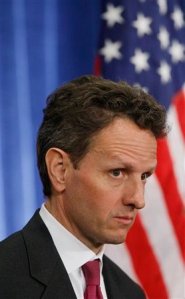 dividends would not increase above 20 per cent. This 20% cap on income from capital gains and dividends is, of course, without regard to the actual total income of the receiver. It is also not subject to the Alternative Minimum Tax (AMT) which was enacted to make every one pay their fair share. Geithner and Obama have effectively drawn a line between two groups of taxpayers. The wealthy whose income comes in the form of passive dividends and capital gains and those wealthy whose income comes in the form of salaries or the net profits of their own businesses. Of these two groups which are “the wealthy” as that term is understood in the taxing imaginations of the vast majority of Americans? Do we see those people getting up at 5:00 a.m. to go out and run their businesses as “the wealthy” or do we see as “the wealthy” those who sit around and clip coupons from “tax free” municipal bonds like Ross Perot or collect dividends paid by Exxon, Shell and the like. This latter group is precisely the “wealthy” who Warren Buffet chided for being taxed at a lower rate than his secretary!!!!
How can it be that the working “wealthy” who are also paying large amounts of self employment and medicare taxes are deserving of having to pay yet more while those who “invest” are taxed at about half the income tax rate of the former and pay no social security or medicare taxes at all? Who is better off, those who must labor to earn their pay or those who “live off the fat of the land.” In the latter group of investors I believe you would place such wealthy democrats as George Soros and Theresa Heinz Kerry among many, many more.
My simple and only point is that our politics make a certain group “the wealthy” who should pay more while another group, with equivalent or even higher incomes, are politically allowed to pay less. The politically loaded language of this “debate” actually allows the “investing wealthy” to advocate soaking the faux or “working wealthy,” who are really just the upper middle class, while pretending thereby to be oh so generous. It reminds me of this speaker at an SEIU rally who was so concerned with the plight of government that she wanted the government to “raise my taxes.” I doubt very much that it was her ox she was talking about!!!!
Tax debates ought to be more about what’s good for the whole country and less about what’s good for the various groups of voters. The framing of the tax debate as a political choice between different “classes” of taxpayers has had another pernicious effect, it has actually resulted in our shifting a large percentage of the tax burden to our children and the unborn through borrowing and promising more than we can deliver. The innocents will never even have the chance to vote about whether to accept this burden from us. They will never receive the benefits. The debt will just be there when they reach adulthood and they will have to pay. I hope we can do better. We’re going to need to be more straightforward and less partisan in this debate if we are to survive as a free republic. I hope I’m not being too naive.
P.S. The graph presented at http://www.quickanded.com/2010/02/effective-tax-rates-of-the-richest-400-americans.html presents my point perfectly concerning the effective income tax rates of the truly wealthy as opposed to rates applicable to the merely working higher income upper middle class.



 Many are aware of this quote from George Washington:

 Short and Sweet Blog