HERE COMES THE PREDICTABLE PRESIDENT

Posted April 13, 2011 by Michael Chovanec
Categories: Political Economy, Taxes

Tags: , , , , , ,

It is widely believed that the Obama “budget plan” to be announced today will call for an increase in tax rates on the “wealthy.” Wow, what a difference four months makes. As readers of this blog know there are two forms of income received by the “wealthy.” Ordinary income, obtained through personal work and effort and “capital gains and dividend” income, obtained through investments. A fellow blogger, Chad Aldeman of “The Quick and the Ed Blog,” has analyzed the effective tax rates of US top 400 income earners for 2007. This is what he reports:

. . . . [T]hat the super rich have been paying smaller and smaller portions of their incomes to taxes*. The chart below shows the effective tax rate for the richest 400 American filers from 1992 and 2007. The blue line represents the highest income tax bracket, the red line is the tax rate on long-term capital gains, and the orange line is the average tax rate that the richest 400 filers actually paid.

There are two important things to note from this chart. The first, and most visually apparent, is that the tax rates of the rich are far more closely linked to the capital gains taxes than income taxes. Salaries and wages, the source of income taxed at the blue line, represented only 6.5 percent of these filers’ income. Nearly two-thirds of their income comes from capital gains, and this is why you see a much tighter coupling between the orange and red lines.

As provided by the Tax Foundation, taxfoundation.org, in 2008 the total Adjusted Gross Income for all filers with incomes above $380,000 (the top 1%) was $1.685 Trillion dollars. These people already pay about $392 Billion in income tax. Therefore, even if we took 100% of all the money earned by everyone in the top 1% of filers, we would still have a deficit of about $400 Billion for FY2011. As with the effective rate figures for the top 400 income earners in the chart above, the effective income tax rate for the top 1% is far below the 35% maximum rate. In fact it was 23.27% for the entire top 1% in 2007. This is less than halfway between the capital gains/dividend tax rate of 15% and the top income tax rate of 35%. In fact it is only 40% of the way.

What these facts mean, I believe, is that we need to look at increasing the capital gains tax rate (as well as limiting the exclusion from taxation for municipal bond interest) as a means for increasing the government’s take. There is a lot of room here for higher taxes, don’t you think? This is especially true when you understand that higher wage earners pay, in addition to income tax, 12% social security tax on the first $110,000 of earned income and 3% medicare tax on everything they earn from personal work. On the other hand, the capital gain/dividend crowd, the truly wealthy, pay 0% in either “entitlement” category.

I wonder what President Obama is going say about taxes. Maybe he’ll go for goring the capital gains/dividend crowd by 5% more, from 15% to 20%. Well, La Dee Dah. How about proposing that this preferred tax rate rise to it’s Reagan era level of 28%? Or might this proposal hurt Obama sponsors like Mrs. Heinz Kerry, Mr. Soros, Mr. Buffet, Mr. Gates, or even Mr. Gore? Therefore, I doubt very much that Mr. Obama will suggest that the capital gains tax rate should rise to more than the Clinton era’s level of 20%. This, it should be noted, is in stark contrast to the words of candidate Obama who declared that increasing capital gains tax rates was a “fairness” issue. I, of course, would advocate heavy congressional scrutiny of any proposal to increase anyone’s taxes to make sure the increase is not self defeating for the country, however, if we are going to consider raising taxes on the wealthy, let’s consider more than a single aspect of the “taxing the wealthy” issue.

DEAL-MAKING BETWEEN GOVERNMENT AND BUSINESS

Posted April 1, 2011 by Michael Chovanec
Categories: Political Economy

Tags: , , , , , , , ,

I have a question. Is it easier to make a living by competing against other hard nosed competitors for the success of having the best and most economical product or by forming “partnerships” with the federal government furthering the government’s purposes in exchange for a share of the pie guaranteed by government power? The latter has the additional advantage of raising the prestige of the corporate power players. I think I know the answer. Let’s see how it works in real life.

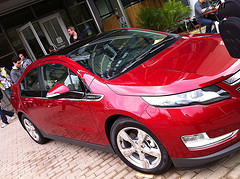
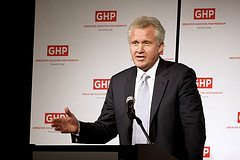
Did you hear how many Chevy Volts have been sold by GM dealers in the last three months? It seems to be about a thousand or so and this is with a very generous federal government subsidy of $7500 per vehicle. Did you also hear recently that GE’s Jeff Immelt has agreed to purchase either 25,000 or 50,000 GM hybrid products over the next two years, including Volts.

Chevy Volt courtesy Swirlspice

That’s quite a jumpstart for a car that seems to be having some trouble getting into people’s garages. Perhaps the trouble for consumers is the price tag of over $40,000. Perhaps even more important than the premium price tag is the fact that Consumer Reports found a few significant problems with the Volt when they tested it and published their review. In any case it is undisputable that the public has yet to catch on to the benefits of owning a Volt.

Enter GE, stage right. The GE purchase from GM (government motors) is a big deal for all concerned. I wonder why it happened? Maybe GM has given GE real special pricing (like 30 or 40% off) or maybe something else has happened? Is it possible that GM and GE are now secret partners of some kind? Or is GE just somehow dumber than the ordinary consumer spending his own money and reading Consumer Reports. Or is GE’s Immelt perhaps just way smarter than those consumers who resist the $7500 tax incentive, after all GE’s Immelt was recently named Chairman of Mr. Obama’s Economic Advisory Board. From this vantage point at the top of Washington’s business heap, I’m sure Immelt sees information which tells him that the price of oil is going up (but uh oh, on the other hand, what will happen to the economics of this purchase if the price of electricity goes up along with the price of oil)? It’s hard to figure what real economic benefits GE receives for making this nearly $2 Billion purchase and GE isn’t letting us in on Immelt’s thoughts.

Is it possible, though, that the real source of the impetus for this purchase lies in the fact that GM and GE are both closely connected with federal government–otherwise known as the source of all power and largesse in the universe, and that these two behemoths of industry have found this to be a compelling interest they have in common?

Are GE and GM cooperating because they are being operated as subsidiaries of the federal government? Remember GM is still owned to a large extent by the feds. Remember also that GE is real big into green energy technologies. GE is in the business of making wind generators. They also make all sorts of high tech electrical devices as well as the lowly lightbulb and are positioned to rake in vast profits in any federal subsidy or mandate program designed to support the green energy industry. Such mandates and subsidies might even be designed by the government to target products in which GE has the advantage. It is also true, as you may recall NBC, the formerly GE owned network, constantly beat the political (public education) drum for green energy. Are these things just coincidences?
Can this be the interest which both of these giant companies have in common?

Remember Mr. Obama’s “business friendly” statement during his state of the union address:

Clean energy breakthroughs will only translate into clean energy jobs if businesses know there will be a market for what they’re selling.

In Washingtonese this means that if the public is forced or induced to buy GE’s products, this will encourage and profit GE to make those products. In this way the government can create an unlimited market for “inventions” whether the public would willingly buy them with their own money or not. This statement had to be music to the ears of GE and Jeff Imelt, it’s CEO, since you may know that in the last five years the stock price of GE has fallen over 40% and was at one point in 2009 down over 70%. In that regard, it seems that President Obama at his State of the Union addressv was preaching to his choir, Immelt and GE.

Jeff Immelt, CEO of GE

Even before the President’s speech, but after the 2010 midterm election victory by Republicans, Immelt publicly suggested that he would be willing to use the economic clout of GE to support other companys’ high tech inventions when he said:

Business backing for new technology such as advanced autos is going to be more important as government spending wanes.

What use does a business like GE have for “backing [the] new technology” of other companies for the technology’s own sake? Aren’t corporations like GE in business to make profits for their own shareholders? Can it be true that Immelt and other corporate power players are just adding to their own prestige as deal-makers with stockholders’ money? Or is it possible that their main motivation is to lay the groundwork for important future “public private partnerships” where the government can lay the competition low through it’s regulatory and taxing power?

Whether this is just synergy in business or corporatism Mussolini-style is not unambiguously clear but it does bear close watching. In view of the price tag and the report by Consumer Reports, one should look skeptically at the idea that GE acted because it found the Volt a compellingly efficient piece of equipment rather than because it saw the opportunity to make a deal with the current interventionist administration.

HEAD’S UP IN THE UPCOMING DEBATE OVER FUNDING SOCIAL SECURITY

Posted March 13, 2011 by Michael Chovanec
Categories: Politics, Taxes

Tags: , , , , , , , , , , , , , , , ,

Remember when President Obama, last week, said in a press conference that in the middle of the decade his budget would have us to a point where we would no longer be adding to the deficit? Halleleujah!! Unfortunately, it is indisputable that the Obama budget never once comes close to matching income and outflow. The following is how the President’s new press secretary explained it, and did it without backing down an inch from what the President said:

This is an example of avoiding a plain mathematical truth through application of obfuscation and is just plain tomfoolery. It is true that:

In war, truth is the first casualty. Aeschylus Greek tragic dramatist (525 BC – 456 BC) .

But our politicians, for purposes other than war, have seemed to take this adage and placed it at the service of their intramural debates and elections. This is not a difference of worldviews, a topic often explored by this blog, with it’s attendant differences in context, language and emphasis created by differing worldviews. This is an example of a simple lack of candor. In no one’s world should this be okay. This is not an issue of context, of language or emphasis. It is just not true.

This also gives us a little taste of how we’ll be treated in the upcoming social security debates. An example of this was delivered by a group of Democrat Senators about 30 days ago. These Senators explained that the Republicans are in favor of ‘privatizing’ social security and that social security can pay every dollar of benefits for the next 27 years and that social security is actuarially sound among other important things.

I am unsure whether there have been any post-Bush Republican proposals for “privatizing” social security but I am certain that there is a big problem with calling social security “actuarially sound” and explaining that it has the resources to pay benefits for 27 years without any changes without further explanation. It is a bit like the President’s news conference when he suggested that in 2015 his budget will be balanced and his press secretary had to spin and spin the point until he was dry.

What is the truth? The truth is that in 2011 current social security benefits will exceed current social security taxes. How can it be that social security is “actuarially sound” or able to pay every penny of benefits for the next 27 years without any changes and yet social security has now started to pay out more in benefits than it receives in taxes? Are the Republicans ginning up lies? Are the Democrats now having to courageously put a stop it?

Well, the truth is that the social security system will need to call on non-social security tax revenues in order to pay the difference between current social security benefits and current social security taxes for the foreseeable future. It is a fact that this began in FY 2010. There is no end in sight. Since this is undeniably true, what do the Democrat Senators mean by saying that social security can pay every penny of benefits for the next 27 years? These Senators are only saying that the general tax revenues which are going to have pay the social security benefits will not be used to do so directly, they are saying that something else will happen between cup and lip. What will happen, however, is only on the books of the Social Security Administration. The government’s general revenues will, instead, be used to pay off some of the IOU’s which have been piling up in the SSA for 27 years. The general revenue funds which have redeemed the IOU’s will then be used to pay current social security benefits. In this way there will be two stops for these dollars, not one. The dollars will change status from general revenues to the proceeds from paying off the IOU’s. The net effect will be nothing, zero.

Do you remember the old pragmatic-sounding “pay as you go” Unified government budgets which began in 1983. Under the Unified budget social security taxes were used to pay-as-you-go for non-social security government programs. The surplus between social security outlays and expenditures in those years was used to make the federal budget deficit look smaller or the budget surplus look larger, including during the years of Mr. Clinton’s magic “budget surpluses” of FY 1998, 99 and 2000. See the chart below for a graphic example of what was going on.

For instance, as the chart shows, in FY 2000 approximately $200 billion was added to the trust fund as a result of this social security surplus. The accumulated surplus is what the Democratic Party’s Senators are actually talking about in terms of the “solvency” and “actuarial soundness” of the program. The existence of these IOU’s will not lessen the difficulty and the reality of coming up with the difference between the social security taxes and the social security benefits to pay retirees on an ongoing year to year basis.
This is a fact that everyone needs to know so that when politicians deny that social security amounts to a fiscal problem at the present time, you’ll know that they are trying to tell you something about accounting, not about reality. Because the general tax revenues will first be used to pay off the IOU’s which the SSA has been accumulating in it’s filing cabinets before being used to pay benefits doesn’t make a hill of beans to the painful reality that somebody will have to pay the bill.

Oh and by the way, as to the partisan politics of this. Control of Congress has been split almost evenly during the period since FY 1984 between Democrat and Republican. The presidency a bit more Republican at 16 years to 10. It should also be noted that during the legendary Clinton “budget surpluses” the Congress was Republican. In short, this not a partisan problem (notwithstanding the rather duplicitous grandstanding and fear-mongering by the Democratic Senators featured above) it’s a government problem. The only reason that the Social Security system didn’t collapse in the 1980’s, after nearly 40 years of Congressional control by the Democrats, the party whose Senators are now yoohooing about how the Republicans are all for putting granny out on the street, was because the government used it’s power to raise taxes not because it used it’s head to properly administer the taxes it had to fund the social security entitlement it had created!!!!!!

THE IMPERATIVE OF POWER

Posted March 9, 2011 by Michael Chovanec
Categories: Foreign Policy, Politics

Tags: , , , , , , , ,

Libyan Dictator Gaddafi

It is clear to me as I watch the pressures increase on President Obama to somehow become militarily involved in the Libyan “civil war” that at this time in history this is only one in a long line of uniquely American situations. The US is the indispensible nation in every sense. Britain, France and Italy, together or in any forseeable combination with others including China and/or Russia, could not project force into the region in sufficient quantity and quality to impose a “no fly zone” or to deploy and supply land forces to intervene in this part or any part of northern Africa. Hence, the decision as to what to do with Col. Gaddafi is ours and ours alone.

What mounting pressures? First, there are the news stories of the dictator Gadaffi’s airplanes attacking civilians and images of the injured. Second, there is the economic problem of the potential interruption of exports of Libyan crude and natural gas which is causing a spike in oil prices. Third, there is the Hitler problem, i.e. this idea is that leaving a brutal dictator in power is a bad thing, if he can be removed, since the dictator is, by definition, brutal. The fact that leaving him in power may not be the worst thing that could happen is disregarded or never even entertained. Last, there is the political pressure applied by John McCain and others on the President to “do something.” The political benefit of the latter’s course is that after having come out publically for a “no fly zone,” in subsequent days if the President does nothing and anything bad happens in Libya, it can politically be spun as being the “President’s fault.”

As the American public we simply must become less idealistic and more realistic. First, American armed forces are not and should not be used as the policemen of the world. They have been raised and are supported by us to advance the interests of the United States. If the mere fact of their existence creates irresistable political pressure for them to be deployed unwisely and in ways not directly related to the interests of the United States of America, then it might very well be better if they did not exist in the first place. In short, as the father of a soldier, I suggest that it may be better to be France which has no power to do anything so they can simply sit back and criticize and complain which ever way it turns out.

As Strafor’s George Friedman observed recently:

It should also be remembered that the same international community that condemned Saddam Hussein as a brutal dictator quite easily turned to condemn the United States both for deposing him and for the steps its military took in trying to deal with the subsequent insurgency. It is not difficult to imagine a situation where there is extended Libyan resistance to the occupying force followed by international condemnation of the counterinsurgency effort.

As much as I may disagree with President Obama on many things, I do not envy him his job. He has no way to go where he will not be castigated and criticized for what he does or doesn’t do. He simply cannot win. There is no outcome, other than full fledged western-style democracy, which will unambiguously please everyone and that is very unlikely indeed.

It reminds me of discussions I have had with friends and acquaintances about the wars in Afghanistan and Iraq. Some of them criticize former President Bush for going into these wars, others criticize him for mishandling them but almost no one refrains from criticizing him under the philosophy that “he did his best to do what was right for the US” and leave it at that. They also refuse even to engage in the “hypothetical situations” which I pose. Usually they simply snort and act as if my hypothetical and indeed any such hypothetical is ridiculous. An example, assume that President Bush failed to take aggressive military action against those who attacked us from Afghanistan, what further mischief would those miscreants have been encouraged and enabled to inflict and who would have been blamed? Would Osama Bin Laden have been able to take up the mantle of Salladin, having defeated and humiliated the obviously weak infidel enemies, and been able to earlier and even more thoroughly radicalize south Asian and north African Muslims in their opposition to the West. Would Mubarak have fallen earlier? Where did the Bush go who promised no “nation building” and a humble foreign policy when the crap hit the fan?

Obviously, it is far too complex an exercise for a 10 minute conversation to rerun history with all it’s moving parts possibly moving differently. The problem is, however, that we prefer to act (and vote) as if the one variable that we would like to modify would have been the only change in the entire situation and that if our preferred choice had been made ‘things’ would have obviously turned out better. We like to think only about the opportunity costs of the roads not taken without giving any credit to the beneficial effects of the road actually taken.

This same kind of analysis could be applied to the folks who opposed the Obama stimulus. They don’t like to talk about the probability that without it the US and much of the world could have been plunged into a rather lengthy depression with attendant deflation with far more unemployment for a substantial period of time. They simply assume that the last two years would have been the exactly same (or maybe even better) except we wouldn’t have borrowed 3 trillion dollars. This is a ridiculous assumption. On the other hand, the pro-stimulus group prefers to leave to later the question of the future costs of having borrowed trillions to provide the present liquidity which has kept transactions happening and prices from falling. That this may very well cause a Japan style lost decade or worse is dismissed out of hand by the gogo-stimulus crowd (namely Paul Krugman) as being unthinkable. The opponent in Krugman’s mind is a repeat of the Great Depression and anything is better than that. The only possible problem with borrowing these trillions in Krug-world is that you may not borrow enough to keep everyone happy until the bandwagon starts rolling again.

I guess what I am really saying is that the existence of power–whether to project substantial military force into Libya or the power to borrow and spend trillions of dollars–creates it’s own imperative to use that power and let the future care for the future. It may be better policy in the long run to have our leaders constrained by laws and other circumstances which do not allow them the freedom to engage in the “big thing.” As it stands, our leaders, rather than being subject to a future of being second guessed as to what the world would have looked like if they had used the power they had, they are very likely to be overtempted to simply use it and see what happens.

UNION-BUSTING OR JUST POLITICS?

Posted March 2, 2011 by Michael Chovanec
Categories: Politics

You have undoubtedly heard the saying: ‘Live by the sword, die by the sword.’ You probably know that it is actually a paraphrased biblical reference from Matt 26:52:

Then said Jesus unto him, ‘put up again thy sword into his place: for all they that take the sword shall perish with the sword.’

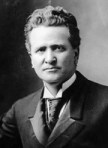
Today in Wisconsin, a historically labor-friendly state actually closely associated with the beginnings of the progressive movement and the home of the Progessive Party’s 1924 presidential candidate, Sen Robert Follette, Sr., the truth of this statement comes into sharp relief.


Politics is a winner take all business. Party politicians are all about gathering political power in whatever way they can. What is their motivation for engaging in this process? Of course, it is so that they will have more and more power to exercise in a manner which will benefit their friends and reduce the ability of their opponents to fight back. How would officeholders who decided not to “dance with who brung’um” ever successfully achieve a re-election when their friends would now be tepid or hostile to that re-election and their “enemies” would smell blood in the water? The world just doesn’t work like that. The more power that officeholders have the more is at stake in an election. Therefore, as government power increases more money is attracted to the process and the losing side has more to lose if it candidate does not win. And yet somehow we’re surprised at the hyper-partisanship and vitriol which enters the system. Higher stakes makes it less likely that the tone will be civil and the process run by Marquess of Queensberry rules. There will be winners and losers and to the victors belong the spoils.

As President Obama summed up so clearly when addressing Latinos just before the 2010 elections:

. . . . We’re gonna punish our enemies and we’re gonna reward our friends who stand with us . . . .

Just as clearly, three days after the 2008 election, with Republicans gathered at the White House to discuss potential bipartisan ideas for a stimulus bill, President Obama said: “Elections have consequences. I won.”

Public employee unions have long been in the business of electoral politics. They have provided hundreds of millions if not billions of dollars for campaigns, nearly all of it going to Democratic party candidates in state and federal elections. These unions have also provided countless hours of work for these candidates. Through election cycle after election cycle the union-supported Democratic candidates have won. As such, for decades the Democratic party has been generally in charge of state governments from Trenton, NJ to Madison, WI to Sacramento, CA. After Democratic victory public employee unions could “negotiate” their wages and benefits with the officeholders whom they had helped place into power. It worked for everybody, at least for everybody who was on the inside.

In Wisconsin after the 2010 election the number of Republicans in the 99 member State Assembly went from 38 to 60. Similarly in the Wisconsin State Senate Republican representation went from 14 to 19 of the total of 33 members. The governor’s chair also switched from Democrat to Republican. When a similar re-alignment at the federal level occurred we got a one-sided stimulus bill and a vast expansion of the federal government through reformation of our entire health care system. Both occurred with virtually no Republican votes.

In politics, when a regime falls the supporters of the old regime run the risk of being too closely linked to the previous leadership and they may have some or all of the deals that they previously struck taken away. They will doubtless lose access to the resources they had grown used to having. The public employees unions have been very closely linked to the Democratic party. They have prospered as a result of their insider status. Acting aggrieved when they are attacked by political opponents who have succeeded in achieving political victory is a little too much to stomach when the unions had engaged in the game full force for years and won victory after victory. This is especially so when they had previously received benefit after benefit at the public trough as a result of these victories.

Let’s try to be objective. Do you really believe that public sector unions were motivated in their support for Democratic candidates solely as support for “good government” divorced from any “personal benefit” from the victory of those candidates? How can they actually expect us to cry crocodile tears when they lose one and must now pay the piper?

That leads me to my final point. We have heard lots of talk about how Republicans would pay for this “union-busting tactic.” The unions suggest vocally that it is somehow shameful to pass a law limiting the public employee unions, particularly teachers, to collectively bargain only about wages and not about benefits. But nobody forces them to work in the jobs they now hold. If the pasture is greener elsewhere, union members are free to leave anytime. They don’t want to leave, however, because the benefits of their public-private partnership with the Democratic party and the government of Wisconsin has been too lucrative to give up without a fight.

Tactically, the unions position themselves as if they are innocent victims of the political process and the budget shortfalls which are totally not their fault. Say they: “You can’t balance the budget on the back of the hard-working union members.” It is as if they believe that as union members they are somehow morally superior and that lawmakers should be ashamed of themselves for voting in a way to limit their ability to “collectively bargain” in the future with their political cronies.

It is always possible that the voters who put the Republicans in power this time will turn on them over this issue and return them to the political wilderness in 2012. But why should the members of the Wisconsin Senate’s Democratic minority be avoiding even a vote on this issue if they truly believe that passage would be so damaging to Republicans. See what happened to the Democrats in the federal elections in 2010 after passage of the stimulus and health care bills. If the bill passes they will really put a whipping on the Republicans for this overreaching, won’t they? Plus, when the Democrats return to power in a couple of years they can always put it back the way it was, can’t they? On the other hand, is it possible that what the Democrats and unions are really afraid of is that these reforms will work and the budget will be balanced and, rather than the blame, the Republicans will get the politcial credit and a longer lease on political power in Wisconsin? Oh politics, politics.

PROPOSED COMPROMISE IN WISCONSIN

Posted February 20, 2011 by Michael Chovanec
Categories: Law, Political Economy, Taxes

I generally like unions which are formed by the workers of a single enterprise. It gives people who have worked at a job for some time a voice vis-a-vis management. It also binds the workers to being realistic and to avoiding outrageous demands which could make the business uncompetititve and cost them all their jobs. The discipline provided by such a one-on-one arrangement obviously does not apply to public sector unions which are hardly competitive with anyone.

Why are public sector workers usually barred from striking? There are several reasons. First, their jobs are usually vitally important and have to do with public health and safety. Second, their jobs usually amount to monopolies, i.e. police, firemen, air traffic controllers, etc. Third, there is no competition or limited competition between private sector and public workers and hence no recourse in the event of a strike. With public employee monopolies or near monopolies the right to stop work amounts to a right to extort the public and such a situation is even more dangerous because it includes the taxing power to collect the extorted payment.

What’s up with public school teachers in Wisconsin? Public school teachers, under Wisconsin law, are denied the right to strike. Notwithstanding this legal technicality they have staged a ‘sick in’ and have arisen from their sick beds to go to the capital to protest what appears soon will be the law in their state. The rotunda of the state capital has, from time to time, been filled with thousands of ‘sick’ teachers who are taking their complaints to the government. They are asking their government to redress their grievances. They are exercising their political rights to try to get the best darn pay and benefits deal that they can. Yay.

The public teacher unions are protesting passage of a bill which will refuse teachers the ability to collectively bargain about anything other than salaries. This would mean that benefits and work rules would no longer be fair game for collective bargaining. The public school teachers’ voices as to the education of our kids would no longer drown out the voices of the rest of us. A system excluding non-wage bargaining would have the effect of preventing a political deal where local elected leaders could strike a bold stance on limiting the growth of salaries while providing them the wiggle room to promise future benefits to be paid for by people who may not even be current taxpayers and voters, i.e. pensions, retiree health benefits and prospective work rules.

I propose a compromise with the public teachers’ unions which would be in the form of a quid pro quo. Public school teachers would agree, in exchange for regaining full bargaining rights, to the implementation of a primary/secondary school voucher program. The program would be simple. It would allow, upon reasonable notice, any parent to receive a voucher to educate their child. The voucher would be paid out from the funds of the local school district in the amount of 50% of the per pupil average cost in that district, excluding the debt service on buildings already built. After full implementation of this voucher system the ability of public school teachers to collectively bargain on every issue, including fringe benefits, would be reinstated. Plus, in this deal, they would gain the right to strike.

My plan would effectively increase the funding for public education since the voucher would represent no more than 50% of the average per pupil funding in any given district. For every student who moves out of the public system and into the private one, 50% of the funding for that student would remain in the public schools. In that way with people supplementing the voucher with additional funds in order to place their child in the private institution of their choice, the total amount of school funding (the sum of both private and public funds) would increase. This, in turn, would make more funds available per pupil for paying public school teachers’ salaries and benefits. It would also introduce an economic element to the competition between schools which has been sorely lacking. And finally it would end the monopoly or virtual monopoly which public school teachers have had on the taxes paid by the public for education of the young.

In short, public school teachers would be given the right to collectively bargain and strike in return for giving up their virtual monopoly on the public funds used for educational purposes in Wisconsin. Simple and straightforward. Everyone is a winner.

COMPETITION VS. MANDATED ENERGY

Posted February 8, 2011 by Michael Chovanec
Categories: Political Economy, Taxes

One of the President’s principal messages from his State of the Union Address, emphasized by his weekly video message released last weekend, was this: WE MUST MANAGE U.S. ENERGY MARKETS. In both messages he succinctly states his case: “Clean energy breakthroughs will only translate into clean energy jobs if businesses know there will be a market for what they’re selling.”

And slightly differently in the weekly message he states:

“And to give these companies the certainty of knowing that there will be a market for what they sell I set this goal for America: by 2035 80% of electicity should come from clean energy.”

There can be no mistake, the President wishes to mandate what you are permitted to buy in terms of energy.

That means Obama believes in a monopoly of the most basic element of physical life, energy. Are monopolies bad and what will be the effects of monopoly power in energy? Such a monopoly will necessarily cause energy prices to rise:

What, if anything other than price increases for energy, is wrong with a government monopoly in energy? The underlying assumptions are wrong, such as: (1) the government is smart enough to correctly predict what energy source(s) will most economically and efficiently replace fossil fuels in the mid term future; (2) the government will make economically intelligent decisions about which individuals and companies to subsidize because it always makes decisions strictly on the basis of merit; and (3) government will divorce itself from politics long enough to do what is in the best interests of the ENTIRE US public to permit them to pursue their own happiness.

The first thing we need to understand is that energy is not just coal and oil. Taken at it’s very basic level energy is “the what” that makes things happen. The energy which the President has in mind is all the ways which we humans have discovered to cause our world to go. It even includes food energy, which makes our own bodies go, when government policy inefficiently (and apparently counterproductively)causes reductions in the availability of food by subsidizing its use as fuel and mandating that it be available for our cars. In short, it is about everything which runs things.

From an economic point of view it is important to really understand that controlling energy means controlling everything physical in our world. How can that be? That is because the price of energy is deeply embedded in the cost of every product and service we create or consume. At it’s most fundamental level everything we do in terms of work and play is about human ingenuity being used to manipulate energy in ways to create wealth and pleasure.

Let’s consider what a monopoly on energy will do to the economy. For instance, preparing a delicious hamburger is about manipulating many different forms of energy. It includes the growing of grass and corn and requires gasoline to plow the field and gasoline to transport the livestock to and from the pasture, feedlot and meat processing plant. Electrical power is used for numerous purposes in the processing plant and in the freezing process. Then gasoline is again used in transporting the ground beef patty from the plant to McDonald’s. Lots of electrical power is used in the restaurant and perhaps even natural gas for cooking the food. If you increase the cost of gasoline and electrical power and natural gas, this will necessarily increase the costs incurred by the producers and suppliers of the hamburger. The real price which we pay for a hamburger will likewise have to rise.

A monopoly in energy is the most dangerous possible monopoly because energy is the most basic tool used by people to manipulate their world. You’ve got to have it. Without it you are left to your hands, your feet, your domestic animals and the tools you already have to create wealth. The price of energy simply has to be paid, just like food, water and shelter. It is fundamental. In the event of a monopoly, energy will become a much greater percentage of the cost of what we sell. If the increase in prices is due to forces applicable to all competitors, foreign and domestic, then fine, so be it. The problem with a government created monopoly, however, is that it creates problems only for the country which creates and adopts that monopoly. It makes it’s own country poorer vis-a-vis all other countries who don’t adopt and maintain such a monopoly or who adopt but don’t enforce it.

Will this monopoly create an innovation economy, like the President desires, which makes our country more competitive? It is a fact that any successful innovation must yield either a lower cost for an existing product, a new product for which a market exists or a higher quality product which can substitute for an existing product at the same cost. That is how innovation and competition work. It either lowers a cost or satisfies another need, a need which may not have been perceived before, as for an iPad. If other countries do not need or want the products whose raison d’etre is green energy, then they won’t be potential buyers. In such a case the US economy is a loser versus the rest of the world because innovations only concern energy over which the U.S. government has a monopoly.

RECOGNIZING LIMITS ON GOVERNMENTAL POWER

Posted January 26, 2011 by Michael Chovanec
Categories: Political Economy

On ABC’s public affairs program, “This Week with Christiane Amanpour” two very interesting comments were made during the roundtable discussion on Sunday, January 23. First, the dyed-in-the-wool progressive, Paul Krugman, said this about President Obama’s change in character after the 2010 mid term elections:

I think the model is something like Clinton who, in fact, mostly was just riding on a successful economy which was successful . . . for reasons which had mostly nothing to do with him. But he was able to be a very popular President by presiding over that, by providing competent management on those things you could control. I think that is Obama’s model now. . . .

Seconds later in answer to a question from the host, George Will reported on a lunch conversation he had recently had with Austan Goolsbe, Obama’s Chairman of the Council of Economic Advisers:

Amanpour: . . . [B]ut when it comes to real conclusions how do you kickstart and how do you make a dent in that 9.4 figure?
Will: You don’t. I had lunch this week with Austan Goolsbee who was your guest a few weeks ago. He said, “Look, people seem to feel that in the basement of the White House somewhere there’s an enormous switch and you go down and throw it and jobs are created.” The fact is that the terrible frustration in the White House must be that everything that really matters is beyond their control, which is how to create jobs. It’s not going to happen because of the government.

The following is a 2008 video in which the newly tapped Chairman Goolsbee explained that after Obama’s inauguration they would be ready to come in with a bang to change the job picture. He specifically distinguished this type of ‘hands on’ activist government policy from the sort of “wait and see” if things get better policy which he derisively characterized as the policy of the previous administration.

Which Goolsbee is right? The one who admits, after two years in power, that there is no switch that a government can throw to do something about nagging economic problems, like unemployment. Or the one who came into power in 2008 saying that he recognized that when the ball was in Obama’s hands and that he (Obama) would actively manage the use of federal government economic power against the economic problems facing the country. Is Krugman being serious when he says that Clinton’s successful economy was not of his own doing even though Clinton, like Obama, came into power during a recession (remember his election motto, “it’s the economy stupid”) and he has always taken full political credit for the economic turnaround?

I hope that both Krugman and Goolsbee really do understand now that the economic tools in the hands of the government have limitations in terms of raising all boats in a national economy. If it were not so we would be in perpetual sunshine and happiness because politicians would promise and use the magical tool or tools. I hope that they also realize that when the government acts it is really only able to pick economic winners and losers. For instance, the Fed kept interest rates low and the politicians used Fannie Mae and Freddie Mac to hype up the housing market for several years in a way which made people happy. In fact this made a lot of identifiable people prosperous but only for a while. On the other hand the hangover which will last for a number of years is going to be suffered by the rest of us as the price we pay for the government providing short term benefits to high flying home buyers, home builders, mortage originators, financial marketers and bankers. The reaching of such a realization by these two prominent political economists concerning the limitations of the government’s power over the economy will be very good news indeed if it translates into greater prudence on the part of future political economists as to what they promise.

FREE SPEECH AND THE CLASH OF WORLDVIEWS

Posted January 18, 2011 by Michael Chovanec
Categories: Clash of Worldviews, Law, Media and Censorship

Before I have my say about the political aftermath of the tragic shootings in Arizona let me address the human aftermath. I pray for the repose of the souls of the dead. I pray that the Lord’s healing grace touch each of those injured. And finally, I pray that the Lord’s comfort and consolation embrace the families of the dead and injured.

After the tragedy, U.S. Rep. James Clyburn has become so concerned about the stimulation of latent violence by the speech of his political opponents, particularly Sarah Palin, that he has this to say on the Bill Press Show between minutes 8 and 11 (click or paste link below):

What Rep. Clyburn has not made public, however, is anything specific about what is actually being said that he believes is so frightening and inciteful to violence that it must be addressed by censorship. Rather than giving specifics about the language which concerns him, this is what Clyburn follows up with:

‘Free speech is as free speech does,’ he said. ‘You cannot yell ‘fire’ in a crowded theater and call it free speech and some of what I hear, and is being called free speech, is worse than that.’*

I am confused. What in particular is being said by Palin or any other opposition leader that Clyburn thinks important to restrain? If not concerned about any specific words is Clyburn possibly concerned with the vehemence with which the opinions are stated? Should stating any and all political opinions in emotion laden terms be something which is banned because of its potential to cause a violent reaction in those who hear it? Or is it the combination of the emotional tone and what they say which concerns him? Remember, Clyburn believes that there is something about this political speech which he believes is on a par with, no is even worse than, shouting fire in a crowded theater? I conclude, in the absence of a clear explanation by Clyburn of what concerns him, that everything Sarah Palin, Glenn Beck or Rush Limbaugh has ever said troubles him and, importantly, what they say and how they say it is, in his opinion, calculated to and intended to stir fatal passions. Distilled to it’s basics this appears to be his point.

So it is Palin & Co.’s provocative manner when they state their basic philosophy, a philosophy anathema to Clyburn, which he believes threatens to bring about violence in America. Clyburn apparently believes that those who embrace and vehemently advocate a limited role for the federal government foment thereby a culture of violence and are a clear and present danger. It is her philosophy which resists enlargement in federal government power which is the real reason that he says of Palin that, although attractive she “is just not intellectually capable of understanding” the connection between what she advocates and the potential for violence. Interestingly, however, the dimwitted or sick people to whom she directs her emotional statements understand the call to violence implicitly contained therein or it wouldn’t be dangerous speech, would it?

Rather than engage in careful reasoning from proposition to conclusion, Clyburn says something which he hopes will result in something he really likes, muzzling his political adversaries. He wants Sarah Palin to either keep quiet or change her worldview to one more in line with his own. If anything said by Palin, Limbaugh or Beck created the same clear and present danger that yelling fire in a crowded theater does, it would already be illegal. Without a single citation to dangerous speech targeted at the congresswoman or anyone else (other than the cockamamie idea of the ” crosshairs targeting of Giffords’ district” as politically vulnerable somehow incited violence against her), Clyburn thinks that Palin-speak is worse than yelling fire in a crowded theater. It is pretty clear that speeches and diatribes recognizing the tautology that enlarging the power of the federal government must, by definition, limit the power of other lower governments and the people themselves, just does not create a clear and present danger of violence. If Clyburn believes that the act of speaking in various ways about this basic tautology stirs up potentially fatal violence it is incumbent upon him to quote the words, clearly describe the tone in which they were said and explain how these things together create the equivalent of shouting fire in a theater.

Clyburn can’t and won’t do this hard headed reasoning and connecting the dots. He would rather hide behind the idea that that Palin’s just dumb. If she asks for explanation Palin would be admitting that she was too stupid to get it. The idea that Palin just “doesn’t get it” doesn’t even try to explain his point. It’s like he’s taking the position that the cool kids know something the square kids don’t and Palin will never be cool until she admits that the cool kids are cooler than she ever will be.

Is it ever okay to muzzle a truthteller or someone who is trying to do their best to be a truthteller? One would have thought that people like Clyburn, who is a member of a generation and a group of the people who are rightfully proud of having “spoken truth to power” would celebrate this, right!!! If you ask him, John Kerry is also a man who tried to speak truth to power about a very serious subject.

Was it John Kerry’s free speech which stirred up Bill Ayers to engage in the bombings of the US Capitol or Pentagon? Regardless of what you believe about John Kerry as a truthteller, should he have been muzzled? More recently, should we have made vituperative anti-Iraq war speeches illegal? Remember what Hillary Clinton said about that in a very vehement way indeed:

And how about this typical Keith Olbermann diatribe which you don’t even have to listen to and you still know what’s in it? Should this be banned? Considering the messenger and the ratings I suppose this is a bit less than frightening.

Oh well, they took this Olbermanism down but you know what I mean, don’t you? Maybe it was too much even for MSNBC

I will never agree to turning off or limiting free political speech unless there is a clear and present danger of imminent violence. I am also saying that it is in the nature of strongly held beliefs to express them strongly. The ability to speak out on strongly held beliefs has it’s own benefits in addition to the attempt to convince others. Standing up for what one believes to be the truth is important. It is not wrong, it is right. In fact everything about speaking the truth is important.

I return to this blog’s theme of a clash of worldviews. Clearly Rep. Clyburn formative memories come from a time and place when his opponents were willing and ready to injure him for his demands for social equality. This has clearly etched itself deeply into his character. I cannot and will not blame him for this. He understandably has strongly held beliefs. I will, however, refer back to a poll taken last summer by the Rasmussen organization which gives much insight into this issue. On June 24, 2010 in an article titled, 48 Percent See Government Today as a Threat to Individual Rights Rasmussen reported:

The latest Rasmussen Reports national telephone survey finds that 48% of Adults see the government today as a threat to rights. Thirty-seven percent (37%) hold the opposite view. Fifteen percent (15%) are undecided.
Most Republicans (74%) and unaffiliateds (51%) consider the government to be a threat to individual rights. Most Democrats (64%) regard the government as a protector of rights.

Is Clyburn’s reasoning in his attack on Palin’s intelligence not a clear enough example that much of the rancor we find in the debate over public policy is actually no less than an fundamental clash of worldviews?

Free speech and freedom of the press are the most basic protections built into our way of life. Along with freedom of religion these rights are our most basic “civil rights.” These are the rights with which we protect our right to liberty and all of the rights derivative of that human liberty. That fact was crystal clear to the founders in the 1780’s and it remains crystal clear to thoughtful people today. Sarah Palin is just as smart as Rep. Clyburn. They just come from vastly different experiences. The truth as to why Clyburn holds the opinions which he holds is contained in the words of JFK:

We are not afraid to entrust the American people with unpleasant facts, foreign ideas, alien philosophies, and competitive values. For a nation that is afraid to let its people judge the truth and falsehood in an open market is a nation that is afraid of its people.

Rep. Clyburn is telling us in relatively clear language that he is afraid of other Americans, particularly it appears, that he is afraid of white people. He can’t tell the difference between those who oppose his big government agenda now and those who appeared ready to injure him at the time of his civil rights struggle. This is understandable given his formative years and his resultant worldview but it does not mean that the rest of us must sacrifice our inalienable right to free speech to make him feel more comfortable. As a congressman he’s the one in power now and he must at least tolerate, if not actually listen to, the voices of the people he would govern.

* Quotation from a Post and Courier Article, see url as follows: http://www.postandcourier.com/article/20110110/PC1602/301109941.

Claire McCaskill’s Money

Posted December 7, 2010 by Michael Chovanec
Categories: Taxes

Claire McCaskill, democratic Senator from the purple state of Missouri, is the 19th richest person in the US Congress.  She is fortunate enough to be in the top 3% of the already rich denizens of that imperial body of paragons.  She would certainly suffer if tax rates go up as she apparently prefers.  This is what she says about taxes, including a prominent mention for those capital gains and dividend taxes:

Can her words be interpreted as being prepared to send the American people out to violently attack the affluent high wage earners, the above $250K’ers, with pitchforks or would she limit her crusade to the truly and utterly rich, those who have multiple homes and whose income comes in the tax-preferred form of capital gains and dividends.  I wonder if she could be any more coy when she conflates these two very different groups?  If she is actually serious about addressing the gross unfairness of capital gain and dividend taxes shouldn’t she just come out and say, “Let’s tax all income, however earned, exactly the same!”  Now that language would shake things up.  Just think of poor John Kerry and Theresa Heinz Kerry.  Is Claire McCaskill, a sitting member of the Senate whose ox would personally be gored, coming out against ultra-prefered treatment given to income in the form the capital gains and dividends?  This is the bulk of the income received by herself and her ultra-wealthy friends.  If it’s true, that’s change I could begin to believe in.  [But of course, as pleased as I would be at this prospect, as a realist I think it would be wise if we were to first carefully consider the practical aspects of nearly tripling capital gains and dividend taxes in terms of its effect on economic growth in our now-sluggish economy.] 

Sen. McCaskill was very likely just spinning.  While she makes a strong statement for fairness and at the same time demonizes her evil Republican enemies, I believe that she is obviously advocating raising the rate on capital gains back the Clinton era level, from 15 to 20%.  She is clearly willing to suffer to cut the deficit, since as a Democratic party member she is by definition a serious deficit hawk.  Her prescription, raising rates on the wages of top earners from 35 to 39.6% and  on capital gains/dividends from 15 to 20%, does nothing to address the inequity between the wage earners and the truly wealthy.  This strategy is a way she can be seen advocating  “raising taxes on the rich” without risking substantial increases in her own cushy capital gains tax rates.  By conflating the high wage earners and the truly wealthy and calling them both “rich” she justifies doing nothing to address the obvious unfair advantage capital gains income retains compared to actual earned income.  She would still prefer not to have her ox gored to the same extent as those relying upon their work to earn the bulk of their living.  But such duplicity is not new nor is it limited to Claire McCaskill.  And so it goes in the imperial capital.

Buffet: RAISE MY ‘CAPITAL GAINS’ TAXES?

Posted November 24, 2010 by Michael Chovanec
Categories: Taxes

Warren Buffet is a nice man.  He wants to do what’s right.  His partial solution to the current situation is to substantially raise taxes on the wealthy.  In fact, Buffet says that the rich have never had it so good.  What is he saying exactly?  Who is he talking about? Why is he saying it?  Here he is having his say in a recent interview with Christiane Amanpour of ABC News:

In his interview with Ms. Amanpour Buffet says something which sounds to me like the Bush tax cuts for the $250,000 a year crowd should be allowed to expire.  Is this really what he means?  How could he be misinterpreted?  Were his comments edited or just sloppy?  Here is what Buffet has also recently said about the fairness of capital gains and dividend taxes for the rich in relation to his view of the taxes paid presidential candidate Romney:

How do these two comments fit together?  Is Buffet’s point that allowing the tax rate on capital gains to rise from it’s present 15% would be a good thing for the economy?  Would he allow it to rise to it’s Clinton era rate of 20% or increase it even more? Or does he really wish to see an increase in the rate of tax paid upon earned income for those earning more than $250,000?  Curiously, if the latter, I would have expected him to define what he means by his use of the term “high end?”  He doesn’t seem to even have in his mind a line of demarcation between the middle class and the “high end” based upon the amount of earned income they receive.  In fact, in his Amanpour interview he appears to refer to the “high end,” not as the people who earn very good salaries, but as people like himself, investors.  A doctor making $350,000 a year with a spouse, two kids, a mortgage, a huge student loan and the specter of Obamacare bearing down on her has much more in common with Buffet’s cleaning lady than she does with billionaire Buffet.  Buffet is too nice a man, I’m sure, to try to  speak for her saying that as a matter of fairness they are both wealthy and should have their taxes raised substantially.  On the other hand, why is he allowing the impression that he is in favor of taxing earned incomes above $250,000?  That is clearly how his words are spun.  If he means that taxes on the type of income which is currently taxed at only 15% should be raised substantially, why doesn’t he just outright say that capital gains taxes should be raised?  This confuses me.  It may just be the editing on the part of ABC News and Christiane Amanpour or it may be sneakiness on the part of Buffet who, as an investor, will be better off if the budget deficit shrinks due to the efforts of others not of his class?  I’m just not sure.   

If Buffet is saying that “investment” income should be re-evaluated in terms of justifying it’s tax advantaged status, then I agree with him wholeheartedly.  In fact I think that re-evaluating taxes in terms of what increases wealth for our citizens and tax revenue for our country is long overdue.  The tinkering which has occurred over the years is just a political process of benefiting your political friends and hurting your political enemies and should be stopped.  Policies which raise all boats in this country should be the policies which are adopted.   

To this end the vast disparity between the 15% tax rate on capital gains and the 35% (soon to be 39.6%) rate paid on earned income, without even considering the over 15.3% in payroll taxes paid by those who personally work for their money, needs to be justified in Congress in the full light of day.  All of the mathematical power of econometrics and all of the common sense of Austrian economics should be brought to bear to measure and justify the benefits of continuing the policy of reduced tax rates on particular types of income, particularly as it concerns capital gains. 

For instance, questions should be asked and answered such as should we limit capital gains tax rates to those who invest in start up businesses which end up employing Americans, being viable and profitable?  How should we view investments made in IPO’s (initial public offerings) for capital gains tax rates?  How about just speculation in the stock market in established companies, does it do anything for the economy as a whole, in terms of spurring economic growth?  How about speculation in commodities?  All sorts of questions come to mind and should be debated.  We should see the truth emerge through the careful questioning of witnesses under oath as to just what is good for the economy and what is just a giveaway to the rich?’  I think that such hearings might even be a C-Span extravaganza.  I would be particularly interested in what side of the issue legislators like “yacht tax dodger” Sen. Kerry would be on.

Also, is there or should there be an issue of fairness in income taxation or is it only about economic incentives and tax revenues.  It shouldn’t be all about who has the big bucks and can buy influence at the top, should it?  Well, you may recall that candidate Obama considered it an issue of fairness to raise the tax rates on  capital gains.  He considered it important to be fair even if increasing capital gains tax rates actually decreased the amount of taxes collected based on that tax.  Said candidate Obama:

I haven’t heard anything on this issue from now-President Obama during his first two years in office.  Perhaps I am naive but why is it that Mr. Obama, after becoming President, no longer considers taxing high wage earning individuals at rates more than double that of billionaire investors like Buffet to be an issue of fairness?  Is there an economic reason which escaped candidate Obama and is now clear to President Obama?  Has he studied up on economics since the 2008 election?  Or is it just an example of politics as usual?

At some point in the ancient past reduced tax rates on capital gains were apparently justified on the basis of some social and economic benefits to society.  Between 1913 and 1921 the rate paid by those earning income from work and those earning by investing their fortunes, was identical.  From ’21 to ’34, the capital gains tax rate was capped at 12.5%.  Then, in 1934 FDR changed the rules allowing a percentage of any capital gains to be excluded from taxes altogether, adjusting the percentage excluded based upon the holding period of the asset.  The rules changed again in 1942 capping capital gains taxes at 25% for those whose tax rates were very high and reducing the necessary holding period to claim this benefit to a single term of six months.  There have been oh so many variations of the capital gains tax rate since 1942 ending with the current rule setting a maximum rate of 15%.  This is not the end, though, since this rate is set to rise to 20% with the expiration of the Bush tax cuts on December 31.  Interestingly in the 80’s Reagan ended the special tax treatment for capital gains altogether.  [How could this have been a Republican idea given how the current crop of Republicans is being reviled for “protecting the rich” while threatening the middle class?]

According to Charlie Gibson’s figures, the econometrics of capital gain taxes show that lowering the rates increases the total revenue from capital gains taxes.  How important is it that we get the maximum revenue from capital gains taxes?  Buffet, in his Amampour interview, seems to say that the theory of capital gains taxes being good for the economy as a whole “hasn’t worked out that way” for about the last ten years and that the American people ought to catch on to the rich man’s ruse.  Perhaps the President, who relies so heavily on the Oracle of Omaha, ought to catch on too.  I fully support having an open debate about whether Buffet is right and let the chips fall where they may.

It appears that a political bargain has already been struck maintaining special tax treatment for capital gains and dividends.  And all without a whimper from Congress which apparently prefers to posture about the “threshold for wealthiness” and identifying who deserves to pay the highest rate while the already ultra-wealthy maintain their advantage versus those who work for a living.  Where should the real class warfare be?  Is it that the rich are setting groups of wage earners against one another in order to avoid debating about retaining their capital gains and dividend tax benefits?  Why has Charlie Gibson stopped casting light on this issue?  Go figure?

The Car’s In The Ditch!!

Posted November 16, 2010 by Michael Chovanec
Categories: Political Economy

Oh no, our “car’s in the ditch!!!”   Until the recent election we heard variation upon variation on this refrain: (1) the previous administration drove this “car in the ditch”; (2) we need to fundamentally transform the US in order to get the car out of the ditch; and, (3) the opposition needs to stop complaining about the necessary repairs and get in the back seat.  In light of the results of the election I am apparently not alone in feeling frustration at the singers of this song.  

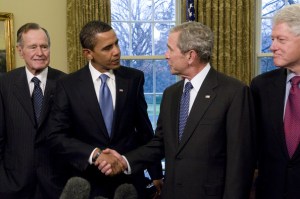
Presidents Obama, Clinton, Bush I and Bush II

The pertinent questions as I see them are these.  What are the basic economic fundamentals which represent the “road” upon which our national car drives?  How did our past presidents, particularly Bush, drive “the car” into the ditch?  Does “getting out” of the ditch require different style of driving than keeping the car on the road in the first place?  How does the current government’s driving measure up?  

I think the fundamental question about an economy is whether it allows and facilitates the creation lots of wealth for ourselves and others?  When the economy, the GDP, grows Americans seem to feel that we all become wealthier to a greater or lesser extent.  At least, based on their public statements, politicians seem to agree.  In order to seem in step they are constantly talking about  whether the economy is in recession or is “growing.”  From this agreement between the public and the politicians, I conclude that I am right and that the policies which allow Americans to create more wealth are the basic economic fundamentals of our country.    

What do we mean when we talk about wealth?  How is wealth created?  According to businessdictionary.com wealth is ‘any tangible or intangible thing which makes a person, family or group better off.’  Seems like a good common-sense definition to me.  What we create through our own efforts is wealth.  When we trade our wealth with others trying to make ourselves and our family better off we create even more wealth.  Why is it that more wealth is created when exchanges are made?  Why isn’t an exchange just a “zero sum game” where people have just traded things of the equal value?  The conclusion that trading creates wealth in addition to that which existed before is based upon a fact of human nature which is that two people will not trade  unless they both expect to be better off, richer, after the trade than beforehand.  Likewise, when fewer transactions occur, less wealth exists because people keep what they have.  The more that people exchange their wealth with others, the more total wealth we have as a nation of individuals.  Therefore, any policy which increases trading among us leads to creation of yet more wealth.  Policies which depress the number of trades, on the other hand, lead to a static or negative trend in wealth.  We might call them, those policies, negative fundamentals.  An important fundamental of the economy then, it seems clear to me, is whether government policies encourage or discourage the creation and trading of wealth.  

All economies which are referred to as “advanced economies” have pursued economic growth based upon specialization, the so-called ‘division of labor. ‘  This way of doing business maximizes wealth because it increases the production of all things.  Individuals will usually spend their time producing things which they are most expert at producing.  Wealth will not be maximized by a person learning to do many things kind of well.  He will maximize the value of his work by learning to do one thing very well and then trading with others to get the other things that he wants.  If he specializes and people are interested in transactions with him, he will generally be much better off than if he had learned to do a lot of things only marginally well.  It is a fundamental of a system of specialization that it causes large numbers of transactions because no one can subsist or create everything he needs and wants by his own efforts.  

What causes people to stop or slow down their normal trading activities in a division of labor style economy?  Why would people ever stop trading when they know that trading makes them wealthier?   There are at least three conditions which will cause people to stop trading.  The first is when people believe that what they have to trade will be worth more tomorrow than it is today.  The second is that they believe that what they want to trade for will cost them less tomorrow than it does today.  The third condition which will stop trading is when the public believes that they need to conserve the things they have today in order to protect themselves and their families tomorrow.  

Enter the dollar bill.  It is small, it is transportable and it is protected by the government.  It is generally assumed by people that the dollar bill will have the same or nearly the same value tomorrow as it does today and therefore it acts as a reliable store of the value of the many trades which people make.  The dollar bill has been a “store of value” for the people of US for the last 100 years and for the world for the last 65.  Having a reliable and durable store of value is indispensable to the specialization economy.

Okay we know all this.  Is it possible that there is a relationship between the perceived future value of the dollar and the reduced value of the current transactions we see in the economy?  This is a difficult proposition to believe because if inflation is perceived as a threat in our economy, and I believe it is, people should be trading like crazy to avoid the future price rises.  Why then aren’t they trading?  Are there other perceptions affecting their desire to enter into current transactions?  Yes.  As indicated above, the public believes that they need to conserve the things they have today in order to protect themselves and their families from what, the shape of which they are not quite sure about, may happen tomorrow.          

Therefore, the fundamental feature of the current economy is the uncertainty and outright pessimism about the economic present and future.  FDR’s famous line in somewhat similar times was, “All we have to fear is fear itself.”  Did Bush or his fellow former presidents do something or several somethings wrong on the economy in order to cause this uncertainty and even profound pessimism? 

 Historically George W. Bush took office at the end of an almost ten year expansion.  The American economy officially entered recession (a period of reduced transactions) in March 2001.  To use the current economic analogy, one or more previous driver(s) had driven the car off of the road before George the Second took the wheel.  Then, less than 8 months after Bush took office, our country was devastatingly attacked by al Qaeda operatives on 911.  The realization of significant risks to our country, which had not been anticipated by the population before, suddenly dawned upon them.  The cost of defense and security precautions skyrocketed as a result of this change in status.  Bush was widely mocked when, in response to the misgivings of the people, he went to the American people and asked that they return to business and leisure as usual.  (Apparently FDR and Bush were not accorded the same credit for their insight.)  Bush, and FDR before him, were interested in either increasing or at least sustaining  the level of transactions in the US economy.  In his view, not unreasonably, this would protect our prosperity and deny al Qaeda their goal.  He also lowered taxes for 100% of taxpayers in the country.  After a few months of economic problems things got better, economically at least, and remained so until nearly the end of Bush’s second term, 2007-8.

Why did things at first improve and then head south on Bush’s watch?  With the tax cuts and the lack of attacks on the homeland things improved in part because of what Bush asked the country to do, go about their normal business.  He was abetted in preciptating the ‘good times’ by a Fed which kept interest rates, including mortgage rates, down.  In large part the good times in the middle of the Bush administration represented a lot of housing transactions, it represented consumption fueled by increases in the ‘equity’ apparently held by individual home owners and it was further abetted by consumer borrowing spurred on by low interest rates.  The Fed didn’t take away the punch bowl at the party this time. 

Then things turned down, why? First and I believe foremost, there was the financial storm.  This was caused by the squandering of vast quantities of money on building unnecessary and luxurious housing for people who could barely afford to pay for it as well as profligate spending on other consumer goods which went to fill all our houses.  The resulting cascade of unpaid loans and credit cards, foreclosures and short sales caused a problem with our financial system which was actually made much worse for the economy by arcane financial derivatives and the bundling of mortgages for sale in the general investment market.  Everything, it turned out, was tied together in a neat bundle and when one knot went everything went.  When people couldn’t pay for what they had purchased, the stuff just hit the fan with both real and psychological effects.

In addition to the negative effect of the sub prime meltdown on the mortgage market, previously built homes overhang the market.  This situtation makes it questionable whether homes already in private hands with loans in good standing will hold their value much less appreciate.  Where have all of the TV advertisements gone which used to ask people to use the equity in their homes as checking accounts?  

Add to this dicey circumstance the recognition of the potential for economic devastation represented by $4.00 a gallon gasoline.  The $4.00 a gallon shock took everyone by surprise back in 2008.  Now the American people are well aware of the nascent crisis in Iran (and the Persian Gulf) and the fact that the government shut down oil exploration in the Gulf of Mexico.  Everybody knows that these, along with the falling value of the dollar, could drive up gasoline and other energy costs for both the short and middle term.   Take all this together with a few moves by the government in the recent past showing even more interest than usual in picking economic winners and losers and the end result is that people are feeling defenseless and economically vulnerable and in no mood to spend money.  In that regard some of our leaders dramatize, by their own words, these and other reasons for concern.  First, the President.

And then the ever popular Robert Gibbs, White House Press Secretary.

And Vice President Joe Biden.

And Treasury Secretary Tim Geithner.

And Fed Chairman Bernanke.

And what of the effect on the economy of the debt which consumers have already built up over the last twenty years.  Does this have an effect on what consumers do in the here and now?  It has had some effect, I believe.  Over the previous seven quarters, according to a Fed report issued in August, the amount of consumer debt has fallen 6.5%.   This reduction, whatever the underlying causes, has a two fold effect.  It means that the consumer has less income to buy things since that part of their income is being used to repay debt for previous purchases.  It also means that the consumer wasn’t interested in securing additional debt for buying new things.  Overall, a reduction in transactions.

In sum then, what do we know about the fundamental state of our economy in terms of the likelihood of increasing transactions?  We know that housing value (a house is the largest asset held by most consumers) is likely to stay static or recede in the short and perhaps medium term which means people are going to have to save more for retirement.  We know that as recently as 2010 when the House passed the Cap and Trade bill, Washington politicians were interested in continuing to hector the public about their energy usage.   We know that some aspects of social security and medicare are on the chopping block.  We know that the public has had a taste of what $4.00 a gallon gasoline was like and didn’t like it.  We know that the income taxes of nearly everyone who has enough income to buy big ticket items without adding to their debt (like John Kerry and his new yacht) is going to be targeted for a significant tax rate hike either now or at the latest, ‘when things get better.’  We know that the bill for the vast amount of wealth destroyed by the sub-prime mortgage mess is still trying to find a place to land permanently and the public is smart enough to figure out that it might just decide to land squarely on their bank accounts and retirement accounts.  Does anyone (other than John Kerry) feel rich?  Even he doesn’t feel rich enough to promptly pay his yacht tax in Massachusetts.  

Given all of the uncertainty and difficulty hanging over the people of this country are you still wondering why people are not buying big new things or investing in new equipment and business or borrowing more money to consume consume consume?  What is being done to improve the economic fundamentals, to increase people’s interest in trading? 

Here’s what one American, an Obama fan no less, thinks about the situation.

Regardless of which of these problems is the fault Bush & Co. and which is the fault of others,  I’m not surprised that we’re not climbing out of the ditch yet.   When we add to the mix the immense increases in Federal borrowing to “avoid a depression” the bill for “business as usual” seems high indeed.  The people look on the mess and are very afraid.  Can you blame them for trying to save for a rainy day?

What’s Important To The American People

Posted November 9, 2010 by Michael Chovanec
Categories: Clash of Worldviews, Political Economy

Have you heard?  We recently had an election.  Although there is disagreement about what the electorate meant by voting as it did, the results are in.  Approximately 25% of the Democratic delegation of the house of representatives was voted out of office.  The Democrats went from a previous 257 – 178 majority to about a 243 – 192 minority.  Likewise of the formerly Democratic senate seats up for election  31% were turned over to the the Republicans.  A number of other Democratic seats in both the house and senate were narrowly retained, mainly in blue states.  Seems like a pretty big “statement” to me but I admit to a a point of view about such things.

The question of why the election turned out this way is, as all political questions are, an open one since the people vote for a whom and are not required to have a valid reason for why they did so.  Is this dramatic swing at least possibly the result of what the Democrats did in ramming through a permanent health care entitlement, a far-reaching financial reform bill and passing a hugely wasteful stimulus bill resulting in spending even more money more quickly than the previous group of drunken sailors?  There are at least two possibilities to choose from.  First, this historic election result could have been caused by a public unnerved and possibly unhappy by the passage of these three major bills which were enacted with virtually no input or support from the opposition party?  Second, this historic result could have been a mere blip on the screen caused solely by a punitive impulse on the part of an electorate understandably impatient for a turnaround in the economy even though the cause of the bad economy was solely the policies of the preceding government?  Which is it?

Speaker Pelosi and the Democrats

One of my favorite political characters already answered this question for herself last Thursday.  After a day or two she finished mulling the meaning of the vote.   Concluded the Speaker, the election represented a mere immature tantrum by the people. Therefore she decided to throw her hat in the ring for leader of the now minority house Democrats.  In a democratically delivered Twitter announcement soon to be former Speaker Pelosi explains her view this way:

Our work is far from finished, . . . .  As a result of Tuesday’s election, the role of Democrats in the 112th Congress will change, but our commitment to serving the American people will not. We have no intention of allowing our great achievements to be rolled back.

Wow, she, in her broad minded and ever forgiving way, will continue to take the part of the immature and tantrum-throwing American people who just put her out of her speakership.  She is really nice, isn’t she?  She wants to be minority leader so she can continue to “serve” the American people.  Her way of doing this is, apparently, to dig in with her Democratic brethren in order to protect  their “vision” of what is best for the immature American people.  She labels these bills, presumably mostly the health care bill, as “our great achievements.”  And according to her, she’s up for the fight to keep it.

Healthcare, once implemented, cannot be undone.  Ms. Pelosi knows this.  The use of the inertia of legislation is what Ms. Pelosi is seeking.  As her “reforms” are implemented insurance policies will be changed.  Insurance companies will go out of business because the model for that business, which requires that the insurers be allowed to design their own policies and choose the people whom they will insure, will pass into history.  People will drop or otherwise alter their coverages waiting for the government to pick them up.  It’s like a bell which cannot be unrung.  When you undertake such a massive and permanent political change in the country and you fail to obtain the the consent of not just a bare majority but of a large majority of the governed to implement it, what is the difference between that and acting the tyrant.  The will of many has not just been ignored but has been permanently thwarted by the kind of activist government represented by Ms. Pelosi’s ‘achievement’ and her intention to engage in guerilla war to protect it. 

But what if she is wrong about the message.  What if an actual majority of the electorate really was sending the message that they want to undo the health care bill which has already apparently resulted in increases in insurance premiums for at least some of the “people?”  How is it that we can characterize what she will be doing then, if she has indeed misread the results?  Well, in that case she would be deliberately thwarting the will of the very Americans she says she serves, wouldn’t she?  Huh?  And she knew in two days what the will of the people was!!!!! That is an impressive act of analysis on her part. 

I am afraid to say that I believe she takes this position after a two day reflection period solely in order to validate her political agenda and so-called achievements.  But that wouldn’t be a very nice thing for her to do, would it?  That would amount to a punitive reaction on her part, albeit not an immature one I’m sure, against the very people she says she serves.  Her political “skills” got health care enacted when a majority or near majority was wholly unwilling to accept it.  She did not do enough, apparently, to convince them that her idea was a good one, she just caused it to pass through manipulation of the political process.  I suppose that this is understandable given her memorable quote:

But now that it has been passed and, perhaps, rejected, what to do?  How could the people who Ms. Pelosi wants to serve have sent a clearer message at any juncture that they were unhappy with a big government takeover of 16% of the economy?   They appeared at the town hall style meetings with politicians ready to protest and ask hard questions so often that the Democrats stopped having such meetings in public where they could not control the agenda.   They wrote letters, jammed switchboards and did everything they could peacefully do to tell their representatives that they didn’t want it.   They lined the streets near the capitol in D.C. the day it was to be passed asking Congress to desist.  It passed anyway.  Then they voted at the very next election and in historic numbers to “throw the bums out” and as a result many of those who had voted for it will be gone from the next congress.  It appears to me that in order to justify her protection of her achievement and her legacy Pelosi deliberately misinterprets the vote of the electorate as a mere temper tantrum seeking to cloak her naked self interestedness in the mantle of the protector of the people.  That’s like a waitress taking your order and bringing you something  else to eat because “it is better for you” and then charging you for it even though you sent it back.  It’s just a plainly arrogant thing to do.   

This is an object lesson for voters for all time.  Your vote is important.  Elections have consequences.  When you elect people you actually lose all control of them until the next election.  In the meantime all sorts of mischief can be perpetrated, even permanent changes in our way of life.  So be careful not to vote for someone who thinks you’re an idiot because, even when you vote them out, they’ll be convinced they’re smarter and better than you are and should be in control of your life anyway.  It’s as simple as that.  Forewarned is forearmed.

“America’s Holy Writ”

Posted November 1, 2010 by Michael Chovanec
Categories: Clash of Worldviews, Law, Political Economy

Andrew Romano of Newsweek published a thought provoking analysis of the beliefs supposedly held by Tea Party adherents in an essay entitled “America’s Holy Writ.”  While I disagree with much of what he writes, he makes some criticisms which have some validity and reaches some conclusions which are not obviously false and therefore are worthy of  being addressed and rebutted.  Let me first suggest to people who are Tea Partiers and those sympathetic with their ideas that they read Romano’s essay.  Be advised, you will need to disengage your emotions in order to remain open to any valid self criticism which is generated by Romano’s thoughts, but this exercise is worth your time. 

The main point I take from Romano’s essay is that Tea Party patriots are wrong to believe that the Constitution is “. . . a holy instruction manual that was lost, but now, thanks to them, is found.”  In this I believe Romano’s criticism is enough on the mark that it should be the cause of some self examination on the part of Tea Party patriots themselves.  While this initial  criticism has some validity, Romano also fully intends to suggest by his use of the term “holy instruction manual” that Tea Partiers are intent on the creation of some form of Christian theocracy, and in this idea I think he’s utterly wrong.  Although there is some evidence that many Tea Partiers see the constitution as a divinely inspired document, there is no evidence whatever that they seek to use government’s power to control all men and women in the legal application of religious doctrine.  They want more freedom, not less.  Romano should understand that Glenn Beck, the Mormon, would be the first guy under the bus in a Protestant Christian orthodox theocratic nation.  The idea of limited government, espoused by Tea Partiers and Glenn Beck, in the land of the free is the exact opposite of a noxious and invasive exercise of government power to enforce religious conformity.  The Tea Partiers are nearly militant in their quest for freedom, not more orthodoxy and regimentation in health care, energy use or even religious observance. Unwarranted and excessive governmental regulation of their lives is anathema to them.

When Tea Partiers are off base it is when they see themselves as bringing the “constitution” itself back to the country.  It has never left.  What has been lost over two centuries is the spirit underlying the constitution.  The spirit that Americans are capable people who can and should govern themselves and their affairs without directives from Washington.  Why have they conflated these two separate ideas?

I believe that this is the thought process.  It begins with a recognition of the well founded historical fact that the constitution was intended to be a very strictly limited grant of power to the federal government.  The tenth amendment enshrines the principle that the grant is a limited one. 

The powers not delegated to the United States by the Constitution, nor prohibited by it to the States, are reserved to the States respectively, or to the people.

To the extent that some ambiguity or incompleteness existed in the constitution the Partiers believe that the constitution should be interpreted as any agreement (covenant) between people is interpreted.  That is, the constitution should be interpreted in light of the original intendment of the people who adopted it for “themselves and for their posterity.”  The Partiers conclude that in light of the original intent of the constitution as a grant of only limited power, and with the added effect of the adoption of the tenth amendment in the first  year of the republic, that this limited federal government they created would persist until there were constitutional amendments providing the agreement of a supermajority that a more expansive scope was authorized.  Partiers are not unreasonable in believing that the constitution, although being subject to change by consent of the people, must only be changed as provided for in the constitution itself.  It is as simple as that.

Where they err, when they err, it is in believing that the constitution leaves no room to argue that strict limits on federal power per se may have implied powers attached to them. Such specificity is just lacking.  The constitution is short and cannot have physically contained all that was necessarily implied by its words.  In fact, as Romano accurately states, in our first Congress the father of the constitution, James Madison,  successfully objected to a motion

James Madison

seeking to add the word “expressly” to the phrase “powers delegated to the United States” contained in the bill of rights’ tenth amendment.  It should be noted by all, including the Partiers, that within three months of the formation of the first constitutional government, Treasury Secretary Alexander Hamilton proposed the chartering of a “Bank of the United States” for the handling of government business. Provision for neither the bank nor even for any corporate chartering was expressed in the constitution. Nevertheless, by a vote of the Congress, obviously made up of many who had participated in the original federalist debates, the bank was created.  Furthermore, the bank bill was signed (albeit with constitutional reservations) by President George Washington.  Hence, Hamilton had successfully argued to the nation’s first legislature and it’s first president that a “Bank of the United States” was necessarily “implied” by the other financial provisions contained in the constitution.  This is not something new.  Chief Justice, John Marshall, the longest serving Chief Justice in history, observed in his 1819 opinion in McCulloch v. Maryland that in leaving the word “expressly” out of the tenth amendment the framers intended to leave the question of whether a given power was granted to one level of government and denied to another, “. . . to depend on a fair construction of the whole instrument.”  So much for the argument that only those things expressly and minutely provided for in the words of the constitution are authorized to the federal government. 

On the other hand, the Partiers see and are shocked by the fact that over the last six or seven decades fundamental and permanent change has occurred in the course of this country without there having been constitutional amendments adopting these changes.  The Partiers understand that the 16th amendment permits taxation of incomes but they are aware that there is absolutely no constitutional source for the creation of the numerous permanent financial entitlements (the equivalent of perpetual debts) which have so altered the financial landscape of the country and the federal treasury. The framers, Partiers say, would obviously not have permitted such an extension and abuse of the federal government because it is the very antithesis of a limited federal government. Yet no amendment to the constitution permitting permanent entitlements has ever been enacted. Likewise the Partiers are aware that the 14th Amendment gave the Congress the mandate to extend civil rights protection to former slaves and their progeny, but they are thoroughly confused by use of this amendment, solely through Supreme Court edict, to eradicate spiritual and religious demonstrations from non-federal but nevertheless public facilities and properties. They are similarly confused as to how a fair understanding of the enumerated power permitting the federal government to “regulate” interstate commerce has been extended to include federal ‘commandments’ touching upon each and every act of commerce occurring in the entire country. It is mind boggling to Partiers that federal court rulings prohibit individual state actions touching upon gay rights, abortion rights, contraception rights and many more rights without the necessity of creating a consensus and amending the constitution. Certainly the framers of the 14th Amendment did not contemplate direct federal court involvement in any of these issues, especially without adoption of enabling legislation by Congress as contemplated by Section 5 of the 14th Amendment itself. These permament ‘rights’ have, in this way, been shoved down the throats of the people without their even being asked what they think.  They might have said yes, they just were never asked.

Romano believes that Partiers are required to view the constitution in the same way he does, pretty much only as a symbol “that suppl[ies] an overarching sense of unity even in a society otherwise riddled with conflict.” He believes that constitutionality is somehow wrapped up in the arcane sociological reasoning used by the Supreme Court for the last six or seven decades to advance the power of the federal courts and government at the expense of everyone else. His implied argument is that Partiers can argue for restricting the federal government’s power but to do so they must acknowledge the power of the Court to legitimate “under the constitution” the extended scope of the government. This, of course, is a losing proposition for the Partiers because the Supreme Court, under the doctrine of stare decisis, usually treats its precedents as settled law even if, in hindsight, they were clearly wrongly decided. It is probably harder to fundamentally change a Supreme Court precedent than to enact a popular constitutional amendment. Hence, Romano would have us believe that there is no going back except by amending the constitution to put the genie back in the bottle. Of course, the difficulty of amending the constitution and changing enshrined Supreme Court precedent is the very reason that the progressives did not seek to amend it order to gain the extension of federal power they sought.  The constitution was intended to be hard to change and those bearing the burden of changing are very likely to lose.   

If Romano is correct, though, and the constitution is truly only a symbol, then the Supreme Court is the actual source of federal power in our society. This doesn’t seem right to me, does it to you? The Partiers, contrary to Romano, believe that the Constitution is the sole source of real and actual power for the federal government over the American people and the states. If the Partiers are correct constitutionally, then a super majority of the states is needed to create “permanent” rules for the power and conduct of the federal government, i.e. a constitutional amendment. A mere five to four vote of Supreme Court justices is not and should not be enough.

I can only speculate what Romano’s counter argument would be to this idea. I imagine it would be something along the lines of, if not the Supreme Court, then whom should decide? This is an interesting question. It has been answered by the likes of Abraham Lincoln and Andrew Jackson, among others. Lincoln’s government just ignored court decisions which it did not agree with. Lincoln’s government even suspended the right to habeus corpus. Likewise people like Justice Kagan believe that the first amendment’s language, “Congress shall make no law . . . abridging the freedom of speech, . . . ” is insufficiently clear and creates an option for the government to deter speech if the government’s motives (as opposed to the effects) are innocent. Who, then, protects the constitution? THE PEOPLE DO!!!!! And they must and will be heard.

Federal power vis-a-vis both the states and the people has vastly increased in the last century placing control of their government farther and farther away from the people. This is precisely the problem. Fundamental change in the country has been flowing from the top down. Often, if not always, the people haven’t been convinced it is a good idea to massively empower the federal government, they’ve just been forced to accept it as a fact of life.  An activist Supreme Court’s extensive use, beginning in the 1930’s, of the 14th Amendment enacted in 1868 but not used in this way for nearly 70 years, is a part of it.  The New Dealer’s use of the constitution’s power to regulate “interstate commerce” as a license to stick the federal government’s long nose into every aspect of commercial life in this country has eroded the power of citizens to correct their government when it is abusive.  Taken together with other “constitutional trends” these mechanisms have swamped the balance of power created by the constitution with its formerly limited federal government presumption. The elitist idea that constitutional lawyers know the constitution better than the people is a recipe for disaster because it attempts to permanently draw a distinction between what happens under the authority of the federal government and what a majority or at least a substantial minority of the people would have willingly allowed if they had had a voice. In following this constitutional strategy the legal “scholars” are close to defining themselves as tyrants who believe their “scholarship” allows them to control the people even when a large portion of the people refuse their consent to such meddling. This, among other factors, is precisely the reason that ‘jamming’ the permanent health entitlement through Congress without even attempting to amend the constitution to permit it has triggered the Tea Party backlash.

There is still more meat on the bones of how insidious constitutional change has been accomplished.  Rather than amending the constitution to provide for the permanent intergenerational transfer of power that is the social security entitlement, FDR created a link between social security taxes as they were paid and the benefits which could be expected after retirement.  In so doing FDR created a politically permanent system without the benefit of a constitutional amendment or the requirement of a supermajority giving consent.  Said FDR:

Those payroll taxes were placed in there so that no damn politician could ever tamper with this program.

A similar link was created by LBJ in enacting the medicare program. LBJ effectively permanently changed health care in the United States and effectively amended the constitution by structuring it as a permanent entitlement.  Of Medicare he said:

And through this new law, Mr. President [referring to Harry Truman], every citizen will be able, in his productive years when he is earning, to insure himself against the ravages of illness in his old age.

These changes in the financial structure of America have wrought permanent change in the power balance among and between all wage
President Johnson

earners and all former wage earning retirees.  These were created without having engaged in the rigorousness of amending the constitution to enshrine those fundamental changes as the province of the federal  government.  As contemplated by FDR and LBJ, these programs admit to little control by the present generation of taxpayers while the beneficiaries, retirees, still live (vote) and in the meantime each new generation become beneficiaries themselves by just paying their taxes.  Therefore, the working citizenry are bound, semi-permanently, to pay the bills of retirees until they too impose this burden upon the working generation behind them.  Not constitutional perhaps, but certainly permanent.

In his last paragraph, Romano glowingly quotes from Jefferson’s letter to Samuel Kercheval in 1816.  Romano quotes Jefferson as supporting the idea that a constitution should not be beyond amendment and that each generation should be accorded the deference to handle its own affairs.  Romano, without even acknowledging the lack of amendments supporting his view of the extraordinary increase in federal power in recent years,  concludes his recitation of Jefferson’s observation with the term, “Amen.”  One could take from this quotation, and it’s rather emphatic adoption, that Romano thought the Kercheval letter an example of excellent insight and public spiritedness.  I suspect that Romano agrees with only a narrow slice of Jefferson’s ideas because most of the letter contains insights of great comfort to the Partiers.  For instance, Jefferson rails against a generation of leaders who would bind a succeeding generation with “perpetual debt” exhorting each  generation creating a debt to work as hard as necessary to discharge it.   Social Security, Medicare, Medicare Part D and Obamacare are all examples of permanent entitlements which resemble the permanent debt so decried by Jefferson.  And these entitlements by design will never to be “paid off.”  In fact in the Kercheval letter Jefferson expressed his private belief that amendments should be made every twenty years or so to permit each generation, “. . . a right to choose for itself the form of government it believes most promotive of its own happiness, . . . .”  This is exactly the opposite of the burdens represented by these entitlements, as well as the $13.5 Trillion national debt itself, which have been bequeathed upon the current and future generations.  Is Romano even aware of the irony of using Jefferson’s letter as support for his view of a malleable constitution?

Finally and most importantly for Partiers to remember is another section from the Kercheval letter.  Jefferson clearly values the “republican” spirit of the people over the republican form of government which the constitution created.  Said the third president,

Where then is our republicanism to be found? Not in our constitution certainly, but merely in the spirit of our people. That would oblige even a despot to govern us republicanly. Owing to this spirit, and to nothing in the form of our constitution, all things have gone well. But this fact, so triumphantly misquoted by the enemies of reformation, is not the fruit of our constitution, but has prevailed in spite of it. Our functionaries have done well, because generally honest men. If any were not so, they feared to show it.

It is this spirit which Jefferson believes defends the concept of liberty and limited government.  And whether the Partiers are consciously aware of it or not, it is the revival of this spirit which will defend our liberties.  Partiers would no doubt prefer it if “a return” to the Constitution were possible which, once accomplished, would permit them to rest easy with their liberties.  Unfortunately, as Jefferson believed, this will never be the case.  The price of freedom is constant vigilance.  It is of this Tea Party-type constitutional spirit rather than of the explicit terms of an ancient document which the current crop of politicians ought to be concerned as the primary threat to political business as usual.

NANCY, THERE YOU GO AGAIN

Posted October 22, 2010 by Michael Chovanec
Categories: Political Economy

More data has arrived on what Progressives believe.  Speaker Pelosi recently threw some red meat to her constituents at a meeting of the “Women of Steel,” a group associated with the United Steelworkers Union.  In the midst of a diatribe against the Republican job-destroying policies of George W. Bush she made some illuminating and, to me, frightening comments.

Pelosi affirmed her primary economic principle.  What is economically beneficial for her political sponsors today is what is “good.”  Therefore, her unflinching vision of a progressive America is as a place where “ownership” of property can be directly changed by government edict.  In addition to merely manipulating income tax rates and increasing transfer payments Pelosi now wants to allow political elites to directly transfer after tax ownership of existing property to more deserving people.   If anyone had illusions, she has now dropped all pretense to being friendly to economic freedom.  She is in favor of any policy which satisfies her vision of “economic justice.”

America, to Pelosi’s mind, is apparently just an unjust place where only some people can produce wealth without the intervention of government to help them.  Apparently, according to her, most people, her people, just lack what it takes in order to create wealth on their own.  This is wrongheaded and should be deeply insulting to those she seeks to help.  In their pride they should reject her and her form of “help.”

Government, in Pelosi-world, can reassign ownership of wealth in order that the little people may have ownership of a bit of it.  In this thinking she fundamentally misunderstands the concept of wealth, the process of creating wealth and the underlying nature and effect of involuntarily “transferring ownership” of wealth.   

What Pelosi fails to realize or actively discounts is that wealth is a result of a truly creative process on the part of a human being.  It happens as a result of the interaction between the abilities, qualities and talents of a human being and the world he or she lives in.  It really is just as simple as that.  A peson can take a piece of wood of little value as such and make something of more and perhaps much more value from it, like a bow and arrow.  Take a quarter pound of ground beef of value as such and spice it up, learning in the process a way to make the best tasting hamburger in the world.  Create a new way to use the internet to network people socially.  In each of these situations and in innumerable others a human, by interacting with his (or her) world, creates wealth.  Bringing into existence a thing of value which did not exist before is a human effort.  Owning wealth, when rightly understood, is just the ownership of a thing of value which was created by you.  When a human being interacts with the environment and creates a thing he creates wealth and in this country he can have ownership of that thing, that wealth.  Hence ownership of wealth is a simple but immensely powerful concept that is inextricably connected with it’s creation and therefore with the consequent improvement of the wealth of society. 

It is undoubtedly true that some people are luckier than others.  Thomas Edison suggested that invention was 99% perspiration and only 1 % inspiration (both of which are characteristically human).  In this he may have been biased in this assessment preferring to attribute his own success to the superioriority of hard work rather than the good fortune of a sharp and creative mind.  The antithesis of Edison is a person who perspires and perspires year upon year and yet is never able to create anything perceived to be of real value by others (Van Gogh comes to mind here).  Likewise there are also certainly others who perspire little but who are very fortunate in having an insight or talent at wealth creation who perspire little.   It is a fact of life as well that some people lack courage or energy or intelligence or imagination or luck and decide to look to others to be told how and when to create things of value, like using someone else’s recipe to cook the world’s greatest hamburger while working at some one else’s fast food joint.  But one way or other we all benefit from either our own creation of wealth or the creation of wealth by another person who gave it to us or shared it with us.  This is how the world of economic freedom has worked since human beings came to be.  Apparently Ms. Pelosi doesn’t like this model one bit.  She prefers to focus not on the creation of wealth but upon its distribution and apparently now upon it’s reassignment. 

Money (what many people mistakenly take for wealth) accumulates around a wealth creator because when that person owns a piece of wealth he can exchange it for something else.  This mechanism applies as much to the wealth represented by an hour of labor creating wealth from interacting with the environment which an employer has created as it does to an invention created alone in a garage.  Money is the usual medium of exchange which facilitates this free transfer of wealth.  Money is also designed as a store of the value received by the person trading real wealth for it.  It allows the seller to retain the value of the sale for an indefinite period of time and this is the reason that it is often mistaken for wealth itself.    

What right does Nancy Pelosi have to endorse taking wealth from one person and assigning it to another?  How does this action encourage the formation or creation of more wealth?  What kind of a country do you have when the ownership of wealth is insecure?  Although it is true you can create, by redividing wealth, an egalitarian place where everyone is economically equally well off for a short time, at the same time you also create a place in which people become disinterested in creating new wealth which they cannot own and trade.  Is it not clear that this seemingly egalitarian system leads over time to everyone being more rather than less focused on themselves?  Doesn’t this system retard the creation of things which have value to others because each thing created is subject to being taken involuntarily by the government to be “shared” with everyone?  And wouldn’t such an unhealthy situation tend to become more and more pronounced over time leading to more and more selfishness since people would no longer have to create things that please one another in order to get along?  And finally wouldn’t this system result in a less wealthy society?  

If your experience of the real world tells you that a wealthier society will come from Ms. Pelosi’s experiment with wealth reassignment, please let me know why and how you see it working in practice.

Why Do You Need To Love Your Neighbor?

Posted September 2, 2010 by Michael Chovanec
Categories: Clash of Worldviews, Law

Last Saturday my beautiful wife and I attended Glenn Beck’s “Restoring Honor” rally at the Lincoln Memorial. 

8/28 Rally at 10:01 EDT

Although nonjoiners by nature we decided to attend the rally when it was first announced in order to demonstrate our support for and draw strength from the gathering and the message.  The message, as we understand it is indirectly political but primarily moral and spiritual.    And finally we wanted to prompt open and honest dialogues about the importance of liberty to the moral and spiritual realities of everyday life.  

By taking public and tangible action we chose to accept the slings and arrows of being labelled racists, homophobes, hatemongers and idiots.  While it is true that there are few who know us who will easily believe that we are any of those things, new acquaintances and passing acquaintances are another matter.  We have acted and will continue to act openly, despite the danger of overt hostility and villification, in order to challenge people to examine the validity and the counter productivity of such marginalizing labels and to create the possibility of at least some open dialogue with those who may be willing to give us the benefit of the doubt.     

When we decided to attend we did not realize that this would be held on the 47th Anniversary of MLK’s “I Have a Dream” speech although there was obviously a connection based upon the venue, the Lincoln Memorial. Shortly before the event, complaints were lodged about the fact that the date for the event coincided with that of Dr. King’s speech and there were calls for rally to be rescheduled.  What did I think about that?  Certainly I meant no disrespect to the memory and legacy of MLK by attending this rally.  In fact, I also believe that a group with a message such as ours, peaceful and loving, would have been welcomed by him especially since his niece, Alveda King, a civil rights advocate in her own right, was to join us at the mall.  I even went so far as to review the famous “I Have a Dream” speech to see in advance whether what we were doing could be misconstrued.  It’s well worth the 17 minutes to watch it.   

Apparently the fact that the rally would be held on the “I Have a Dream” anniversary and the fact that Glenn Beck is outspoken in his ideas for reforming the government into a form more like it’s original one caused Al Sharpton to respond with the idea that Beck was attempting to coopt the legacy of King’s speech.  He explicitly charged that the Beck ideas of a limited federal government directly contravened MLK’s own views, as stated in his speech, that the federal government was the instrument necessary to protect the rights of blacks.  Says Sharpton:

http://www.youtube.com/watch?v=pHJqaICiS-U  

Of course, as Sharpton contends, there is reference in MLK’s speech to George Wallace’s seeking to invoke the “interposition” and “nullification” concepts of state’s rights, but I challenge you to watch the brilliance of the entire speech and not conclude that the speech was primarily directed at changing the hearts of both blacks and whites.  The blacks towards a commitment to non-violence and the whites to a commitment to fair and equal treatment of all people in their day to day lives.  Whether at lunch counters or at motels or hotels, what he invoked was the dignity which each person has the right to expect from every other person, regardless of color or any other attribute.  King’s language, his “symphony of brotherhood” evokes a magnificent and uplifting idea of humanity.  The image of children of former slaves and former slaveowners sitting down together evokes an inspiring idea of a new day.  I suppose it is possible that the statement that blacks would not be satisfied until “justice rolls down like waters and righteousness like a mighty stream” could be understood to mean that he was asking the writing of new laws.  He could have been, I suppose, only calling for the creation of causes of action on behalf of blacks to sue for discrimination.  He could could have further intended this statement to call only for the empowerment of the justice department to punish racial wrongdoers.  However, no one who understands how lawyers use the teeth of the law can very well believe that this action would have satisfied King or the oppressed for whom he was speaking.  King’s language, invoking the idea of a symphony and seeking a time when “justice rolls [. . . ] and righteousness flows” was clearly a call upon the entire American people to change, not just the ones who could otherwise be threaten with suit or prosecution.  Each molecule of the water he called upon had to act individually but also as a part of larger body of water moving in the same direction toards the same end.  It can be interpreted, I truly believe, only as a call to action by us all.  A call upon people to banish the unjust ideas held within their own hearts and minds and to act as if they had been bathed in the cleansing power of God.    

Dr. Alveda King, a keynote speaker at the event, had this to say beforehand.

As readers of this blog know, I am of the opinion that a clash of worldviews has led us to the point we find ourselves in this country — at knifepoint over everything.  Like Alveda King, I believe that we need to have a place to start the discussion.  If we continue to refuse to listen to one another, or to villify everyone who disagrees with us in order to stop listening to them, we’ll never reach accommodation.  Backlash and counterbacklash ad infinitum will be inevitable.  This country simply won’t survive as the land of the free and the home of the brave.

What I heard from the stage on Saturday was a call to return to a God-centered country.  Not a theocracy, which is God rule through the men and women on top, but a call to God ruling His people through a liberty-loving, reformed populace.  Unlike the progressives (yes, I’m making a political comment here) I believe in allowing people to exercise their God-given right to liberty but that right comes with God-imposed responsibilities.  These include treating others everyday with dignity, respect and justice.  Can agnostics and atheists and non-Jew non-Christians be accommodated and respected in a country with a citizenry of an overwhelming Judeo Christian focus?  I have no doubt.  Why?  A commitment to the stated values of an unseen but personally experienced God requires this.  He requires that in addition to loving Him, that you love your neighbor as yourself.  Doesn’t this love require treating everyone as you would have them treat you?  Both the New and Old Testaments require this:  Matt 22: 37-39; Leviticus 19: 18 and 34; and Deuteronomy 10: 19.  Would not then a commitment to honor and truth in our own lives not solve the problems which Al Sharpton points out?  Of course it would.  Was this God focus not the source of the brotherhood being invoked by Dr. King?  Yes and in such a nation, a nation where the people can once again be trusted with the power to run their own lives, we will all be blessed.   

If MLK was seeking lawmaking and not soul making when he came to the Lincoln Memorial on August 28, 1963 he certainly chose an imperfect and counterproductive device.  Manmade laws cannot replace the obligation of abiding by the God made law of treating one another with dignity and respect.  Such laws as man makes for the control of his brother will in many ways be imperfect and at times be used by lawyers and others to inflict great harms.  It is the way of such things.  After all, in a courtroom it is not the truth but the proof (among other things) which prevails.  When Dr. King stood on the steps of the Lincoln Memorial, was he merely looking to men on the other end of the mall in the capitol building to act or was he looking to everyone to act in brotherhood towards one another?  If you watched the MLK speech which I embedded above, I think you know the answer.  And, whether he wanted manmade laws or not, Dr. King, the man of God, was certainly calling upon the spirit of God in every man’s (and woman’s of course) heart to reach out to his neighbor and love him.  Dr. King reached me again on August 28, 2010.  Thanks to Glenn Beck and Alveda King and 500,000 brothers and sisters.  Have faith.

UPDATE: CROSSWINDS AT GROUND ZERO

Posted August 18, 2010 by Michael Chovanec
Categories: Clash of Worldviews, Law, Media and Censorship

Tags: , ,

Speaking of Nancy Pelosi, she has now weighed in on an aspect of locating the mosque at Ground Zero.  The implication of her statement is that bigots who are trying to stir up other bigots should be investigated and that thoughtful non-bigots like herself should remain unconcerned with the affront.  It’s one thing to be aware that there is nothing which can or should be done through the law to prevent this provocative action.  It is quite another to wonder about “who is funding” this “issue.”  It is a legitmate and newsworthy story which really doesn’t need a lot of “funding” if an active press, much of it New York based, pursues it.  Also, what the heck is this Treasure Island that she talking about  that is so much more newsworthy? 

I’m pretty sure that if this mosque ever gets located at Ground Zero she’ll be blaming the groundswell of anger on the people who are angry hoping for anti-Islamic violence which she can tear up about and use to justify some sort of restrictive legislative action!!!!  What of her former concern about stirring up a climate in which “violence occurs?” She is just plain out of touch with reality as well as flyover Americans.

CROSSWINDS AT GROUND ZERO

Posted August 16, 2010 by Michael Chovanec
Categories: Clash of Worldviews, Law

It is really interesting to see the media and politicians pontificating about  the issue of “permitting” observant Muslims to build a mosque at Ground Zero.  The positions create crosswinds on the part of the political/media class which cause some of them to contort their thoughts in nearly unrecognizable ways.  Let’s examine some of the issues presented.

The first thing to do is to boil down the legal issue.  Can we “not permit” the building of the mosque at Ground Zero?  The legal question is how can the building of a mosque be prevented in a world where owners generally have the right to use their own property as they see fit.  In this instance, of course, private property will be utilized by a religious sect for non-violent religious purposes.  Do we even have to get to the idea that the bill of rights prohibits legal impediments against the free exercise of religion when somebody is using their own property for any lawful purpose?  Although the religious purposes to which the property will be used are well known, the fact is that the use is religious only adds strength to the legal right of owners to use  their property for their own purposes.  This, according to the Republicans I know, is as clear a right as any right guaranteed to us in this country.  The use of this property as a mosque violates no law which the state or city of New York have enacted.  It poses no direct threat to public health or safety.  Hence, to me, the organizers appear to have the clear legal right to establish a mosque on their land even though others are offended. 

Notwithstanding the obvious legal rights of the owners, a Republican candidate for governor, Rick Lazio, opposes use of the property for the stated religious purpose.  What gives, are Republicans advocates of property rights or not?  Or is this just another issue of electoral politics trumping principle?  By what legal authority does Lazio advocate the state of New York investigate the “funding sources” for purchase of the property and construction of the mosque?  What is he hoping to find?  Is he suggesting that there is probable cause to believe that the mosque will be used as a staging ground for terrorists?  Or, is he suggesting that the so-called “victory” mosque should be stopped solely because it’s location hurts the feelings of New Yorkers because the 9-11 terrorists were unanimously Islamic and they cloaked their terror in a religious veil?  Does the fact of bruised feelings raise issues limiting the rights of property ownership, religious rights or the free speech rights of the mosque site owners?  I think not, the organizers are within their legal rights to build it and worship in it unless American law changes.  Do we really want those changes at a fundamental level?  Regardless of what Lazio says, aren’t we all better off respecting the rights of Muslims to do this even if we think it’s a poke in the eye?  What rights  will we be giving away if we insist that the Muslims have no right to build their mosque?  But, you say, this is a special situation.  Does that change fundamental constitutional rights? I don’t think so.  But if she spoke up, Speaker Pelosi and her ilk may have a different opinion as to the extent of the rights of the Muslims to build their mosque or at least she would if she were being consistent.  Let me explain.

What could be motivating Muslims to spend $100 Million to build a mosque on a site where they know American feelings will be terribly hurt and their anger stoked?  This is the real emotional belly of this matter, isn’t it?  Could locating the “victory” mosque at Ground Zero be seen by some as a tangible sign that Islam has triumphed over the Great Satan?  Do Americans have the right to take such a perceived motivation, whether intended or not, as an affront to themselves, their country and to the victims of 9-11?  Are Americans required to accept at face value the protestations of the organizers that the mosque’s location means no such insult and is in fact an outreach of brotherhood?  Does the fact that this perceived insult hurts American feelings create a potential for anger and hence indirectly increase the possibility for violence?  Is it fair to say that because this insult appears in the eye of the beholder, after all the organizers having eschewed such an intent, that the beholders are bigoted to take it as such?  Can Americans, who don’t even believe in the concept of face, believe that they will lose face by allowing Muslims to build at Ground Zero?  Of course, just because an insult is implied and not stated are you not within your own rights to be offended?  Says Ms. Pelosi, however, about the creation of a previous climate of violence:

What sort of responsibility do you think Ms. Pelosi would have in mind if the “victory” mosque creates an atmosphere of violence notwithstanding the protestations of the builders?  Or, do you think she might be among the first to blame the people acting violently rather than the builders of the mosque?  The climate of violence leading to the murder of Harvey Milk by another gay man causing Ms. Pelosi to briefly tear up on camera would, I believe, pale in comparison to the climate created by the mosque being built at Ground Zero.  I think that the would be builders know this very well but refuse to acknowledge the legitimate concerns of New Yorkers and Americans at the implications of  building a mosque at Ground Zero.  Ms. Pelosi’s silence on this powder keg issue, where she was previously so outspoken against those using villifying language in the health care debate, speaks volumes.     

Another interesting take is the Republican candidate for the governorship of New York, Carl Paladino, who has suggested that the state use it’s power of eminent domain to condemn the land for “public use.”  Of course, former Supreme Court Justice Stevens, author of the majority opinion, might not want the private property rights of these Muslims to be invaded by the state but in Kelo v. City of New London he established the precedent allowing private property to be taken from one owner and given to another if the city will benefit financially.  After all, this lower Manhattan property is highly valuable for commercial and therefore taxable uses which would benefit the city much more than a mosque at the site.  Such commercial use would generate higher sales tax receipts and probably much higher income taxes for the city.  If this is not done the property will essentially be taken off the tax rolls by reason of the establishment of a “church” at the site.  Why not condemn and then sell the property for commercial and therefore taxable purposes?  If the people of New York want to prevent this mosque being built on “hallowed ground” a few bucks ought to do the trick and the US Supreme Court has led the way with its ruling in Kelo v. City of New London.  This is a result which the rather left of center justices who supplied the bulk of the votes in favor of the city of New London most likely would not have desired but, I imagine, would fall within the letter of their law.  It is also interesting that a Republican candidate for governor, a lawyer – real estate developer, would want the government more involved in decisions concerning the uses to which private property may be put. 

And then there is President Obama, chief magistrate of the entire country weighing in on what is no more than a local land use issue.  Reminds me a little bit of the silly Republican intervention in the case of  Terri Schiavo.  You remember that the Congress intervened in this case which was certainly an issue of personal importance to the family and a case providing 24/7 media coverage but not an issue rising to the level of being addressed in the national legislature.  Of course, the intervention of the president in favor of the building of the mosque contradicts the very same arguments made by fellow progressive Congressmen Frank, Waxman and Wexler Congress during the Schiavo affair that the matter does not rise to the level requiring congressional action.   

And then there’s the extremely strange charge of bigotry leveled by the media against Ground Zero mosque opponents.  How can the people who oppose the mosque on offensiveness grounds be legitimately called bigots?  First it must be decided that a reasonable person would never possibly find the mosque’s creation at Ground Zero offensive.  If anyone answers this question in the affirmative I think that they should forfeit their right to call themselves thinking human beings.  A large majority of those Americans polled believe that the mosque should not be located at Ground Zero.  Such a majority of Americans are unreasonable?  I don’t think so.  Hence, the twisting of the idea of bigotry and racism to fit this scenario is just another shopworn effort by media pundits to cast the rest of us as ignorant, unthinking boobs in need of leadership by the anointed.  Flatly arrogant?  I think so.  

In any event, there are two trains headed in opposite directions on the same track.  One train has the clear legal right of way.  The other has the hearts of the people riding on it.  This is a very dangerous situation and I believe it to be a calculated effort by those who seek to build the Mosque in order to provoke us.  In effect they are self selecting themselves as enemies or at least as those who would give aid and comfort to our enemies.  Our politicians are not helping the situation, stirring up passions by suggesting that we can legally avoid this use of the land without fundamentally changing the nature and extent of our own liberty.  Fortunately, in the same Fox News poll finding that 64% think it wrong to build a mosque at Ground Zero, the majority also realize that the Muslims who own the property have a right to build it there.  If we can simply accept the pain of “permitting” a mosque to be located at Ground Zero, this too shall pass.  Ignore the politicians and the media, the rest of us are grown ups.

WHAT PROGRESSIVES THINK OTHERS BELIEVE

Posted August 7, 2010 by Michael Chovanec
Categories: Clash of Worldviews, Political Economy

This thought occurred to me watching an interchange between David Letterman and Rachel Maddow.  What do progessives think the rest of us believe?  At the conclusion of his conservative and Fox News bashing  interview Dave furrows his brow, compliments Bill O’Reilly’s intelligence (finding him surprisingly capable verbally and logical in his reasoning I suppose) and addresses himself to O’Reilly’s true beliefs.  Says Dave, 

David Letterman

“I don’t think you can be as smart as he is and really believe what he believed [sic].”  [You can find a 5 minute excerpt from the Letterman interview of Rachel Maddow at the end of which David makes that statement at http://www.youtube.com/watch?v=84ujLJBJJ4g.]

What can Letterman mean when he essentially says that O”Reilly must be a liar or a fool but he must be a liar because he’s too smart to be a fool?  This suggests that he, David, is so smart that he has evaluated all the thought processes and experiences which support the expressed views of O’Reilly and similar people and concludes that they are simply wrong?  Not misguided, informed by experiences he as an exalted talk show comedian has not had or just ill informed but plainly and clearly wrong!!!  That’s a whole lot of arrogance in one man it seems to me but let’s examine.  

Returning to a favorite theme of this blog the issue is one of a conflict in worldviews.  Can a worldview be simply valid or invalid as Letterman believes?  Is there a proper worldview held by the super-intelligent and a different, and completely invalid, worldview held by everyone else?   

What do we know of worldviews which the highly intelligent deem too foolish to be held by a thinking person? Rather than attempting to investigate O’Reilly’s views directly I think it more enlightening to try to determine what the highly intelligent believe the that not so intelligent believe.  Some progressives have publicly addressed themselves to some of the elements of the worldviews held by the less intellectually lofty.  These being people they recognize as their political opponents but not as intellectual rivals.   

First there is New York Senator Chuck Schumer, an Ivy Leaguer and real smart guy.  He’s a lawyer and therefore extremely capable.  While being interviewed by the same Rachel Maddow interviewed by Letterman at the time of his O’Reilly comment, Schumer identified some of the ideas of his opponents as ideas which “worked so well for them” politically from the Reagan era until the 2006 elections.  Now, of course, with the ascendence of progressives and their agenda, Reagan’s ideas have rightfully been consigned to the dustbin of history.  Schumer describes these views to include the desire to “cut off the hands of the federal government” when it moves, to support traditional values, and to project a strong foreign policy (probably meaning maintaining a strong military).              

Schumer identifies these leftovers from the Reagan era as the “hard right” implying that they are both out of the mainstream and inflexible so.  Given this interview with Maddow, it is fair to say that Schumer believes at the very least, that his “hard right” opponents subscribe to outmoded and therefore invalid ideas.  These ideas are simply “over” in Schumer’s words.  By assigning no value to these supposedly wornout ideas, Schumer apparently advocates that we head full speed into a brave world of “new ideas.”  His countervailing “new ideas” are those which won the day in 2006 and 2008.  These ideas, the opposite of the ideas held by his opponents, are the idea of an expansive and activist federal government constrained by no principled limits as well as the idea of freedom from the outworn concepts of strong family bonds, personal responsibility and self reliance.  And as a capstone, Schumer would obviously trust our interests to a world of infinite trustworthiness in which trouble is only brought on by the existence of a strong US military.  Are his ideas demonstrably better than those of conservatives or the hated Republicans?  He, like Letterman, has not addressed why his worldview is intellectually superior but simply and loftily opines that it is so.  Is Schumer’s idea of rule from the apex of political power by Washington experts so clearly superior that it doesn’t even have to debate?  How has it worked out for other countries who have tried it?  How would our country look if everyone fully embraced the central tenets of subsidizing failure, taxing success, anything goes personal behavior, looking to government for moral instruction and international weakness?  Wow, he’s got a real imagination as to how this will be a good thing.  If his ideas are clearly superior I will give mine up but first let’s agree on some debating propositions to defend and have a debate.

Talk show host and one time controversial Sunday morning commentator Bill Maher (originator of the conclusion that Brazil “got off oil in the 70’s”)  believes that his opponents are stupid and must be brought into line one way or the other.  In a conversation about the “overuse” of the Senate fillibuster rule he once said that the rule must be discarded because 60% of Americans don’t agree on anything, “even evolution.”  A telling comment about his opponents and their worldviews.  By evolution I imagine he has in mind the idea that all life emerged from “non life” by a process of undirected natural selection.  I know, I’m taking liberties by characterizing his belief in evolution but I doubt he would dispute my characterization.  This is an important element of his worldview, I’m sure and it is a touchstone in his mind between the worthy and the unworthy.  I wonder whether he thinks that O’Reilly shares his views on evolution or does he disagree with Letterman about how smart Bill is?  As for the rest of us I think he’s pretty much convinced we’re all dumb.  What dummies we must be, though, to think that just because there is no conclusive evidence for how life and DNA came into being in the first place that one theory is so much better than the other that the dumb one just needs to be ignored.  No evidence to conclusively prove his understanding of the theory of evolution is necessary.  Yeah, that sort of thing is common in the history of science isn’t it?  Has a theory about the unknown past ever really been permanently and conclusively proven to be correct?  What’s important, I think he would tell you, is a good and powerful theory!!!  Clearly, Maher and his smart ilk just need to get over their squeamishness about allowing people a say in their own lives.  People taking responsibility for themselves is so last year’s news.  They’re just too stupid to live, properly.  Let’s go ahead and drag these Cretans kicking and screaming into the new national health care plan which will be so wonderful that they’ll wonder why they ever opposed it although if it’s opponents are “proven” right and it turns out that politically rationing healthcare is a terrible idea, it will be too late to change back.  As an interesting contrast to his views about government dragging people kicking and screaming into more government control of their lives, he also believes that conservatives favor using “government power” against anyone but white people.  Are all conservatives racists then?  While he claims to believe that not all Republicans are racists, given his view of conservative racism favoring the use of government power against non-whites he must certainly believe that most of them are in fact racist.  This opinion is further demonstrated by his view that “if you’re a racist you’re probably a Republican.”  Perhaps he finds that not all Republicans are conservative.  I guess in Maher’s view we can safely disregard the conservative point of view because they are so ignorant and racist that their worldview is invalid. 

Finally there is President Obama himself.  At least the President concedes that there are experiences and ideas which support worldviews, even if there are worldviews held by those who oppose him.  In 2008 candidate Obama spoke about a betrayal by government causing some of his perceived opponents to “cling” to their religion, their guns and their antipathy against those who aren’t like them.    Is he conceding by this observation the potential validity to his opponent’s worldviews.  I doubt it but maybe.  Let’s analyze what he had to say.  First how can a betrayal by government cause people to “hold on” to their religion?  I first observe that widespread, deep and heartfelt belief in a personally redemptive religion long predates even the existence of a strong government presence on this continent.  Therefore, it seems to me that the failures of government can not really be the cause of the worldview held by observant believers.  How about guns.  Guns, in Obama’s worldview, are tools of oppression even when held by people who have never been convicted of a crime and who are unlikely to commit crimes with them.  I agree with President Obama that it is possible for people to feel threatened by “strangers” and this may have an effect on their worldview regarding guns.  But what governmental betrayal would cause this?  Is it possible that this interest in guns and gun rights is at least partially caused by the federal government policy of nearly uncontrolled illegal immigration?  Perhaps it has to do with it’s poor enforcement of the criminal laws regarding drugs and gangs.  Is Mr. Obama now taking responsibility on behalf of the government for these betrayals and seeking to accommodate and protect the folks seeking to protect themselves?  Is he conceding that this betrayal by government has caused more legitimate interest in the right of citizens to own guns to protect themselves?  That would be news, wouldn’t it?  Do you think that this is what the president means, though?  Isn’t he really talking about his view that the racist tendency of conservatives, as described by Bill Maher, is causing people to arm themselves in an irrational backlash against a non-existent racial threat.   Finally, how about the government betrayal causing small town folks to feel antipathy towards others who don’t look like them?  What can this be caused by?  How could the government be involved?  Perhaps this one is about governmentally enforced policies perceived as “reverse racism” by political opponents.  Could this be the betrayal noted by the President as a cause of antipathy to the “other?”  What other government policy could he be talking about?  Isn’t it also possible that there are some people who are  afraid of “others” just because they have never had a chance to spend time with them or even people like them.  This, however, is a matter of human nature so it would apply naturally to all humans, even Bill Maher.  Government is not involved in this though, so it can’t be that.  The President may be right that a perceived betrayal by government has brought about portions of the worldviews of his ideological opponents, but I don’t think that he would agree with me that uncontrolled immigration or “reverse racism” or others of the policies he still advocates are the policies responsible for creating or hardening those views.  He won’t agree with this idea because this concept would not agree with his own worldview.    

I think we’d get a lot farther in this country if we would all just concede to each other that there are valid views on many sides of the issues.  Accepting this fact we can then make an effort to try to reach understanding of the views of all, their sources and how accommodation can be reached.  I know one thing, if we continue to seek to impose our will on other people through use of government force, we’re simply going to harden our opponents into enemies who will not rest until the ones they perceive as enemy are vanquished.   A very wise President once said that, “A nation divided against itself cannot stand.”  Let’s hope we can change.

OBAMACARE AND THE EFFECT OF THE MID TERMS

Posted August 1, 2010 by Michael Chovanec
Categories: Political Economy

The future of Obamacare looms large in the upcoming off year elections.  Should it be repealed?  Can it be repealed or otherwise stopped with a majority but not a two thirds majority in each house prepared to override vetoes?  If the Democrats retain both houses will a public option be included, as was proposed this month by Rep. Lynn Woolsey (D – Cal.) head of the house Progressive Caucus?  With premiums still rising in the wake of Obamacare’s passage who will get the blame?  Will the blame have any political effects?

Rep. Lynn Woolsey

I’d like to talk about what happens if Obamacare is not stopped and we are all left to feel its effects in the middle of the next decade and beyond.  In fact, it seems inescapable to me that if Obamacare survives the next round of elections that the public option will inevitably come to pass.  This must happen because Obamacare mandates that all are covered and that there be no limitations on that coverage for those who have only recently become insured.  This must drive  up premiums with the effect of pushing most private employers out of the health insurance market. 

This being the case, it is important to examine what happens when a governmentally dictated program controls prices.  When prices are controlled how are total costs affected?  Is the Medicare program a model for how Obamacare will work or are there going to have to be fundamental changes?

Why did the government so vastly miscalculate the projected total cost of Medicare even while it had control of the prices which it paid to providers? Well, in the first place the life expectancy for people aged 65 and older grew significantly subsequent to the enactment of Medicare.  There are therefore lots more patients than was actuarially anticipated. Was this increase in longjevity a coincidence? It appears to me that this outcome resulted from the fact that an enormous market of retired people created who could now pay for all of the medical services which could be defined as being medically necessary.  In other words the existence of Medicare fundamentally changed medical outcomes for the elderly which in turn fundamentally affected the financial aspects of the program. This occurred because the medical industry, knowing it had a large and well financed group of customers, developed lots of ways to extend the useful and comfortable lives of those customers.  These new treatments then became, nearly by definition, medically necessary and therefore were paid for by Medicare. In this way the Medicare entitlement spurred medical innovation and progress and led to generally better health outcomes for the elderly.  This improvement in overall health care included the rest of us who benefitted through a trickle down process from this medical innovation.

Was this a bad thing since it ballooned costs tremendously? This analysis depends, of course, upon one’s point of view. Clearly, extending and adding comfort to the retired leisure years of people who, by and large, were no longer economic producers, was a very good idea from the standpoint of those benefitting. As the politicians constantly remind us, Medicare was and is wildly popular with the public nearly all of whom are  on it or hope to be on it someday. Duh!!!

As a result, the elderly, became very politically active in defense of this entitlement as well as in defense of Social Security, understandably fighting every attempt to limit them. They became a politically powerful voting block. Whether good or bad, however, Medicare’s success and its creation of a voting block with older citizens clearly sewed the seeds of its own financial difficulties.

How will Obamacare work it’s magic? Will it subsidize medical innovation and better health outcomes like Medicare did? Will these medical innovations, which will be available to all, reduce prices because of economies of scale?  Will Obamacare force enough ‘efficiencies’ in the system so that it can remain viable without substantial amounts of financial pain? Can Obamacare or, for that matter, the entire country financially survive if Obamacare follows the Medicare model of ever expanding innovation and better outcomes?

The government, using the tools provided by Obamacare, promises a reduction or at least a freeze on the overall cost of health services and an actual increase in availability of those services. Is 16% of the economy enough? Can we afford more? How can we get more for less? Can we get more for less by capping overall costs or reducing prices as was done with Medicare even though the mix of beneficiaries of Obamacare are annually becoming actuarially older and therefore sicker? Can we logically expect to get the same quantity of high quality services for less money? Perhaps if you believe in the tooth fairy you will believe that you can have more for less but didn’t you grow out of that idea by the time you were ten? Am I being overly pessimistic?  Do economies of scale work effectively in a business which is delivered on the basis of a one on one (doctor-patient) business model?  For the unbelievers amongst us how will overall costs and costs per beneficiary be lowered absent fundamental changes in that doctor-patient relationship?

If the law of supply and demand tells us anything about the relationship between prices and supply there is no doubt what is going to happen. When you artificially cap prices, over a period of time you will get less supply, it’s that simple and it’s also absolutely immutable. Therefore demand will have to be reduced in order that demand and supply stay in equilibrium at the capped price. How can the government reduce demand for medical services, oh let’s think? Obamacare must, of course, become a giant rationing system in order to reduce real demand or shift the demand to other goods and services than those which have been available to date. Despite indignant denials, the government, hard pressed on all economic fronts, could even decide to reduce costs by reducing the availability of life saving treatment for older people. Remember that Obama himself said that he is in favor of trading off expensive life extending pacemakers in favor of palliative pain medication for older Medicare recipients. Oh and wait, reducing the life spans of seniors would have the double benefit of supporting the solvency of Social Security. Of course, this association would never occur to the government would it?

How can Obamacare not become a political rationing scheme? When something is politically rationed it is, by definition, taken from the politically less powerful and given to those more powerful. That, in my opinion, is a simple and immutable result of politics. Political rationing will prefer some demographic groups to others and even some “popular” diseases to other less “popular” ones. You may remember the competition in the 1980’s and 1990’s for government research dollars between cancer and AIDS research groups and, not surprisingly, therefore between the sufferers of those two diseases. Who will be on the winning and losing side of that equation? Congress spoke about the political power relationship when it exempted its current and retired members from Obamacare. Members of Congress were clearly winners. Who will be the losers?