Hi All. I’m back, for today anyway. If anyone remembers me I’m libertarian-leaning, politically, and staunchly Roman Catholic, religiously. It is from that background I offer my observations and comment. As a libertarian thinking person I have an affinity with finding ways to disempower the police state (aka Defund the Police). I’m always suspicious, as any libertarian leaning (and probably even any thinking) person should be, of arbitrarily assertable state power. By referring to ‘arbitrarily assertable’ I mean to convey a sense that we should be very careful of empowering authorities to use force against people who have not harmed anyone. Hence I am suspicious of the use of the forcible arrest power as it was being used against Rayshard Brooks in Atlanta before his death. Rayshard was a man asleep in his car who had injured no one (except perhaps a Wendys which could have been fixed it by a Wendy’s employee gently knocking on his window), Likewise we should not lose sight of the fact that Eric Garner, the man who in 2014 was choked into submission eventually resulting in his death for the “crime” of selling “untaxed” loose cigarettes on a Staten Island street. Eric denied the crime but even if he had been doing so he clearly had harmed no one but nevertheless the policemen involved were charged by political authorities with arresting him. This arrest resulted unfortunately in his death.
My observation is that the people who are demonstrating against the way the police power of the states is being used on our streets, a group who seem to me largely in sympathy with a larger role for government power in nearly every other area of our lives, seem in this one instance to feel strongly in favor of a less aggressive use of government power. My question would be: How is it that you think that an increase in state involvement in American life generally is going to be enforced when you disempower the police? Over the last hundred years the role and philosophy of state officers has evolved from that of Peace Officers (the sort of policing which might have sent a possibly intoxicated Rayshard home instead of arresting him) to Law Enforcement Officers (people who are charged with zero tolerance of arbitrary legal standards adopted by politicians whether these standards are generally accepted by regular people or not). My comment: Pick a philosophy for the type of government you prefer and stick with it but be aware that when you try have it both ways something’s got to give. I’m afraid that in the long run the people now demonstrating for one thing will resolve themselves against liberty and will tolerate and even encourage more arbitrary uses of state power against other regular people just trying to get along.
I saw a movie last week. It is a movie in the new genre of faith movies. Others in the genre are the Kirk Cameron movie Fireproof and Courageous. After I left I was happy that I had gone but not really satisfied by the production. I was left wondering why the dissatisfaction. The production values were good, the performances were on a par with other movies and I was entertained and pleased with the way I had decided to spend my time. What was missing? Why had only 20% of the critics given the movie a good review? Why was my internal critic complaining too?
Stepping back from the movie and the fact that I liked it, I think that it may be the subject matter which earns the brickbats of the critics. The very subject matter of a faith movie is faith. It is a way of seeing reality, ultimate reality. This subject is a hard thing to present, a thing unseen but nevertheless perceived. It’s not as if God can be given a speaking part in a faith movie. In a faith movie God is presented through the facts of the lives of people. Cause and effect, the very stuff which moves movie plots forward, is absent.
There are two ways to view a faith movie. First, as a person of faith you see the plot as a way of God working in the lives of His creatures. It is very natural. If you don’t believe, however, what do you see? You see coincidence after coincidence and you see people making decisions based upon promptings from the Unseen. In fact, if you don’t believe, you see nothing at all, just coincidences and delusional behavior. No movie will cause an unbeliever to believe because a movie portrays events according to an author. In a movie, the screenwriter effectively acts as a god to you, manipulating people and events. It is so in life as well, the Author of life is God to you. He works through the way that you perceive what happens to you. This is why a work of fiction, a movie, will never make a believer out of a non-believer. We might all wish that it was different, but it is not. As a work of fiction, in a movie the overuse of coincidence ruins the plot. Viewed from the eyes of unbelief, it becomes far fetched and stupid. Seen from that perspective it is about perceiving the unseen hand of the writers more than it is seeing the actions of the truly Unseen Hand. Faith, to some extent, is about seeing the forces of a huge universe as taking you, a single person, into account. To others, non-believers, this is naive and silly way to see things. This divide can’t change by reason of a movie because it is about the mindset of the perceiver.
Rabbi Daniel Lapin, a contemporary Jewish leader, has said that there is no word for ‘coincidence’ in the ancient Hebrew language, in other words, “when Hebrew [was] used as God’s language.” I think that this is the point. God speaks to us through what happens in our lives and how we perceive these events. Believers are believers and they just see things differently than non-believers. Believers believe in miracles. The critics and others who view fiction in a certain way will never see faith movies the same way that believers do. I was unsatisfied by “God Is Not Dead” because I already knew that this is the case and I was sad. The faith movie genre is not for everyone.
After Paul Ryan’s selection as Mitt Romney’s number two the Joe Soptic laid off steelworker ad comes into sharper focus. In the ad Mr. Soptic chastises the Republican presidential candidate for his wife’s death some five or six years after a Romney-less Bain Capital closed his steel plant. Seems like a pretty stupid ad, right? The facts make the ad silly even more a lie about Mitt, right? Maybe not silly, it depends on what message the ad is trying to convey. With the selection of Paul Ryan as a running mate it appears clear that the battle will be fought on what the fundamentals of the American economy will be going forward. Will we be a free market economy with a bit of regulation or are we a command and control economy with a little freedom permitted to provide a bit of efficiency?
First let’s watch it one more time to get it fresh in our minds.
The first thing the ad does is to make the point that Mitt Romney doesn’t know the damage he does to other people when he makes economic decisions, such as whether to close a plant etc. Is this an attack on Romney or an attack upon the decision makers in a free market economy generally. Isn’t it really just an implied suggestion that individuals making financial decisions that affect others should have to be supervised or regulated in order to protect the innocent people who are employed in uneconomical businesses. It is clearly an attack on the very idea that there are economic decisions which must be made on mainly economic bases.
The ad goes on to charge that, “Mitt Romney and Bain Capital made millions for themselves and then closed this steel plant.” Is that possible? Can a corporate raider firm really make a great deal of money out of bankrupting a company while at the same time avoiding charges of theft or lawsuits for fraud? I won’t go into great detail but I doubt this very much what with tax laws, securities laws, bankruptcy laws, fraudulent transfer laws, stockholder derivative suits and the rights of bond creditors (at least when the bond creditors are not investors in GM) I don’t think that business owners make money by destroying their businesses. The facts are dense and difficult to understand in such cases and can therefore be spun to make people believe all sorts of silly things. If there were no successful prosecutions or lawsuits arising from Soptic’s plant closing, I think that we can safely believe that nothing quite as untoward as Soptic suggests actually went on there.
Now we get to the meat of the story. After Joe unfortunately lost his insurance because of the plant closing, a decision in which he had no input, his wife was taken to the hospital with pneumonia and her lung cancer was discovered. There is no doubt that this is a tragedy. But Joe pins this tragedy on someone in particular, Bain and Romney. The fact that there was a five-year lag time between the lay off and the pneumonia is not referenced. This fact indisputably exonerates Bain and Romney. In response to the implied question as to why his late wife didn’t seek any medical advice for symptoms of the lung cancer, Joe channels his late wife and suggests that she knew they couldn’t afford insurance. This ad is a dual indictment against the owners of the company. Joe’s first charge is that because the owners had previously made a profit from the plant that they were morally required to keep the plant open regardless of its present profitability. Second, and somewhat more subtly, he charges that the owners, including Bain, took the best part of his working life and that he shouldn’t have been laid off and left as a man who could only get a custodian’s job when the plant closed. I feel sorry for Mr. Soptic and his many losses but I think he is clearly allowing his anger to be used as a tool in a political campaign. He is a man in pain, looking for answers as to why God has allowed these things to happen to him and the people he loves, and he should not be so abused by cynical political people who should know better.
Was Bain supposed to keep an unprofitable steel plant in business for five years to provide high paying jobs and medical insurance to the plant’s employees? Were Bain and Romney legally or morally required to indefinitely pay people’s insurance who had worked at a plant closed because it was unprofitable? Why was a fund to provide continued insurance in the event of a plant closing not a benefit negotiated in the union contract? Is it possible that the employees knew at the time of the takeover that they would have been worse off without Bain’s involvement? I doubt that many in this country would hold Bain and Romney morally responsible for Mrs. Soptic’s unfortunate death. By missing Romney, however, this ad makes the system of free markets, for which Romney is a poster boy, the malefactor in the Soptic story. Misfortunes abound in a free market economy as they do everywhere else. Ending the free market system, however, would be a profound misfortune for everyone who values their individual initiative and the right to pursue their own happiness as they each see fit. This ad is nothing more than Michael Moore’s brand of half-truths and innuendos brought to the small screen. I pray that Mitt and Paul can overcome the Obama assault on our cherished freedoms, economic, religious or whatever, and halt the progress of the endlessly dehumanizing bureaucracy of the social welfare state.
Given the passage of the Financial Reform bill and Obamacare, I thought it might be useful to step back and consider where we are headed. We have now turned over two of the largest chunks of our economy to the government to run, for better or worse. Government also yearns to serve us by taking over our energy sector but, if you believe Harry Reid, that’s off the table for the time being. Those among us who believe that government is good while business is bad must be bursting with enthusiasm and happiness for the brave new world.
Now that we find ourselves at this point, let’s ask the most relevant question. When government is tasked with providing important goods and services, how does it do?
If there is anything to the criticism of government workers implied in the following statement, “[t]hat’s close enough for government work” can we realistically look forward to excellence in medical treatment for all? Will government control of the financial sector mean that only bad ideas will be impeded and new ones, innovative ones which if developed would lead to the creation of wealth, will live and thrive? Will the setting loose of government’s imagination and energy overwhelm us with it’s active and effective brilliance? I, perhaps in limited company given the fact that these things have been passed by the representatives of the people, am dubious.
I cannot say it any better than it has already been said by the noteworthy Richard Maybury, the so called Three Thousand Year Old Man. I have been reading Mr. Maybury’s insights and ideas for some years now and generally find his logic compelling. I believe that you will profit also, in wisdom at least, from the eight minutes it takes to view his video.
Taking the liberty of paraphrasing Mr. Maybury, when government treats us like its wards, whose money and needs are to be carefully cared for but without the need of our input we are very unlikely to be pleased by the result. The fact that the Obamacare and financial overhaul bills are over 2000 pages long and both provide for development of further regulations by the agencies charged with their implementation, makes it clear that their rules, not ours, will apply. It’s as simple as this, we are now to be treated like children. They’ve got our money and now they mean to “care for us.”
On June 24 Rasumussen reported the following poll results:
Nearly half of American Adults see the government today as a threat to individual rights rather than a protector of those rights.
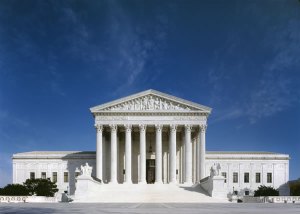
United States Supreme Court
That is, according to Rasmussen, 48% of American adults believe that government is a threat to individual rights.
Additionally, most Americans (52%) say it is more important for the government to protect individual rights than to promote economic growth.
One final and interesting point made by Rasmussen about this poll is the breakdown in opinion between self identified Republicans, Democrats and Independents.
Most Republicans (74%) and unaffiliateds (51%) consider the government to be a threat to individual rights. Most Democrats (64%) regard the government as a protector of rights.
The polling represents a point of view that the more conservative among us are becoming more interested in our civil liberties. To see these poll results in practice before the US Supreme Court we have Thursday’s opinion in Skilling v. United States. Skilling was formerly the CEO of Enron. The justices, in striking down Skilling’s conviction, lined up in a very interesting way. In this so called “right to honest services” case the Court unanimously agreed that, as it applied to Skilling, this criminal statute was too vague and Skilling had been deprived of his constitutional due process rights. The author of the Court’s main opinion, Justice Ruth Bader Ginsburg, is the former general counsel for the ACLU. She concludes for the majority that the “honest services” statute is vague and this vagueness is overcome only in those cases involving bribes or kickbacks. Limited to such cases she finds the law constitutional but, because Skilling had not participated in bribery or kickbacks, the statute was defective as to him.
In a separate opinion Justice Scalia joined by Justice Thomas, certainly the most conservative members of the Court, joined by Justice Kennedy, argues that the reasoning of Justice Ginsburg is insufficiently broad. Justice Scalia concludes that any conviction under this statute would be defective on due process grounds since nowhere in the statute is there a limitation to those cases involving kickbacks and bribery. Hence, Scalia says, the statute is overbroad, ambiguous and fundamentally defective and future opinions should invalidate any convictions under it on this basis.
The juxtaposition of these two opinions and their authoring jurists is fascinating. The so-called conservative would flatly invalidate all convictions under this statute while the former general counsel for the ACLU would uphold convictions in certain circumstances which are unnamed in the statute. Who is the civil libertarian here? Why the divergence? Is there something in the way each of them see the world which makes them break down this way? Are the results of the Rasmussen poll playing out on the stage of the highest court in the land?
Of course you may say that this is just like medieval theologians arguing over how many angels may dance on the head of a pin. Why, you may ask, is this anything more than a simple academic disagreement between extremely intelligent justices? Why is this a civil liberties case?
My answer: the Skilling case is rightly understood as a political rather than a law enforcement case. Why do I believe that the prosecution of Mr. Skilling was political? I think we can all agree that there was considerable pressure on the Bush justice department to convict Skilling as well as Ken Lay and other higher ups at Enron as well as the accountants at Arthur Andersen (another prosecution which failed at the Supreme Court level in 2005) of something, given the high profile of this largest bankruptcy in US history. There simply can’t, in our modern America, be such a thing without criminal charges, can there? Somebody must be made to pay and pay dearly. Our federal government cannot be seen to be passive here because people would start to wonder if the federal government’s “protection” of the public is really all that valuable if there is no criminal violation associated with Enron’s fall. [Note: The justice department publicly began looking at BP for criminal violations associated with the oil leak several weeks ago prior to the agreement by BP, under pressure from the White House, to fund an independently administered $20 Billion compensation fund.]
In the end, the government charged Skilling with both a violation of the “right to honest services” law and insider trading violations. Lacking a strong insider trading case against Skilling, evidence of this fact being conclusive since a local Houston jury acquitted on all nine such counts, the government used it’s “go to” statute, the “right to honest services” law, to “get him.” At trial the government gained a conviction but it did so only through the use of a criminal statute which was, as to Skilling, unconstitutionally vague according to a unanimous Court. From the point of view of the executive branch, however, the justice department was vindicated by a jury which convicted, even though Skilling was eventually let off on a legal loophole. It was plainly just a political prosecution.
The Courts are there to protect us from being crushed under the overbearing weight of the federal government. It is laudable that all of the justices stepped up to agree that Skilling, an unpopular and much villified character, was subjected to prosecution under an unconstitutionally vague law. It is interesting, I think, in light of the Rasmussen poll, that the more conservative justices were willing to go further than the reputed “civil libertarians” to restrict the power of the feds.
[See also: Fox News Judge Andrew Napolitano attacking the Patriot Act as blatantly abominable, unconstitutional and hateful from the stand point of civil liberties.]
Many are aware of this quote from George Washington:
Government is not reason; it is not eloquence; it is force. Like fire, it is a dangerous servant and a fearful master.
If, as Washington believed, government is just force and if, as many American’s believe, a focus of the current administration is “redistribution of wealth” through government action, then the redistribution of wealth by force is a focus of the current administration along with their allies in both houses of Congress. What makes this “redistribution” logically different than a burglary or a car jacking or armed robbery? Implied violence is certainly not a distinction because it is present in both situations. Supporters of the redistribution would say that the difference is the fact that it is accomplished by means of law which was arrived at through our representative government. Is this a principled distinction?
What law is this that permits forceful reassigning of wealth? The tax law? The health care law? Social Securityand Medicare? The $800 billion stimulus law? The previous $152 stimulus law? The TARP law? The incipient new laws on Financial Regulation and Cap and Trade? Is there a distinction between burglary/robbery and “redistribution” other than that the political system has decided to give what some people own to different people? In whose eyes is this a fundamental distinction? Isn’t it like changing the rules after the game has been played? Like the proverbial two wolves and a sheep voting about what’s for dinner? Even if it is a good idea economically and government policy wise, is taking something and giving it to someone else without even the appearance of compensation morally okay? Is it principled? Can principled and moral resistance to this aspect of the political system be rightfully characterized as mere ideological claptrap?
Says Al Sharpton:
Is Sharpton alone? President Obama gave a radio interview in 2001 in which he addresses forcible redistribution of wealth. See http://www.youtube.com/watch?v=iivL4c_3pck.
How do we analyze this? Let’s say that there is a new law. That law states that poor or unemployed persons or investment bankers are permitted to let themselves into your house and remove your property up to a certain amount. Should this be considered as proper “redistribution under law” or criminal activity? Is there a moral difference between this new law and the current laws of “redistribution?” What if the law requires us to leave a certain amount of designated property on our front lawns for later pick up by the beneficiaries of government largesse avoiding the unpleasantness of actual entry? Is such a system justifiable under traditional morality?
I believe that passing a law does not lessen the moral failing of a policy of governmentally enforced redistribution. This, however, is the reason that progressives expect a violent backlash to the redoubling of redistribution policy under the leadership triumvirate of Obama-Pelosi-Reid. They understand that fundamentally there is no difference between theft under law and “redistribution” of wealth through taxing and spending. This is equally true whether the redistribution is accomplished by means of the income tax or inflation or through some other governmental means. Progressives, however, reject the very idea of a morality which transcends the rule of the majority. They are well aware that their aim is to make some people poorer and some richer by means of the law and they want to to accomplish this, in part, to demonstrate their rejection of any idea of a transcendent morality. They challenge this morality! They want a reaction from those who accept it.
Right now there is no easily perceptible connection between the manna being conferred upon the beneficiaries of redistribution and the source of that redistribution. This is because taxes have not really gone up yet and governmentally measured inflation is limited. The current source of redistribution is borrowed money which taxpayers are on the hook for. People are being given benefits and we are simply promising to pay for them in the future.
How will we pay? The payment will come in at least three ways. First, taxes will go up. Second, the value of the dollars we hold will be eroded through inflation. Finally, we will all pay for the current transfer of wealth through a future of less, possibly much less, because the debt will act as a drag upon the productiveness of our economy and everyone will be worse off than they otherwise would have been.
Progressives know that some people will resist this, feeling that the law is being used to mask what is essentially theft. Given their aim to demonstrate rejection of a principled morality, they expect people to resist and to resist this taking by force. Resistance by force is a right under law when someone enters your home to take your property unless you welcome them and invite them to do so. The fundamental reason that this redistribution by law cannot be resisted by force, however, is that the government has sanctioned this taking. In fact government is the one acting as the intermediary and doing the taking. We cannot forcibly resist the government taking because it is at once the repository of “lawful” force and the source of the political law which creates the redistribution.
Why no violence yet? Is it because the “resisters” have a deeply ingrained respect for government whether acting morally or not or is it because the loss of property has not really been felt yet? I don’t know for certain but I believe and hope it is the former. Nonviolent resistance and protest through the political process is the only way to maintain what is left of our limited government constitutional republic. Any violent opposition will be violently put down by the lawfully instituted authorities. Those violently asserting moral rights to their own property will lose their legal credibility as well as their moral superiority.
A reinvigoration of the principles and self discipline of Americans to refrain from looking to government to take property from others is necessary. In fact, it seems that an example of self discipline is necessary. We must start with ourselves before we look to others to relinquish their redistribution “benefits.” Violent resistance to this “theft under law” can result only in losing our constitution and our right to insist upon its principled limits on government. Through resistance by force we will enter a free for all in which might makes right. Progressives are not really afraid of this since theirs is a world where the majority may freely trample on the rights of a minority through government action, i.e. redistribution under law. We cannot allow ourselves or those who see the world in a similar way to go there.
John Schoen, a columnist for MSNBC’s personal finance site, writes about gold. gold bugs and gold values in an article titled “Gold Bugs Fly High As Values Soar.” This article features prominent quotations from an “investment strategist” at Barclay’s Wealth, Michael Crook, http://www.msnbc.msn.com/id/37490761/ns/business-personal_finance/. Says Crook:
As the market realizes that the events that it’s working though are not the end game, the selling from the ETFs creates source of downward momentum that we actually haven’t seen before,” . . . . Investment demand has become a much a larger source of demand than it used to be. So the question is that a true shift in preference or it is it a bubble? We’re wagering it’s the latter.
As indicated by this quote, Crook and Schoen’s article generally take the view that the current run up in gold is just another bubble not unlike the bubble in the early 1980s when gold rose in price to over $800 per ounce. If so, this bubble could mimic the tech stock bubble or the oil bubble or even the housing bubble which is still in the process of popping.
I wrote a response to Mr. Schoen. I would like to share with you the gist of that response.
John:
Do you have any bullion gold yourself? If not, I would be interested in an article about why you’ve decided to avoid bullion. Is it because you see that in the last century the fiat dollar has never collapsed therefore it is not possible that it will collapse? Do you think it is impossible for the fiat dollar to become worthless or nearly so? If not impossible, how ‘unlikely’ is it do you think? If it is merely ‘unlikely’ and not impossible how do you quantify the likelihood of the occurrence of that unlikely eventuality? Have you read or do you know of Nicholas Taleb’s book, “The Black Swan” which concerns the impact of the highly unlikely event or non-event?
I consider it unlikely that gold will lose half of its dollar value over the next twelve months but it appears to me that the difference between you and me is that I don’t consider it impossible that this will happen or that it may double again. If an event such as these were considered impossible by some, I would have to understand why they believed it was impossible before I would believe in its impossibility. Crook simply opines that markets are discovering that this period is not the “end game.”
The destruction of gold’s current valuation or the doubling of it is not impossible at the very least because Congress could conceivably pass a law deeming the value of gold at $600 per ounce or there could be rampant deflation when the Bush tax cuts expire in 2011 or the Fed could successfully reduce the size of the money supply when velocity returns to a more normal value and in any of these events and a million more I could think of, gold would lose much of its market value. Likewise war and hyperinflation might push the value quickly higher. Virtually anything is possible, even the election of an honest government at some point in the future is possible, but that’s another subject.
It seems to me, however, that holding some gold is a reasonable hedge against a Talebian Black Swan event, hyperinflation, loss of the dollar’s reserve currency status in favor of gold, or world war, whatever. Not likely events, and events too terrible to contemplate to be sure, but not impossible ones either.
I should also have included this but I didn’t think of it until later.
No more than 5% of net financial assets held in gold though, is that a good idea John? For me and apparently for you, diversification is important. For others, with the US government apparently ready to step in to take care of them in their dotage although they haven’t provided for it themselves, why not? They could end up mega-rich. If they win great, if not, it would sort of be like the Wall Streeters who were bailed out by the government too.
You also cite Congressman Anthony Weiner and his public crusade against gold companies supporting conservative talk show hosts. Weiner has criticized at least one prominent coin dealer for a “mark up” of either two or three times (208%) the melt value ofsomegold coins they offered for sale. Does Weiner understand the numismatic value of gold? There are pennies and a few other coins which I have owned which are worth hundreds of times their base metal value? Is Weiner simply saying that there are rare coin dealers who are sharks? Duh!! Who doesn’t know that? However, are the people who are buying that type of gold betting on the Talebian Black Swan of government confiscation of non-numismatic gold? Wouldn’t this action very likely send the price of the remaining gold, the numismatic gold, that much higher? I just wonder? Is the public as stupid as the intelligentsia think? Do we all need to be protected from ourselves and from the evil, racist Glenn Beck?
P.S. Your point about exchange value is a good one John. Perhaps some silver coins then as well?
In the end, who knows what will happen. The Boy Scout motto should ever be our watchword whether young or old, “Be Prepared.”
Michael Yon, a former Green Beret, went to Iraq and Afghanistan in order to discover the story of our wars from the point of view of those fighting them. In his own words:
. . . [W]hat spurred me to drop what I was doing, get on a plane and fly halfway around the world, to a war zone, was a growing sense that what I was seeing reported on television, as well as in newspapers and magazines, was inconsistent with the reality my friends were describing. I wanted to see the truth, first hand, for myself.
For more than five years Yon has been issuing his Dispatches from embeds with American and UK units both in Iraq and Afghanistan. He has spoken often and powerfully about his experiences and observations. He has shown directness and even bluntness in his assessments, often including implied and explicit criticism of the US and UK upper echelon. He jumped into the political hornet’s nest when he observed that the war in Iraq had morphed into a civil war but did so because he felt it was necessary to be accurate about events on the ground. He has also been particularly direct when talking about the military and police forces of the two host nations. He has always told it like it was and, notwithstanding his sometimes impolitic opinions, for the most part was welcomed by the allied military at all levels.
Last month, despite the terms of a written understanding with the army, Yon was abruptly dis-embedded from his unit, the 5th Stryker Brigade, 2nd Infantry Division in Aghanistan. There is significant evidence that this action was taken from the level of and at the direction of Gen. McChrystal and staff. D.B. Grady explains the context of the order to dis-embed Yon in the Atlantic, http://www.theatlantic.com/politics/archive/2010/06/michael-yons-war/57483/.
Despite early optimism, Yon has clearly expressed his lack of confidence in Gen. McChrystal’s capacity to lead the US to a successful outcome in Afghanistan. He has also leveled substantial criticism against the actions of a Canadian General who was subsequently relieved of command. The specifics of these episodes are all beside the point however. The point I am making is that dis-embedding Yon was a form of censorship and a threat.
Let’s ask ourselves some pertinent questions. Is controlling access to non-secret information a form of censorship? When is such access-censorship permissible in a country whose press is supposedly free? Does access-censorship become more permissible when you are in a war and you, as the authority, believe people’s lives may be lost if your war aims are made more difficult to accomplish by reason of the publication of non-secret information or even uncomfortable opinions? Are there written guidelines which are to be applied by the party making the decision to limit access to non-secret information? Isn’t the censorship of Michael Yon worthy of substantial news coverage especially when it acts as an implied threat to others? After all the remainder of the press rallied around Fox News when the White House was trying to isolate and marginalize it. Why is D.B. Grady, a freelance writer, the only one even mildly interested in it? I truly hesitate to make this political connection, but did the fact that President Obama made himself, until very recently, virtually unavailable for press corps questions set the tone in which this action was acceptable? Would the press have pursued the story if Bush’s army had cut off Yon’s embed when he went public saying that the war in Iraq had become a civil war when that conclusion contradicted the Bush party line?
Long before his dis-embed, Yon made this important statement about access to information:
The longer I stayed, the better I understood things. And I began to realize that Americans need to see these things in order to understand what is happening here and come to a more informed judgment of whether this struggle is “worth” the cost, in money and lives. No one can make that determination without a balanced set of facts.
How do we, the American people, reach a reasoned conclusion about the war in Afghanistan without Yon and others like him giving us the raw data? Is a man like Yon, whose embeds are at the discretion of the army, entitled to express opinions about the leadership of the war without losing his observation post thus cutting off his access to information and ours along with him? Is this another issue which must be injected into the political process if the press itself turns away?
Note: It should be disclosed that the author of this post has read Yon’s Dispatches for years and has made voluntary financial contributions to help keep him in place.
 Many are aware of this quote from George Washington:


 Short and Sweet Blog