Archive for the ‘Taxes’ category

The Real Cure For the Fiscal Cliff? Raising Taxes on the Wealthy?

December 1, 2012

Well we’re back here again. In the middle of 2011 I wrote about budget cuts versus tax increases. The ideas haven’t changed much. The alignment of the parties in power hasn’t changed much. What has changed? The only major changes are that the US government has borrowed another $1.5 Trillion since then (about a 10% increase in the debt previously owed) and a so-called “fiscal cliff” looms on December 31.

What does the President have to say about avoiding this “fiscal cliff?”

It appears that cutting tax rates on the so-called middle class (the under $250K earners) so that these folks can get ahead will be defined as accomplishing the “urgent business” of avoiding the present “fiscal cliff.” Clearly, this “fiscal cliff” has little to nothing to do with the $100+ Million per month of additional debt we are still incurring (an additional .8% of additional debt per month). This “fiscal cliff” which the President is talking about has mostly to do with the expiration of the Bush tax rates, which will revert to the higher rates set under President Clinton in 1994 with the assistance of a Democratically controlled congress. This “hard choice” by the President cuts the guts out of the idea that revenue can be used to significantly reduce the amount of debt we are continuing to incur since the proceeds of an increase in taxes on the wealthy are paltry when compared with the tax bonanza of allowing all the Bush rates return to their Clinton-era alternatives. This ‘solution’ has the virtue, however, of being politically kind of easy since the “not middle class” don’t have very many votes. And, anyway, the capital gains tax rates on the real multi millionaires (many if not mostly being members of the Democratic party) will only go up from 15 to 20%, retaining quite the advantage over the folks who earn their income through their own personal effort. Even so, the President’s multi-millionaire constituents won’t fare so badly since the capital gains rate will still be quite a bit below Reagan’s capital gains rate of 28% even though the tax rates on the people who earn their living at work will be significantly above the 28% rate enjoyed under the same Reagan.

What wasn’t directly mentioned by the President was that this “fiscal cliff” also includes automatic spending cuts, half of them being taken out of the defense budget (a cut of nearly 10% in a single year). It may be a “defense cliff” but it just doesn’t seem like much of a generalized “fiscal cliff” when the $130 Billion in cuts is compared to the sheer size of a $3.7 Trillion federal government budget (3%). Maybe that part of the “fiscal cliff” doesn’t really bother him so much, you think?

The administration has also just opened a new front on the “fiscal cliff.” Through Treasury Secretary Geithner the administration is pushing for Congress to permanently forsake its authority to control the extension of credit by the United States. It is actually one of the 17 enumerated powers of the Congress, specifically Art. I Sec. 8.2, which provides that Congress has the authority,”[t]o borrow money on the credit of the United States.” Put this alongside the question of whether the Congress has the power to completely take over the health care system of the United States which is nowhere to be found, but that’s another question for another day. Here’s Secretary Geithner being interviewed by Al Hunt about it.

Talk about frightening. The executive branch is proposing a modification to the basic power structure of the constitution without attempting to amend it. Oh well, what else is new?

My conclusion is the same as it was 1.5 Trillion borrowed dollars ago. We must show that we can do the hard things in order to maintain our credibility as a nation. The hard things would include letting tax rates go up and stay up on everyone and cutting the budget in a way which is hard and painful for a large number of folks. We’ve got to do it in order to maintain the value of the dollar. In order to keep our credit rating. In order to maintain our self respect. In order to keep from destroying the good and healthy aspects of a government, of, by and for the people.

President Obama Does It Again

December 9, 2011

Remember my last post? It was all about the daylight which has appeared between Buffett and Obama on dividend and capital gains taxes. Buffet clearly thinks that people who already pay ordinary income taxes, as opposed to capital gains taxes, are taxed enough. Buffett’s thought is that people who make money in manipulating financial instruments, thereby paying an income tax rate of 15% on capital gains and dividends, should pay more. Mr. Obama has let the capital gains tax issue gather dust. Perhaps he has overlooked it or perhaps his connected financial backers don’t want that tax boondoggle to go away. Instead, this week, the president gave a speech on the ‘New Nationalism’ in which he once again tries to make us believe that everyone who makes a lot of money doesn’t pay his fair share. He actually suggests that Buffett agrees with him on this. Here is what our President said while attempting to emulate Progressive Party presidential candidate Theodore Roosevelt:

Under President Clinton, the top rate was only about 39 percent. Today, thanks to loopholes and shelters, a quarter of all millionaires now pay lower tax rates than millions of you, millions of middle-class families. Some billionaires have a tax rate as low as 1 percent. One percent.

That is the height of unfairness. It is wrong. (Applause.) It’s wrong that in the United States of America, a teacher or a nurse or a construction worker, maybe earns $50,000 a year, should pay a higher tax rate than somebody raking in $50 million. (Applause.) It’s wrong for Warren Buffett’s secretary to pay a higher tax rate than Warren Buffett. (Applause.) And by the way, Warren Buffett agrees with me. (Laughter.) So do most Americans — Democrats, independents and Republicans. And I know that many of our wealthiest citizens would agree to contribute a little more if it meant reducing the deficit and strengthening the economy that made their success possible.

It’s enough to make a person cringe. The President of the United States seems to be fudging to the favor of his high dollar backers who, like Buffett, make their money in the financial business. I think he should be quiet about fairness until he returns to the issue of capital gains and to the position he forthrightly took in his campaign; that capital gains should be taxed at the same rate as all other income. When you do that, President Obama, come to the rest of the high income citizens, those who make their money in the real economy, and ask them for more. Until then, please just shut up.

DAYLIGHT BETWEEN BUFFETT AND OBAMA

November 7, 2011

Sorry about the six weeks of silence. Been busy. First, let me clean up some unfinished business on Warren Buffett and what he thinks about taxing “high earners” much more.

Billionaire Mayor Michael Bloomberg’s media operation has outed Warren Buffett’s real views concerning the need to raise taxes on the wealthy. Do you believe you already know them? Who exactly does he think should pay more in income tax? Have a look for the answer to this question.

Now, have you heard of the Buffet rule? The millionaire surtax? The Occupy Wall Street rule — “Let’s Eat the Rich”? Each of these ideas seems to be supported by the president. First, let’s see about the millionaire surtax idea. The democratic party’s own senate majority leader has proposed a 5.6 surtax on all income above $1,000,000 in order to fund the president’s job program. A permanent tax of this type, of course, would fly directly in the face of Mr. Buffett’s position as stated in the clip above that people who already pay tax at the ordinary income rate should not see their taxes raised. Reid, though, proposed this when he saw that the president’s taxing proposals to fund his so-called jobs bill weren’t going to fly.

How about this Buffett rule? What is that? The Buffett Rule is a rule which would make the tax rates levied upon dividends and capital gains up to the level applicable to ordinary earned incomes. Remember Buffett’s secretary? Yeah, it would actually do what Buffett says he wants. You’ll remember that I blogged about Obama’s hesitance to do this very thing back in April.

Well, this is what Mr. Obama said last month to a CNBC reporter in response to a question as to whether he would support the surtax proposed by the senate majority leader:

So, the approach that the Senate is taking, I’m comfortable with in order to deal with the jobs bill.

We’re still going to need to reform this tax code to make sure that we’re closing loopholes, closing special interest tax breaks, making sure that the very simple principle, what we call the Buffett Rule, which is that millionaires and billionaires aren’t paying lower tax rates than ordinary families, that that’s in place.

This gets really confusing. In April Mr. Obama’s proposed tax plan did not include a return the Reagan Rule of taxing all incomes equally. In fact of the three players, Rep. Ryan, the president and the Debt Commission, it was only the Debt Commission which did that. Now, however, Mr. Obama says something which sounds a lot like he is adopting at least the taxation part of the Commission’s proposal. Is there any indication that he is serious about this? Shouldn’t this be touted by the press as big news? A change in the president’s position vis-a-vis taxes on capital gains and dividends? Why isn’t this big news?

I propose to you that it is not big news precisely because it is just a big fudge (I would have said something else but look at the abuse Joe Wilson got when he said something unkind about the president’s health care bill which apparently is turning out to be a reality). Even the rosy glass wearing news media sees it as a fudge and therefore is just not interested in reporting it as a change in position. Wouldn’t the famously liberal media prefer that taxes on the “paper rich” be raised to at least the level of the “working rich?” All this is confusing if you pay attention to what is being said but watch what is being done on this score when the “super committee” which is tasked with reducing the budget reports in the day before Thanksgiving. That will be action, not words. By the way, isn’t Thanksgiving Wednesday the least important news day of the year. Everyone is traveling or cooking. Can you imagine anyone paying more than just passing attention? Why did they set this day for issuing their report? Washington is such a strange place. And we have a strange president who first rails against the mega-rich both directly and through his OWS surrogates but perversely won’t raise their taxes. He even seems to prefer their company (i.e. Martha’s Vineyard) to the company of his old ChiTown crew.

Bravo Mr. Buffett!! At least you cleared up the ambiguity in your own position. On the other hand, even if the President is ignoring your sage advice on this score apparently you’re still bundling lots of money for him. What do you think that this might be about? I know, I know, I’m may be a bit too cynical about a really nice man like Mr. Buffett.

LAUDING AN INTELLECTUAL OPPONENT

September 18, 2011

Let me recommend for the contrast of ideas a blogger who disagrees with me on many, if not most, ideas on political economy. Steve Attewell is a fellow WordPress blogger at the Realignment Project. He has written much more than I have and is a very accomplished

Steve Attewell's Bio Pic

blogger. He is a very bright and articulate Ph.D. student in the history of public policy at UC Santa Barbara. Steve is a progressive by his own definition, a definition which can be found in the archives of his blog. Lest one believe that there is a lack of good faith on the other side of economic and political debates of our time, Steve’s blog shows this to be a demonstrably false notion. People of intellectual integrity, thoughtfulness and good will do exist on all sides of the debate (assuming that he would consider me and others of like mind as having the equivalent qualities) and I am happy to say, Steve is obviously a man possessing them. This is a pre-requisite for fruitful and informative discussion of any issue.

He recently wrote a blog post, ‘Living in the Age of Magical Austerity Thinking.’ He argues that those who believe that austerity is the answer to our current economic problems are incorrect. He can be forgiven if he goes a bit over the top when characterizing his intellectual opponents as those who feel, “. . . solicitude of the have-muches, distaste for redistribution, fear of state capacity, and fear for the rights of the managing classes . . .” since his economic thinking is largely informed by Nobel Laureate Paul Krugman. Krugman’s own ideas go beyond Steve’s tepid castigation, calling austerity adherents and their political representatives the equivalent of sadists. Some of my own ideas concerning austerity can be found here.

I recommend Steve to anyone who reads this blog as a balance to my own ideas. Incidentally, I admit to being McCurious, Steve’s interlocutor in the comments section of his Magical Thinking post. I also appear in the comments section of his post on GM’s ‘recovery’ as being indicative of the success of “Industrial Policy.”

I’ll be on vacay for a couple weeks. This is unfortunate because there is so much to talk about with the President’s jobs bill, the new “minimum tax on millionaires” and the Republican search for a presidential candidate in the air. I particularly look forward to seeing how the millionaire tax does in the Senate where there are so many wealthy paragons among the Democratic majority. Forgive my cynicism for doubting that they will pass this measure even while many of them will give strong lip service to it. They’ll prefer to attack the House, trying to put the “blame” on the Republicans for being shills for the ultra-wealthy. I hope that this is going to be the fight. I would like full hearings in Congress which investigate the underlying question: the real benefits of taxing capital gains at a lower rate than ordinary incomes.

Rep. Paul Ryan Courtesy SpeakerBoehner

I normally like Representative Paul Ryan’s take on things but this morning on the Fox News Sunday public affairs program is an exception. When defending the tax rate differential for capital gains Ryan could only fall back on the saying that, “when you tax something more you get less of it.” Exactly what does that mean in this context? Why doesn’t the same adage apply to all incomes????? Wouldn’t increasing all incomes be good? Why the advantage for capital gains? Let’s have the question of benefitting capital gains in relation to ordinary income put to the test out in the open meeting rooms of capital (pun intended) hill with C-Span covering the full proceedings. Ryan, who I believe has previously described himself as a Ronald Reagan Republican, will need to explain to the viewers why Ronald Reagan’s tax reform pegged the top marginal rate on all incomes, whether capital or ordinary, at 28%. Did that make economic sense then? Why not now? That’s the sort of political fight that I’d like to see.

At least the President is finally being true to his campaign position that taxing capital gains like ordinary incomes is a “matter of fairness.” You may remember my previous posts on the President and Warren Buffett’s view of the appopriate tax rates which should be applied to capital gains and dividend-type income, here, here, here and here. See you in a couple of weeks.

CLASH OF WORLDVIEWS — EXHIBIT 1

September 9, 2011

Have a look at this exchange between Rick Santelli and Tom Friedman on CNBC. Santelli is very focused on the fact that social security is a pyramid scheme requiring constantly increasing numbers of participants over time in order to support those who got in the system, the scheme, ahead of them. Such schemes were apparently originated by Charles Ponzi beginning in the early 1900’s. Friedman is focused on the “out of order idea” that a “popular” government program could be associated with a situation otherwise characterized as criminal conduct. The two of them, Friedman and Santelli, then proceed to cross talk for a couple of minutes instead of carefully delineating what they agreed about and what they did not agree about. Have a look. It looks for a moment that Friedman will begin to reach across and agree with Santelli about the pyramid scheme when Rick removes the criminal connotation from contention but that moment passes and they get back in their corners and fight it out.

This is so very instructive as to what happens in America in the 2010’s. These two men, both very smart, are so invested in their own worldviews that they do not seek points of practical and factual agreement, they seek only points of disagreement.

Who was right? A Ponzi scheme, according to the SEC’s government website, has the following characteristics.

What is a Ponzi scheme?
A Ponzi scheme is an investment fraud that involves the payment of purported returns to existing investors from funds contributed by new investors. Ponzi scheme organizers often solicit new investors by promising to invest funds in opportunities claimed to generate high returns with little or no risk. In many Ponzi schemes, the fraudsters focus on attracting new money to make promised payments to earlier-stage investors and to use for personal expenses, instead of engaging in any legitimate investment activity.

Why do Ponzi schemes collapse?
With little or no legitimate earnings, the schemes require a consistent flow of money from new investors to continue. Ponzi schemes tend to collapse when it becomes difficult to recruit new investors or when a large number of investors ask to cash out.

Santelli and Friedman could have agreed on the fact that Social Security requires an ever-growing pool of funds from newer workers over time to pay the mandated benefits of retired workers. This certainly meets at least one of the criteria specified in this government website description. Likewise, as with the Ponzi scheme there is no investment activity which goes on with social security, the money is used to pay people who joined the system earlier. Any money not so used is placed into government IOU’s with very low interest rates which, when they are redeemed, will have to be paid out of other government tax monies. They could have agreed that the available funds must meet the mandated benefits over time and that this can only be achieved, in the context of Social Security, by: 1. Cutting mandated benefits; 2. Quickly increasing the numbers of those paying into the system; or 3. Increasing by some means the per person amount that the newer folks, those still working, are required to pay in. The latter solution was tried and is the one alluded to by Friedman which occurred during the Reagan administration in 1984, the last time social security came close to running out of money to pay mandated benefits. Santelli’s implied criticism of this “solution” is that the 2.4 Trillion dollars in taxes which exceeded the benefits actually paid out between 1984 and 2009 was gobbled up by federal government which spent the money as if it were ordinary tax money and the government left a bunch of IOU’s in the till. In terms of the description of the Ponzi scheme, these funds may legitimately be viewed as having been used for the personal expenses of the scheme promoters, in this case the U.S. government. This fact, Santelli’s argument implies, made the government the equivalent of Charles Ponzi, the criminal, who raked off some of the proceeds from the new “investors” for his own use rather than to pay the early investors. It appears to me that just the label, Ponzi scheme, angered Friedman greatly. No real attempt at rational discussion was made after this charge was leveled by Santelli. Pehaps had Santelli chosen the less judgmental term “pyramid scheme” it would have seemed less offensive to Friedman?

What purpose did this exchange serve other than entertainment for CNBC viewers? Who comes off well? Until we get to the point where we can stop calling each other liars or “idiots” because the other’s worldview is different than our own, we’re not going to get very far in bridging the differences between us. We will remain at drawn daggers over every issue. And that is not good since the existence of a country, this country, which is a multicultural country, must necessarily be based upon reaching some type of a broad based agreement across the generations and the classes and the races and the cultures as to what this country’s government should be about.

They could have agreed on all of the facts. But they chose instead to fight out a war of terminology which predicably degenerated into calling the other a belittling name. The different assumptions which each makes underly this argument. The distinction is whether the government is viewed as a benevolent father figure seeking only the good of its citizens or as a self-interested participant whose actions benefit some of its citizens at the expense of others. There you have it, a concrete example of the clash of worldviews.

THE PRESIDENT’S JOB-SPEECH

September 8, 2011

Tonight’s the big night. A joint session of Congress and the President will present (at least part of) a plan to create more jobs to reduce the 9.? unemployment rate. Is the air electric with anticipation? Well, uhuh, it’s not, unless you mean about the NFL opener between the last two Super Bowl champs, the Packers and Saints, which will start shortly after the President leaves the speaker’s podium.

What’s happening? It’s just another chance for the President to get on TV and use his teleprompter jiujitsu on his opponents. What will likely transpire is an announcement that there is an exciting list of things which will receive federal money so that “we the people can have jobs.”

Afraid of the moniker that he’s just a big spending liberal, the President will “pay for” at least some of these expenses with “revenue enhancements” paid for by the people who still have a little money left in 2011. The President will seek to tax away any money that might have been “saved” and make sure that it is spent productively, as is always the federal way. Although the Republicans in Congress have already indicated their refusal to go along with this, the motive behind the plan is so that the President can say in his re-election bid that it is the Republican refusal to go along with his brilliant plan that is causing the continuing malaise in the economy. And, he and his surrogates will go on, the Republican refusal is because they love the “rich” so very much and don’t care about the poor unemployed. There will be no discussion about why the plan would have worked or whether there would have been some job losses to offset the job gains if he had gotten his way. It’s the perfect political plan, make it look like you’re trying to do something while making the other guy look like he’s resisting for political purposes, not economic ones. Same old playbook. It worked with the debate over increasing the national debt limit. The Tea Party label is permanently damaged and they got less than a 2% reduction in spending for the fiscal year beginning October 1. He made them pay a pretty high price for that hollow “victory.” Same plan, phase II.

The President, I predict, will not suggest increasing the capital gains or divident taxes on the very wealthy, he will target instead the upper middle class. Tiresome and predictable but it’s worked (politically) before. So why not again?

I know one thing for sure. Mr. Obama doesn’t understand or, perhaps, care about the TANSTAAFL rule. The TANSTAAFL rule provides that there is no such thing as a free lunch, someboy always has to pay. And the only interest group which he feels should not pay in order to build up the economy is the massive and growing government sector.

Coils of USPS Stamps - Courtesy USPS Website

The government does actually produce things but mostly not things that the public would pay for at the prices it charges. It uses either monopolies or taxes to corral the resources to make it run. If we don’t watch out, though, plans like President’s will create an entire country in the image of the U.S. Postal System. And that would be a helluva shame.

RAISING TAXES VS. BUDGET CUTS

July 1, 2011

As I write this the Debt Ceiling talks are on life support. The president has become involved in order to revive the talks. Although the nominal focus of the talks is upon raising the borrowing limit, the nuts and bolts actually concern budgetary reform.

A few days ago Republican talk participants withdrew. The withdrawal was apparently caused by the insistence of Democratic members on raising taxes. The president met with congressional leaders from both sides. At his press conference Wednesday he chastised the Republicans for being unwilling to raise taxes on some, including jet owners, in order to pay for things like student loans and other high priority federal government programs.
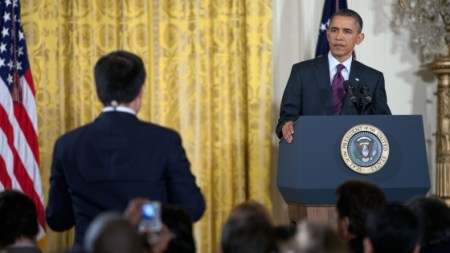
June 29 Press Conference (Courtesy WhiteHouse.gov)

Just before the 2008 Democratic landslide election it was Fox News’ resident liberal, Juan Williams, who said, and I paraphrase, if the Democrats win this election in the numbers it appears that they will (and they did) there is one thing that won’t matter — the deficit. How prescient was Williams? The question is, though, do the deficit and the federal debt really matter?

To answer this question you must first understand what a dollar is. We all know that a dollar is a unit of value. It is the unit which we use to facilitate our economy. How does this work in practice? It is only paper after all. It works because on every dollar bill there is the legend, “This note is legal tender for all debts, public and private.” In that phrase is the value. By federal law you use the dollar as the means of paying your debts. But what if the transaction doesn’t involve dollars at all, though, what is the role of the dollar then? How is the dollar involved?

Let me give you an example, what if you and I agree to trade my Kawasaki dirt bike for your 1994 Ford Thunderbird. After the transaction, under IRS rules, the the party which received the vehicle with the greater market value in dollars must report that as a gain on his Form 1040 and pay income taxes denominated in dollars on the gain. But let’s suppose that one of us backs out of the exchange, what happens then? The one wishing to perform takes the other one to court. In the typical court proceeding the judge will not order the physical exchange to occur but will issue an order that the party refusing to perform must pay the performing party the difference in market value between the two vehicles plus, in many instances, attorneys fees, all of which are reckoned in dollars. Hence, even in situations not involving dollars per se, the dollar is ever present.

What then backs our dollars? Where do they come from? Is it just a big secret or a fiction we all agree on or does it really have something to do with the real world?

FDIC "Teller Sign"


Our dollars, at least the greater part of them which are in banks, are backed by the full faith and credit of the USA through a federal agency called the FDIC. FDIC provides deposit insurance to bank depositors. This insurance says that if the bank goes bust that the vast majority of dollar deposits will be made good by the federal government. If the bank doesn’t have the money then the FDIC will stand good for their debt to you which is represented by your deposit in the bank (up to $250,000 per depositor).

Where does the FDIC get it’s money? It gets the money first from premium payments by banks and when reserves from those premium revenues fall short the FDIC can draw on the borrowing power of the USA and if the borrowing power of the USA falls short the Federal Reserve Bank will simply print the money (although the Fed will receive a federal bond in the amount of the cash created like it did during QE and QE2) and the FDIC will in turn give it to the disappointed depositors. Problem solved?

As our president is finding out, however, the ability to print bonds and dollars does not mean that you have unlimited wealth. You cannot print them at will and in any amounts you wish without consequence. The government may have access to dollars (through an increase in the national debt limit which is simply the ability to print more bonds) but the actual value is not in the ability to print bonds and inject the dollars into the system. That process is clearly limited only by the availability of paper and ink. The real value of the dollar relies in a very real sense on the resolve and dependableness of the USA to make the hard choice of choosing to pay it’s creditors first out of it’s income and consume only what is left. A reputation for dependability in seeing that creditors are paid is what gives the dollar it’s value.

In seeking to raise the debt limit the government is not showing the world we are as dependable as we have always been. We are not seeking to pay our creditors out of our income. We seek to borrow some more in order to pay our creditors back. In seeking to raise the debt limit today the government is really just putting off the day when the dependability of the USA will really be tested. And ideally for this government, that ultimate test will happen only after the current crop of debt-increasing politicians has left office. Now, after a bit, we get to the real point of this post.

How is it possible that passing a resolution to create more federal debt, basically just printing more greenbacks, indicates that the US is a dependable nation? It simply doesn’t. It shows nothing but a devil may care attitude towards being dependable and hence towards the value of the dollar itself.

Well then, how is it that the US can show that it is a dependable nation? How do we demonstrate that the value of the dollar should be relied upon now and in the future because it is backed by our full faith and credit? We must do something which is hard. We must show that we can endure the pain of taking responsbility for the debt. We must make what the president calls the “hard choices.”

Showing dependability cannot be achieved to any great extent by extending the depreciation schedules for jet plane owners, or by “making the tax code more progressive” or by taking itemized deductions away from all those who make $250,000 or more. Raising taxes, while possibly being helpful in reducing the debt, will actually be counterproductive to the idea that the majority of people in this country have the resolve to do something hard. It will demonstrate that a majority are not interested in giving but are interested only in taking!!!!

That the top 10 per cent of income earners in the US already pay around 70% of all US personal income taxes is well known. What is not so well known is that a trememdous part of the US government’s budget is made up of “transfer payments.” Transfer payments are payments which are made without the government getting anything valuable (except a vote I guess) in return. Federal transfer payments make up these percentages of the total federal budget: 20% in social security payments; 21 % in medicare, medicaid and CHIP payments; and, 14% in safety net programs.

If we do not show a willingness to fundamentally change ourselves by rejecting the idea that the federal budget should predominately be a vehicle for transfer payments, we will simply not show that we are willing to accept hard choices. We will give evidence that we are a people who want someone else to pay our bills and are not, therefore, very dependable at all except in our wants. We will show that we are willing to raise the taxes of a few in order to pay the bills of the many. Perhaps raising taxes, an outcome apparently desired by the president, will help balance the books in the short run however it will do nothing about the long run problem of a country which is interested in living at the expense of someone else. Unless we show that we, as a people, reject the belief that our federal government is mainly a vehicle for transfer payments, we will prove that our full faith and credit is just not worth very much and the dollar will eventually be valued accordingly.

A cynic might say, ‘what other decision would one expect from a form of government which has no effective protection for the property right of the minority in their own income?’ This nation has been exceptional so far and I fervently hope that it will remain so by debunking this voice of the cynic. In fact our country must debunk the cynic or risk allowing the entire idea of self-government to perish along with the value of the dollar.

Happy July 4.

UPPER MIDDLE CLASS NOW THE “ENEMY”

April 14, 2011

I define the upper middle class as those people who have high incomes but who, if they stopped work, would have to substantially reduce their lifestyles. They may have capital gains and dividend income as well, but the bulk of their income comes as a result of their own work and effort. This is the basis on which I distinguish between the upper middle class and the truly wealthy. ”] The truly wealthy, as opposed to the upper middle class, have high incomes but need not work whatsoever to earn them. Their lifestyles are simply not dependent on their own efforts. President Obama sees the distinction between the upper middle class and the truly wealthy but for some inexplicable reason singles out the upper middle class for the harshest treatment in his “austerity budget” priorities. The new Obama plan gores the devil out of the upper middle class while doing little to affect the lifestyles of the truly wealthy. Both the Ryan and the Simpson-Bowles Deficit Commission priorities do substantially less to single out the upper middle class for special tax “punishment.”

Derek Thompson, of the Atlantic, has posted a comparison of the three deficit reduction plans on the table. Thompson compares the highlights of the taxing policies of the three plans, Congressman Ryan’s, President Obama’s and the Simpson-Bowles Deficit Reduction Commission’s. This is what Thompson says about the three:

Tax Reform

White House: Let Bush tax cuts expire for “the wealthy.” Limit itemized deductions for the wealthiest 2% of Americans to reduce the deficit by $320 billion over ten years. Convene a panel on tax reform. (Another part of the speech calls for “tax reform to cut about $1 trillion in spending from the tax code,” that is $1 trillion in tax expenditure cuts.)

Paul Ryan: Extend the Bush tax cuts and enact tax reform. Repeal $800 billion in tax increases imposed by Affordable Care Act simpler, less burdensome tax code for households and small businesses. Consolidate and lowers tax rates for individuals so that the top rate comes down from 35 to 25 percent and pay for it by sweeping out deductions and exemptions. Lower corporate tax rate from 35 percent to 25 percent and pay for it by sweeping out tax expenditures.

Deficit Commission: Enact comprehensive tax reform. Consolidate and lower individual income rates to 12%, 22%, and 28%. Eliminate most tax expenditures that don’t protect the low-income. Tax capital gains and dividends as normal income. Lower corporate income rate to 28%, eliminate most deductions, and move to a territorial tax system, which would not tax profits made by U.S. multinationals overseas.

As you can see, of the three only the Deficit Commission’s plan returns the taxes on Capital Gains to the Reagan era status of treating them like earned incomes. As such the plan proposed by the least politically potent of the three, the Deficit Commission, would actually get at the wealthy by having them pay their income taxes as if they earned those incomes by their own blood, sweat and tears instead of through dividends and capital gains. Remember what candidate Obama once said about this issue and “fairness”:

Apparently the President has changed his mind since his election as to what is fair. He chooses in his own plan to maintain the current gross tax rate advantage for the truly wealthy vis-a-vis the upper middle class. Even stranger, by both raising the tax rate on those in the upper two percent of income earners and eliminating many, if not all, of the itemized tax deductions, the President has singled out the upper middle class to pay much more in tax, not the truly wealthy like his friend Warren Buffet. This is because, other than the charitable contribution deduction, few of the truly wealthy claim the benefit of the other itemized tax deductions. The truly wealthy are likely to own their own homes outright so the deductibility of mortgage interest is of no concern. In addition to the increased tax effect, removing the mortgage interest deduction will actually cause the expensive homes of the upper middle class to lose market value since prospective buyers will be even less interested in owning them. Furthermore, in order to claim other so-called itemized deductions those expenses must exceed 7% of their Adjusted Gross Income. The truly wealthy are much less likely to meet the threshold of 7% to claim medical care deductions or other lesser known deductions subject to the 7% cap than those making at the lower ranges of the $250,000 limit.

The people getting the shaft under Obama’s priorities are the ones who go to work everyday, often at 5:00 a.m. to run their businesses, check on their hospitalized patients or otherwise work for a living. They’re the ones climbing the ladder, they are not at the top yet. They are motivated and personally involved in providing goods and services as well as jobs in the real world. Why would Obama single out those who are climbing the ladder to subject them to the heaviest burden of taxation? Is it truly just politics or is it his ideology? At the next press conference won’t somebody, like Charlie Gibson who did so at a democratic presidential debate, ask him about why this is? Ask him why he’s backed off his campaign rhetoric concerning Capital Gains tax fairness. Of course, this would only be possible if there ever is another news conference with real journalists in attendance!!!

HERE COMES THE PREDICTABLE PRESIDENT

April 13, 2011

It is widely believed that the Obama “budget plan” to be announced today will call for an increase in tax rates on the “wealthy.” Wow, what a difference four months makes. As readers of this blog know there are two forms of income received by the “wealthy.” Ordinary income, obtained through personal work and effort and “capital gains and dividend” income, obtained through investments. A fellow blogger, Chad Aldeman of “The Quick and the Ed Blog,” has analyzed the effective tax rates of US top 400 income earners for 2007. This is what he reports:

. . . . [T]hat the super rich have been paying smaller and smaller portions of their incomes to taxes*. The chart below shows the effective tax rate for the richest 400 American filers from 1992 and 2007. The blue line represents the highest income tax bracket, the red line is the tax rate on long-term capital gains, and the orange line is the average tax rate that the richest 400 filers actually paid.

There are two important things to note from this chart. The first, and most visually apparent, is that the tax rates of the rich are far more closely linked to the capital gains taxes than income taxes. Salaries and wages, the source of income taxed at the blue line, represented only 6.5 percent of these filers’ income. Nearly two-thirds of their income comes from capital gains, and this is why you see a much tighter coupling between the orange and red lines.

As provided by the Tax Foundation, taxfoundation.org, in 2008 the total Adjusted Gross Income for all filers with incomes above $380,000 (the top 1%) was $1.685 Trillion dollars. These people already pay about $392 Billion in income tax. Therefore, even if we took 100% of all the money earned by everyone in the top 1% of filers, we would still have a deficit of about $400 Billion for FY2011. As with the effective rate figures for the top 400 income earners in the chart above, the effective income tax rate for the top 1% is far below the 35% maximum rate. In fact it was 23.27% for the entire top 1% in 2007. This is less than halfway between the capital gains/dividend tax rate of 15% and the top income tax rate of 35%. In fact it is only 40% of the way.

What these facts mean, I believe, is that we need to look at increasing the capital gains tax rate (as well as limiting the exclusion from taxation for municipal bond interest) as a means for increasing the government’s take. There is a lot of room here for higher taxes, don’t you think? This is especially true when you understand that higher wage earners pay, in addition to income tax, 12% social security tax on the first $110,000 of earned income and 3% medicare tax on everything they earn from personal work. On the other hand, the capital gain/dividend crowd, the truly wealthy, pay 0% in either “entitlement” category.

I wonder what President Obama is going say about taxes. Maybe he’ll go for goring the capital gains/dividend crowd by 5% more, from 15% to 20%. Well, La Dee Dah. How about proposing that this preferred tax rate rise to it’s Reagan era level of 28%? Or might this proposal hurt Obama sponsors like Mrs. Heinz Kerry, Mr. Soros, Mr. Buffet, Mr. Gates, or even Mr. Gore? Therefore, I doubt very much that Mr. Obama will suggest that the capital gains tax rate should rise to more than the Clinton era’s level of 20%. This, it should be noted, is in stark contrast to the words of candidate Obama who declared that increasing capital gains tax rates was a “fairness” issue. I, of course, would advocate heavy congressional scrutiny of any proposal to increase anyone’s taxes to make sure the increase is not self defeating for the country, however, if we are going to consider raising taxes on the wealthy, let’s consider more than a single aspect of the “taxing the wealthy” issue.

HEAD’S UP IN THE UPCOMING DEBATE OVER FUNDING SOCIAL SECURITY

March 13, 2011

Remember when President Obama, last week, said in a press conference that in the middle of the decade his budget would have us to a point where we would no longer be adding to the deficit? Halleleujah!! Unfortunately, it is indisputable that the Obama budget never once comes close to matching income and outflow. The following is how the President’s new press secretary explained it, and did it without backing down an inch from what the President said:

This is an example of avoiding a plain mathematical truth through application of obfuscation and is just plain tomfoolery. It is true that:

In war, truth is the first casualty. Aeschylus Greek tragic dramatist (525 BC – 456 BC) .

But our politicians, for purposes other than war, have seemed to take this adage and placed it at the service of their intramural debates and elections. This is not a difference of worldviews, a topic often explored by this blog, with it’s attendant differences in context, language and emphasis created by differing worldviews. This is an example of a simple lack of candor. In no one’s world should this be okay. This is not an issue of context, of language or emphasis. It is just not true.

This also gives us a little taste of how we’ll be treated in the upcoming social security debates. An example of this was delivered by a group of Democrat Senators about 30 days ago. These Senators explained that the Republicans are in favor of ‘privatizing’ social security and that social security can pay every dollar of benefits for the next 27 years and that social security is actuarially sound among other important things.

I am unsure whether there have been any post-Bush Republican proposals for “privatizing” social security but I am certain that there is a big problem with calling social security “actuarially sound” and explaining that it has the resources to pay benefits for 27 years without any changes without further explanation. It is a bit like the President’s news conference when he suggested that in 2015 his budget will be balanced and his press secretary had to spin and spin the point until he was dry.

What is the truth? The truth is that in 2011 current social security benefits will exceed current social security taxes. How can it be that social security is “actuarially sound” or able to pay every penny of benefits for the next 27 years without any changes and yet social security has now started to pay out more in benefits than it receives in taxes? Are the Republicans ginning up lies? Are the Democrats now having to courageously put a stop it?

Well, the truth is that the social security system will need to call on non-social security tax revenues in order to pay the difference between current social security benefits and current social security taxes for the foreseeable future. It is a fact that this began in FY 2010. There is no end in sight. Since this is undeniably true, what do the Democrat Senators mean by saying that social security can pay every penny of benefits for the next 27 years? These Senators are only saying that the general tax revenues which are going to have pay the social security benefits will not be used to do so directly, they are saying that something else will happen between cup and lip. What will happen, however, is only on the books of the Social Security Administration. The government’s general revenues will, instead, be used to pay off some of the IOU’s which have been piling up in the SSA for 27 years. The general revenue funds which have redeemed the IOU’s will then be used to pay current social security benefits. In this way there will be two stops for these dollars, not one. The dollars will change status from general revenues to the proceeds from paying off the IOU’s. The net effect will be nothing, zero.

Do you remember the old pragmatic-sounding “pay as you go” Unified government budgets which began in 1983. Under the Unified budget social security taxes were used to pay-as-you-go for non-social security government programs. The surplus between social security outlays and expenditures in those years was used to make the federal budget deficit look smaller or the budget surplus look larger, including during the years of Mr. Clinton’s magic “budget surpluses” of FY 1998, 99 and 2000. See the chart below for a graphic example of what was going on.

For instance, as the chart shows, in FY 2000 approximately $200 billion was added to the trust fund as a result of this social security surplus. The accumulated surplus is what the Democratic Party’s Senators are actually talking about in terms of the “solvency” and “actuarial soundness” of the program. The existence of these IOU’s will not lessen the difficulty and the reality of coming up with the difference between the social security taxes and the social security benefits to pay retirees on an ongoing year to year basis.
This is a fact that everyone needs to know so that when politicians deny that social security amounts to a fiscal problem at the present time, you’ll know that they are trying to tell you something about accounting, not about reality. Because the general tax revenues will first be used to pay off the IOU’s which the SSA has been accumulating in it’s filing cabinets before being used to pay benefits doesn’t make a hill of beans to the painful reality that somebody will have to pay the bill.

Oh and by the way, as to the partisan politics of this. Control of Congress has been split almost evenly during the period since FY 1984 between Democrat and Republican. The presidency a bit more Republican at 16 years to 10. It should also be noted that during the legendary Clinton “budget surpluses” the Congress was Republican. In short, this not a partisan problem (notwithstanding the rather duplicitous grandstanding and fear-mongering by the Democratic Senators featured above) it’s a government problem. The only reason that the Social Security system didn’t collapse in the 1980’s, after nearly 40 years of Congressional control by the Democrats, the party whose Senators are now yoohooing about how the Republicans are all for putting granny out on the street, was because the government used it’s power to raise taxes not because it used it’s head to properly administer the taxes it had to fund the social security entitlement it had created!!!!!!

PROPOSED COMPROMISE IN WISCONSIN

February 20, 2011

I generally like unions which are formed by the workers of a single enterprise. It gives people who have worked at a job for some time a voice vis-a-vis management. It also binds the workers to being realistic and to avoiding outrageous demands which could make the business uncompetititve and cost them all their jobs. The discipline provided by such a one-on-one arrangement obviously does not apply to public sector unions which are hardly competitive with anyone.

Why are public sector workers usually barred from striking? There are several reasons. First, their jobs are usually vitally important and have to do with public health and safety. Second, their jobs usually amount to monopolies, i.e. police, firemen, air traffic controllers, etc. Third, there is no competition or limited competition between private sector and public workers and hence no recourse in the event of a strike. With public employee monopolies or near monopolies the right to stop work amounts to a right to extort the public and such a situation is even more dangerous because it includes the taxing power to collect the extorted payment.

What’s up with public school teachers in Wisconsin? Public school teachers, under Wisconsin law, are denied the right to strike. Notwithstanding this legal technicality they have staged a ‘sick in’ and have arisen from their sick beds to go to the capital to protest what appears soon will be the law in their state. The rotunda of the state capital has, from time to time, been filled with thousands of ‘sick’ teachers who are taking their complaints to the government. They are asking their government to redress their grievances. They are exercising their political rights to try to get the best darn pay and benefits deal that they can. Yay.

The public teacher unions are protesting passage of a bill which will refuse teachers the ability to collectively bargain about anything other than salaries. This would mean that benefits and work rules would no longer be fair game for collective bargaining. The public school teachers’ voices as to the education of our kids would no longer drown out the voices of the rest of us. A system excluding non-wage bargaining would have the effect of preventing a political deal where local elected leaders could strike a bold stance on limiting the growth of salaries while providing them the wiggle room to promise future benefits to be paid for by people who may not even be current taxpayers and voters, i.e. pensions, retiree health benefits and prospective work rules.

I propose a compromise with the public teachers’ unions which would be in the form of a quid pro quo. Public school teachers would agree, in exchange for regaining full bargaining rights, to the implementation of a primary/secondary school voucher program. The program would be simple. It would allow, upon reasonable notice, any parent to receive a voucher to educate their child. The voucher would be paid out from the funds of the local school district in the amount of 50% of the per pupil average cost in that district, excluding the debt service on buildings already built. After full implementation of this voucher system the ability of public school teachers to collectively bargain on every issue, including fringe benefits, would be reinstated. Plus, in this deal, they would gain the right to strike.

My plan would effectively increase the funding for public education since the voucher would represent no more than 50% of the average per pupil funding in any given district. For every student who moves out of the public system and into the private one, 50% of the funding for that student would remain in the public schools. In that way with people supplementing the voucher with additional funds in order to place their child in the private institution of their choice, the total amount of school funding (the sum of both private and public funds) would increase. This, in turn, would make more funds available per pupil for paying public school teachers’ salaries and benefits. It would also introduce an economic element to the competition between schools which has been sorely lacking. And finally it would end the monopoly or virtual monopoly which public school teachers have had on the taxes paid by the public for education of the young.

In short, public school teachers would be given the right to collectively bargain and strike in return for giving up their virtual monopoly on the public funds used for educational purposes in Wisconsin. Simple and straightforward. Everyone is a winner.

COMPETITION VS. MANDATED ENERGY

February 8, 2011

One of the President’s principal messages from his State of the Union Address, emphasized by his weekly video message released last weekend, was this: WE MUST MANAGE U.S. ENERGY MARKETS. In both messages he succinctly states his case: “Clean energy breakthroughs will only translate into clean energy jobs if businesses know there will be a market for what they’re selling.”

And slightly differently in the weekly message he states:

“And to give these companies the certainty of knowing that there will be a market for what they sell I set this goal for America: by 2035 80% of electicity should come from clean energy.”

There can be no mistake, the President wishes to mandate what you are permitted to buy in terms of energy.

That means Obama believes in a monopoly of the most basic element of physical life, energy. Are monopolies bad and what will be the effects of monopoly power in energy? Such a monopoly will necessarily cause energy prices to rise:

What, if anything other than price increases for energy, is wrong with a government monopoly in energy? The underlying assumptions are wrong, such as: (1) the government is smart enough to correctly predict what energy source(s) will most economically and efficiently replace fossil fuels in the mid term future; (2) the government will make economically intelligent decisions about which individuals and companies to subsidize because it always makes decisions strictly on the basis of merit; and (3) government will divorce itself from politics long enough to do what is in the best interests of the ENTIRE US public to permit them to pursue their own happiness.

The first thing we need to understand is that energy is not just coal and oil. Taken at it’s very basic level energy is “the what” that makes things happen. The energy which the President has in mind is all the ways which we humans have discovered to cause our world to go. It even includes food energy, which makes our own bodies go, when government policy inefficiently (and apparently counterproductively)causes reductions in the availability of food by subsidizing its use as fuel and mandating that it be available for our cars. In short, it is about everything which runs things.

From an economic point of view it is important to really understand that controlling energy means controlling everything physical in our world. How can that be? That is because the price of energy is deeply embedded in the cost of every product and service we create or consume. At it’s most fundamental level everything we do in terms of work and play is about human ingenuity being used to manipulate energy in ways to create wealth and pleasure.

Let’s consider what a monopoly on energy will do to the economy. For instance, preparing a delicious hamburger is about manipulating many different forms of energy. It includes the growing of grass and corn and requires gasoline to plow the field and gasoline to transport the livestock to and from the pasture, feedlot and meat processing plant. Electrical power is used for numerous purposes in the processing plant and in the freezing process. Then gasoline is again used in transporting the ground beef patty from the plant to McDonald’s. Lots of electrical power is used in the restaurant and perhaps even natural gas for cooking the food. If you increase the cost of gasoline and electrical power and natural gas, this will necessarily increase the costs incurred by the producers and suppliers of the hamburger. The real price which we pay for a hamburger will likewise have to rise.

A monopoly in energy is the most dangerous possible monopoly because energy is the most basic tool used by people to manipulate their world. You’ve got to have it. Without it you are left to your hands, your feet, your domestic animals and the tools you already have to create wealth. The price of energy simply has to be paid, just like food, water and shelter. It is fundamental. In the event of a monopoly, energy will become a much greater percentage of the cost of what we sell. If the increase in prices is due to forces applicable to all competitors, foreign and domestic, then fine, so be it. The problem with a government created monopoly, however, is that it creates problems only for the country which creates and adopts that monopoly. It makes it’s own country poorer vis-a-vis all other countries who don’t adopt and maintain such a monopoly or who adopt but don’t enforce it.

Will this monopoly create an innovation economy, like the President desires, which makes our country more competitive? It is a fact that any successful innovation must yield either a lower cost for an existing product, a new product for which a market exists or a higher quality product which can substitute for an existing product at the same cost. That is how innovation and competition work. It either lowers a cost or satisfies another need, a need which may not have been perceived before, as for an iPad. If other countries do not need or want the products whose raison d’etre is green energy, then they won’t be potential buyers. In such a case the US economy is a loser versus the rest of the world because innovations only concern energy over which the U.S. government has a monopoly.

Claire McCaskill’s Money

December 7, 2010

Claire McCaskill, democratic Senator from the purple state of Missouri, is the 19th richest person in the US Congress.  She is fortunate enough to be in the top 3% of the already rich denizens of that imperial body of paragons.  She would certainly suffer if tax rates go up as she apparently prefers.  This is what she says about taxes, including a prominent mention for those capital gains and dividend taxes:

Can her words be interpreted as being prepared to send the American people out to violently attack the affluent high wage earners, the above $250K’ers, with pitchforks or would she limit her crusade to the truly and utterly rich, those who have multiple homes and whose income comes in the tax-preferred form of capital gains and dividends.  I wonder if she could be any more coy when she conflates these two very different groups?  If she is actually serious about addressing the gross unfairness of capital gain and dividend taxes shouldn’t she just come out and say, “Let’s tax all income, however earned, exactly the same!”  Now that language would shake things up.  Just think of poor John Kerry and Theresa Heinz Kerry.  Is Claire McCaskill, a sitting member of the Senate whose ox would personally be gored, coming out against ultra-prefered treatment given to income in the form the capital gains and dividends?  This is the bulk of the income received by herself and her ultra-wealthy friends.  If it’s true, that’s change I could begin to believe in.  [But of course, as pleased as I would be at this prospect, as a realist I think it would be wise if we were to first carefully consider the practical aspects of nearly tripling capital gains and dividend taxes in terms of its effect on economic growth in our now-sluggish economy.] 

Sen. McCaskill was very likely just spinning.  While she makes a strong statement for fairness and at the same time demonizes her evil Republican enemies, I believe that she is obviously advocating raising the rate on capital gains back the Clinton era level, from 15 to 20%.  She is clearly willing to suffer to cut the deficit, since as a Democratic party member she is by definition a serious deficit hawk.  Her prescription, raising rates on the wages of top earners from 35 to 39.6% and  on capital gains/dividends from 15 to 20%, does nothing to address the inequity between the wage earners and the truly wealthy.  This strategy is a way she can be seen advocating  “raising taxes on the rich” without risking substantial increases in her own cushy capital gains tax rates.  By conflating the high wage earners and the truly wealthy and calling them both “rich” she justifies doing nothing to address the obvious unfair advantage capital gains income retains compared to actual earned income.  She would still prefer not to have her ox gored to the same extent as those relying upon their work to earn the bulk of their living.  But such duplicity is not new nor is it limited to Claire McCaskill.  And so it goes in the imperial capital.

Buffet: RAISE MY ‘CAPITAL GAINS’ TAXES?

November 24, 2010

Warren Buffet is a nice man.  He wants to do what’s right.  His partial solution to the current situation is to substantially raise taxes on the wealthy.  In fact, Buffet says that the rich have never had it so good.  What is he saying exactly?  Who is he talking about? Why is he saying it?  Here he is having his say in a recent interview with Christiane Amanpour of ABC News:

In his interview with Ms. Amanpour Buffet says something which sounds to me like the Bush tax cuts for the $250,000 a year crowd should be allowed to expire.  Is this really what he means?  How could he be misinterpreted?  Were his comments edited or just sloppy?  Here is what Buffet has also recently said about the fairness of capital gains and dividend taxes for the rich in relation to his view of the taxes paid presidential candidate Romney:

How do these two comments fit together?  Is Buffet’s point that allowing the tax rate on capital gains to rise from it’s present 15% would be a good thing for the economy?  Would he allow it to rise to it’s Clinton era rate of 20% or increase it even more? Or does he really wish to see an increase in the rate of tax paid upon earned income for those earning more than $250,000?  Curiously, if the latter, I would have expected him to define what he means by his use of the term “high end?”  He doesn’t seem to even have in his mind a line of demarcation between the middle class and the “high end” based upon the amount of earned income they receive.  In fact, in his Amanpour interview he appears to refer to the “high end,” not as the people who earn very good salaries, but as people like himself, investors.  A doctor making $350,000 a year with a spouse, two kids, a mortgage, a huge student loan and the specter of Obamacare bearing down on her has much more in common with Buffet’s cleaning lady than she does with billionaire Buffet.  Buffet is too nice a man, I’m sure, to try to  speak for her saying that as a matter of fairness they are both wealthy and should have their taxes raised substantially.  On the other hand, why is he allowing the impression that he is in favor of taxing earned incomes above $250,000?  That is clearly how his words are spun.  If he means that taxes on the type of income which is currently taxed at only 15% should be raised substantially, why doesn’t he just outright say that capital gains taxes should be raised?  This confuses me.  It may just be the editing on the part of ABC News and Christiane Amanpour or it may be sneakiness on the part of Buffet who, as an investor, will be better off if the budget deficit shrinks due to the efforts of others not of his class?  I’m just not sure.   

If Buffet is saying that “investment” income should be re-evaluated in terms of justifying it’s tax advantaged status, then I agree with him wholeheartedly.  In fact I think that re-evaluating taxes in terms of what increases wealth for our citizens and tax revenue for our country is long overdue.  The tinkering which has occurred over the years is just a political process of benefiting your political friends and hurting your political enemies and should be stopped.  Policies which raise all boats in this country should be the policies which are adopted.   

To this end the vast disparity between the 15% tax rate on capital gains and the 35% (soon to be 39.6%) rate paid on earned income, without even considering the over 15.3% in payroll taxes paid by those who personally work for their money, needs to be justified in Congress in the full light of day.  All of the mathematical power of econometrics and all of the common sense of Austrian economics should be brought to bear to measure and justify the benefits of continuing the policy of reduced tax rates on particular types of income, particularly as it concerns capital gains. 

For instance, questions should be asked and answered such as should we limit capital gains tax rates to those who invest in start up businesses which end up employing Americans, being viable and profitable?  How should we view investments made in IPO’s (initial public offerings) for capital gains tax rates?  How about just speculation in the stock market in established companies, does it do anything for the economy as a whole, in terms of spurring economic growth?  How about speculation in commodities?  All sorts of questions come to mind and should be debated.  We should see the truth emerge through the careful questioning of witnesses under oath as to just what is good for the economy and what is just a giveaway to the rich?’  I think that such hearings might even be a C-Span extravaganza.  I would be particularly interested in what side of the issue legislators like “yacht tax dodger” Sen. Kerry would be on.

Also, is there or should there be an issue of fairness in income taxation or is it only about economic incentives and tax revenues.  It shouldn’t be all about who has the big bucks and can buy influence at the top, should it?  Well, you may recall that candidate Obama considered it an issue of fairness to raise the tax rates on  capital gains.  He considered it important to be fair even if increasing capital gains tax rates actually decreased the amount of taxes collected based on that tax.  Said candidate Obama:

I haven’t heard anything on this issue from now-President Obama during his first two years in office.  Perhaps I am naive but why is it that Mr. Obama, after becoming President, no longer considers taxing high wage earning individuals at rates more than double that of billionaire investors like Buffet to be an issue of fairness?  Is there an economic reason which escaped candidate Obama and is now clear to President Obama?  Has he studied up on economics since the 2008 election?  Or is it just an example of politics as usual?

At some point in the ancient past reduced tax rates on capital gains were apparently justified on the basis of some social and economic benefits to society.  Between 1913 and 1921 the rate paid by those earning income from work and those earning by investing their fortunes, was identical.  From ’21 to ’34, the capital gains tax rate was capped at 12.5%.  Then, in 1934 FDR changed the rules allowing a percentage of any capital gains to be excluded from taxes altogether, adjusting the percentage excluded based upon the holding period of the asset.  The rules changed again in 1942 capping capital gains taxes at 25% for those whose tax rates were very high and reducing the necessary holding period to claim this benefit to a single term of six months.  There have been oh so many variations of the capital gains tax rate since 1942 ending with the current rule setting a maximum rate of 15%.  This is not the end, though, since this rate is set to rise to 20% with the expiration of the Bush tax cuts on December 31.  Interestingly in the 80’s Reagan ended the special tax treatment for capital gains altogether.  [How could this have been a Republican idea given how the current crop of Republicans is being reviled for “protecting the rich” while threatening the middle class?]

According to Charlie Gibson’s figures, the econometrics of capital gain taxes show that lowering the rates increases the total revenue from capital gains taxes.  How important is it that we get the maximum revenue from capital gains taxes?  Buffet, in his Amampour interview, seems to say that the theory of capital gains taxes being good for the economy as a whole “hasn’t worked out that way” for about the last ten years and that the American people ought to catch on to the rich man’s ruse.  Perhaps the President, who relies so heavily on the Oracle of Omaha, ought to catch on too.  I fully support having an open debate about whether Buffet is right and let the chips fall where they may.

It appears that a political bargain has already been struck maintaining special tax treatment for capital gains and dividends.  And all without a whimper from Congress which apparently prefers to posture about the “threshold for wealthiness” and identifying who deserves to pay the highest rate while the already ultra-wealthy maintain their advantage versus those who work for a living.  Where should the real class warfare be?  Is it that the rich are setting groups of wage earners against one another in order to avoid debating about retaining their capital gains and dividend tax benefits?  Why has Charlie Gibson stopped casting light on this issue?  Go figure?