Archive for the ‘Law’ category

THOSE INTERESTING CORPORATIONS

March 26, 2014

The U.S. Supreme Court heard arguments on the Hobby Lobby case yesterday. Hobby Lobby is a closely held (family owned) for-profit corporation. If you’re unaware or only vaguely aware of it, this case concerns whether a for-profit business corporation or its owners can claim the protection of the federal Religious Freedom Restoration Act (RFRA).  Specifically, the question to be decided is whether RFRA permits a corporation to avoid compliance with the so-called HHS Mandate requiring businesses to supply cost-free contraceptives, sterilizations and abortifascients to their insured employees under the Obamacare law if compliance would offend the religious sensibilities of the owners of the corporation.

The for-profit corporation is our ubiquitous legally created “servant” but I believe that the unique nature of this type of servant is little understood. Most Americans see these servants rather as oligarchs and overlords.   According to the 1919 Michigan Supreme Court case, Ford Motor Company v. Dodge, the nature of the corporation and its governance can be described as follows:

A business corporation is organized and carried on primarily for the profit of the stockholders. The powers of the directors are to be employed for that end. The discretion of directors is to be exercised in the choice of means to attain that end, and does not extend to a change in the end itself, to the reduction of profits, or to the nondistribution of profits among stockholders in order to devote them to other purposes.

There is committed to the discretion of directors, a discretion to be exercised in good faith, the infinite details of business, including the wages which shall be paid to employees, the number of hours they shall work, the conditions under which labor shall be carried on, and the price for which products shall be offered to the public.

It is pretty simple according to the law, a corporation is a “good man of business” which is the term used by Ebeneezer Scrooge to describe his late partner Jacob Marley in Charles Dickens’s A Christmas Carol. Corporations are our servants because we have created them to serve our needs. Corporations were conceived of as a method by which men could accomplish economically desirable ends for society which would otherwise be impossible or exceedingly difficult to achieve. Corporations are empowered to accomplish these economically desirable ends by means of a fictional personhood which permits organization of large amounts of capital and numerous employees.  In contrast to humans as owners, who have inherent limitations chief among them being their mortality and other human frailties, corporations renew themselves with fresh blood whenever necessary and they can do so eternally.  Corporate investors are provided with limited liability and, for this benefit, they surrender the control of the details of the business to a board of directors who themselves can be replaced whenever necessary or convenient. The limited liability aspect of the corporate ownership facilitates accumulation of large amounts of capital since the investors are not generally liable for anything other than their original investments. The corporation’s employees and customers can work for it and contract with it as if it were a person in its own right. In concept the corporation is just that simple. We shall see, however, in upcoming installments that there are unintended and un-envisioned complications of utilizing the corporate form including the possibility that a family like the one which owns Hobby Lobby, can be forced to use its money is ways which would clearly violate the “free exercise of religion” clause of the First Amendment and the Religious Freedom Restoration Act if the family owned the business other than through the use of the corporate form.

ABORTION’S MORALITY VERSUS ITS LEGALITY

September 4, 2012

It looks to me like Rep. Akin, senatorial candidate from Missouri, is confused about the difference between the idea of morality and the idea of legality. In Akin-World should all immoral conduct be subject to some form of legal sanction? If so, whose morality should govern? Haven’t we already lived over forty years under the governmentally imposed morality of the rights of the mother control all abortion nearly all the time? Shouldn’t we know the difference? Isn’t the very idea that a woman is pregnant through involuntary sexual intercourse something that we all shudder about? Isn’t that shudder an acknowledgement that there is something deeply different about unwanted pregnancy and “forced pregnancy?” I certainly think and, more importantly, feel so and I’m a committed pro-lifer. But this is the very reason that the question about pregnancy through rape is such a loaded one. It makes even pro-lifers extremely uncomfortable and confused. Therefore, when Rep. Akin was asked the question about the collision between pregnancy by rape and a law against all abortion he sought refuge in an unproven and probably baseless medical hypothesis, that a woman’s body would protect against pregnancy if the cause were rape by violence or, as Akin put it so inartfully, ‘legitimate rape.’

[youtube+http//youtu.be/yKa5CY-KOHc]

Lets examine this issue a bit.

There is no significant evidence that in cases of “legitimate rape,” read that ‘rape with violence’, that women’s bodies will tend to repel and protect against pregnancy from the sperm of the attacker. In fact, this whole idea is really pretty stupid if you are putting it forward in an effort to prove that rape-pregnancies don’t exist. They do. So, even if there was some evidence, even one case of pregnancy based upon such a rape is deserving of being addressed in the context of the question of whether there are any circumstances in which abortion should be legally permissible. And even if there were a mountain of evidence which indicated that rape with violence pregnancies were impossible, what of other rapes? Rape through trickery, rape of an involuntarily intoxicated person, rape by an authority figure and other situations in which the will of the woman is overborne, what should be the case for abortion then? Is the idea of Rep. Akin that it just easier to argue for and enforce a prohibition of all abortions rather than address these questions on their merits or lack thereof? Is there another reason?

Of course, in the Catholic church all abortion is immoral. That is because we Catholics view the act of abortion is itself intrinsically evil and therefore is impermissible in any situation. This is a good and clear and morally defensible argument. It is a hard teaching and one which creates foreseeable albeit rare situations where women are called to bear children conceived without their consent. A horrific circumstance but one which a woman of extreme faith could embrace and grow immeasurably through the love she shows to the innocent child of rape. But, what about the world in which we live? How many women of such faith exist even among Catholic women? Do we as a society have the right to impose this trial of faith upon a woman because we consider the act of abortion to be inherently evil?

In the natural law world inhabited by philosophers there are apparently arguments both supporting and opposing abortions in rape situations. The first, as indicated above, is the natural law ethical theory of Double Effect. In that analysis, before you get to any other consideration, you determine whether the action to be undertaken is either “good in itself” or indifferent. If the action is itself inherently evil, then it is never permissible. When the death of an innocent child is involved, in this view, actions taken to end it’s life are inherently evil and therefore impermissible. The countering natural law theory has to do with acts which are contrary to nature. It is obvious that it is contrary to nature for a mother to kill her child. There is vast evidence that women will go to great lengths for their children both to preserve their lives and advance their interests at all or nearly all costs. An act contrary to this natural imperative is clearly an act contrary to nature. When, however, might this not be so? Clearly this “natural law” view comes into conflict with the natural law of self preservation in some circumstances. When, then, does the natural law of self defense come into play in the pregnancy arena? Is it not fundamentally defensible to suggest that this is a very different situation than one in which the woman voluntarily places herself in that position? For instance, when a child has been conceived against the will of its mother and poses a threat to her life, as any pregnancy does, should the woman be forced to carry the child to term? What risk is a woman legally required to undertake when she is involuntarily pregnant? The common law (a form of natural law which has been used in this country’s courts for hundreds of years) has already taken a position on a similar circumstance. The common law does not require a person to rescue another unless they have created that circumstance or they are in a special relationship with the person at risk. This is essentially the situation created by a rape-pregnancy. The woman, who had no hand in creating her pregnancy, should not be legally required to carry the pregnancy to term because she neither created the circumstance nor does she have a special relationship with the child which was created without her consent. This is not a moral position though, this is a legal position. It may not be your or my cup of tea, but it is defensible and reasonable.

Catholic and other anti-abortion advocates can reasonably argue that it is immoral to abort a child because abortion is inherently evil and unjustified on any basis. It seems to me that these are fundamentally different questions, though, whether it should be illegal for a woman to abort a rape-child and whether it is immoral. It seems to me that in that circumstance a woman should have the legal option to abort the child even if I would also argue that she should morally avoid utilizing that legal option. It seems to me that anti-abortion advocates like myself should acknowledge the legal, if not moral, difference between the voluntary pregnancy and the involuntary one. This is especially true when our opponents inexplicably see no difference between the two situations in terms of the rights of the mother to abort the child. Our opponents argue simplemindedly that the child has no right to life when his/her life cannot be supported outside the womb of its mother regardless of whether or not the mother voluntarily embraced the possibility of new life when engaging in sexual relations. To utilize the foregoing common law analysis the mother who voluntarily agrees to engage in sexual intercourse both has a hand in creating her condition and has a special relationship, thereby, with the child. Legally there is a basis for placing a legal obligation upon the mother, a woman who is pregnant through voluntary actions on her part, to carry the child to term. There is simply a valid legal difference between the rights and legal obligations of women carrying children who were conceived through voluntary intercourse and those conceived through rape, even if some would argue that there is no moral distinction because the child is in both instances an “innocent.” Those who are pro-choice see no moral or legal difference and I think that those who are pro-life should view things with more depth in terms of what should be legal in this country even while maintaining their moral consciences for personal decision making. If we in the pro-life camp continue to refuse to see the difference between law and morality, there will be more Akin moments to come.

THE REAL MEANING OF BANKRUPTCY

August 20, 2012

I think that bankruptcy must be a misunderstood concept. In the Joe Soptic commercial (the commercial about how Bain Capital and Romney closed Soptic’s steel plant after siphoning out all of the money leading to the death of Soptic’s wife) bankruptcy and the idea of plant closing are conflated by focusing on the plant being “loaded up with debt” causing the plant to shut down. A permanent plant closing should be based upon whether the plant has value as a going concern, not whether the owner has accumulated debt. In other words, if a plant can produce and sell its products at a profit, there should be a mechanism for capturing this value. This is bankruptcy. Under bankruptcy rules the insolvency of the owner will not end its economic life of the plant but merely transfer ownership. What bankruptcy essentially does is shift ownership of assets, like factories, from an insolvent debtor to the debtor’s creditors or to others who buy the business from the bankruptcy court. This is the very idea of bankruptcy including the oft heard term ‘Chapter 11.’ When the value of a business as an ongoing concern exceeds the value of the same business when sold for its constituent parts, bankruptcy allows an orderly transfer of the underlying business in a way which protects its value for the benefit of the owner’s creditors. What happened with Soptic’s plant was that it was closed because it was no longer economically viable even if it is true that excessive debt was incurred by the company owner’s, including Bain, in the years leading up to the end.

As an example, see what happened to GM after its pre-packaged bankruptcy. GM went through bankruptcy and is now making “record” profits. It is once again number one in the world. But how can this be possible, the old owners of GM stock lost all of their equity, their stock certificates became worthless. Well, creditors like the US government* got 61% of new GM for about $50 Billion advanced. The unions got 17.5% for $20 Billion owed by old GM to their medical care trust fund. The bondholders got 10% for the $27 Billion that they loaned. Other creditors, including the people injured by GM products manufactured by the old GM got a percentage as well but they lost any right to sue the GM which emerged from bankruptcy. This is what bankruptcy is about. There was a small difference, though, between GM and other Chapter 11 bankruptcies. Notwithstanding the GM bankruptcy its union contracts remained intact. Contracts of any type can be broken or modified by the bankruptcy judge if it is in the best interest of the new company. The “loser” with the broken contract becomes a creditor of the old company, as with the $20 Billion owed to the UAW’s health care trust. But in this case, the union contracts were left intact to follow the new GM. And in fact, in 2011, the GM union contracts were even extended by agreement with the management of new GM, including the US government. But, even if the GM bankruptcy was unfair to bondholders and overly generous to the old GM’s unions, the effect of bankruptcy was that the new owners replaced the old owners and the company continued as a going concern. And that’s what I’m talking about.

*Of course, there was a enormous bailout from the US government involved in GM’s bankruptcy. Bailouts are unusual, notwithstanding President Obama’s campaign touting of the GM model, and such bailouts are really unnecessary in most cases. Other buyers were interested in GM but not in its union contracts. If businesses are economically viable after the bankruptcy judge eliminates burdensome contracts and debts, they can continue. In the GM bankruptcy it was the unions which were bailed out (the collective bargaining contracts were hardly touched) but the equity of the stockholders was destroyed. New GM was created to ‘buy’ the business of old GM but with collective bargaining agreements in place to carry on the business. And so it goes.

An Angry Mike Bloomberg Calls For An Illegal Police Strike

July 31, 2012

The Mayor of New York City is so frustrated with the lack of gun laws that he calls for an illegal police strike to blackmail people into supporting them.

I, for one, have no personal agenda against cities like LA, Chicago and New York experimenting with gun laws. Why doesn’t the mayor just pass a total assault weapon ban in New York City (isn’t that already the law there) and let’s see what happens. That is, after all, the essence of federalism. The problem in Bloomberg’s world may be what the Supreme Court did in 2010 when it decided that the Second Amendment provides an individual right of gun ownership trumping the authority of State and local governments to prohibit same. It did this through interpreting the 14th Amendment’s “due process” guarantee as incorporating the Second Amendment into the law of the States as as I have previously explained.

So, it appears to me that the Mayor is upset by the very same thing which has gotten much of the rest of the country boiling mad with a federal court system seemingly obsessed with micromanaging purely local issues. In addition to providing gun rights to individuals in those States and municipalities which are interested in curtailing them, they likewise intervene in cases involving school prayer, abortion rights, land use, public employee rights and even as lowly an issue as the terms of school dress codes. Many people can sympathize with Mayor Bloomberg’s anger. It has seemed to many of us for a long time that it is not good that the public will of individual States and their subdivisions should be judicially preempted in so many ways. An overly broad definition of the term “due process” together with courts filled with hubris has inserted the federal courts into every nook and cranny of America’s public and private life. Is the breadth of the 14th Amendment which has been “recognized” in the last 60 years really the intention of the people who adopted the 14th Amendment in 1868 to protect the rights of former slaves? Doubtful.

And, it should be remembered that Mayor Bloomberg, in his anger, is not just anybody calling for illegal strikes by police. As mayor of New York City, a city driven to near breakdown in 1966-68 with illegal job actions by public employees including transit workers, sanitation workers, fire fighters and police, he is certainly aware of the history of such strikes. They nearly resulted in municipal bankruptcy for NYC in 1975. Can he really be suggesting the sort of disregard for law which almost broke his city? Would he authorize a strike by servicemen who feel that the army is shortchanging them on bombproof vehicles? I doubt it. That would be anarchy and Mayor Bloomberg certainly wouldn’t be calling for that, would he? Be careful what you wish for Mr. Mayor!!!!!

CHIEF JUSTICE JOHN ROBERTS – A MAN ASTRIDE HISTORY?

July 15, 2012

After allowing my shock and anger to subside, I believe that it is now safe for me to share some calm reflections on Chief Justice and his decision. First of all, it should be clearly understood that the Affordable Care Act (ACA) decision was the Chief Justice’s decision and his alone. Everything about the ACA hung on his vote in a Court in which cases involving questions about the original intent of the framers (or amenders) of the constitution are balanced on a knife-edge.

The issue I see presented in this case is one of justice. Is our country and its judiciary fundamentally committed to the rule of law and the idea of justice? In that regard the first question is whether the Chief Justice truly believes that the constitutional power to tax covers the ACA “tax penalty” or did he base his vote upon other considerations? The second is, what is the likely effect of this decision on our form of government and the future of our politics?

Of course no other person actually gets into the mind of any judge to determine the basis upon which he or she makes decisions. Appellate court judges, like Supreme Court Justices, do have to write opinions which legally support the rulings they make but they don’t have to tell the truth or the whole truth about the basis of the decision.* The Chief Justice’s opinion contains the following quotations, to wit:

“We do not consider whether the act embodies sound policies. That judgment is entrusted to the nation’s elected leaders. We ask only whether Congress has the power under the Constitution to enact the challenged provisions,”

and,

Members of this court are vested with the authority to interpret the law; we possess neither the expertise nor the prerogative to make policy judgments. Those decisions are entrusted to our nation’s elected leaders, who can be thrown out of office if the people disagree with them. It is not our job to protect the people from the consequences of their political choices.

The language of these quotes signifies the Chief’s awareness of the politics of the situation. Does he really believe deeply in the idea that the ACA is constitutionally permissible? I doubt it. Why not? Most importantly, according to reports, he changed his vote to “constitutional” very late in the process. He first voted for unconstitutionality at the Justices’ conference immediately after oral argument. At that point he voted to overturn the ACA. He voted ‘unconstitutional’ right after having heard three days of oral arguments, read and digested the record and studied in-depth the legal briefing of the parties. Then, sometime later, he moved into the ‘constitutional’ camp. This alone creates a lot of suspicion as to his motivations. Did he really discover a new point of view after the conference which he had not considered and rejected before?

In order to see it as a tax, it seems to me, that one has to believe that everyone is actually being fictionally taxed and that those who purchase conforming insurance get a 100% exemption from paying that tax. If this is true, this should have been clear to the Chief early in the process. This can not be an unexpected twist in legal thinking which may not have occurred to him previously. Here’s a quote from the Chief’s opinion, the justification for his position that the “penalty tax” is in fact enough of a tax to qualify as constitutional:

Indeed, it is estimated that 4 million people each year will choose to pay the IRS rather than buy insurance … That Congress apparently regards such extensive failure to comply with the mandate as tolerable suggests that Congress did not think it was creating 4 million outlaws. It suggests instead that the shared responsibility payment merely imposes a tax citizens may lawfully choose to pay in lieu of buying health insurance.

This statistically based analysis is very questionable. It is questionable enough to wonder how it even got into a Supreme Court opinion. The Chief is allowing his view of the intentions of Congress to overshadow the words of Congress and the Congressmen and Congresswomen who argued about it and voted on it. What is the relevance of a statistical analysis like this? Is it true that there could not possibly be that many scofflaws to whom Congress would have intended to assess a penalty? What? There are at least that many people who fail to file required income tax returns in the first place.** Are these non-filers penalized for their bad behavior or taxed an extra amount? Non-filers are definitely punished, not taxed, for their failure. The bad behavior is the failure to file and the penalty is both monetary and potentially physical incarceration. Can a less convincing argument actually be made about the tax versus penalty question? Isn’t this especially true when the administration officials and supportive Congresspersons continue to state, even after the opinion, that this is not a TAX but is a PENALTY. The Chief’s rationale just seems a little theoretical and not exactly legally overwhelming. When viewed as very a late change of position it seems likely to be a rationalization. Perhaps not, but it reasonably creates serious suspicions.

Then why the change you ask? Is it possible that the Chief wishes to retain for the Court its lofty position in the politics of this country as the final arbiter of all important decisions. Does the Chief believe that a 5-4 vote overturning of the ACA would seriously degrade the public’s opinion of the Court and the legitimacy of its role in declaring the terms of constitutional law as applicable to the State and Federal governments and the people themselves? Is Chief Justice Roberts worried about whether it may become politically palatable for Congress to insulate the laws it makes from review by the federal courts pursuant to the authority of Article III Sections 1 and 2 of the Constitution. That is possible and it is frightening when viewed from the perspective of those of us who have seen the Chief as a straight arrow from the first. We’ve seen him, perhaps now it seems naively, as a man who stands up for the constitutional oath which he took to:

. . . {S]upport and defend the Constitution of the United States against all enemies, foreign and domestic; that I will bear true faith and allegiance to the same; that I take this obligation freely, without any mental reservation or purpose.”

How could a serious and honorable man having taken this oath give primacy to the political position of the Court over enforcing the terms of the Constitution itself? This is the question. Does the Chief see his role as a man sitting astride history who must act politically to protect the constitutional prerogatives which the Court has arrogated to itself (See Marbury v. Madison) or as an impartial arbiter of the law, including constitutional law? If the latter I am content to live with the results of this decision in every respect because this is how the system was designed. Let the chips fall where they may in the event of human error. Stuff happens. But if the former and it turns out to be just another cynical example of people making political calculations in the short run which often, if not always, turn out to be very destructive in the long one then I’m afraid that this time it will be taken as a blatant affront to justice and the rule of law itself. This may be the straw which breaks the backs and the hearts of those trying to protect and re-energize the constitutional idea of limited government. This is particularly true when the one perceived as practicing the cynicism was previously revered for his extensive and demonstrated knowledge of the law and his stated commitment to the rule of law.

The purpose of the Constitution was stated by the framers in the following terms,

. . . [T]o form a more perfect union, establish justice, insure domestic tranquility, provide for the common defense, promote the general welfare, and secure the blessings of liberty to ourselves and our posterity, . . . .

This Constitution was written for a nation of laws, a nation dedicated to justice. Not cynical case by case justice, but a nation in which the laws are sacred and are treated that way. I, one of the naive ones, believe that if the decisions of the Supreme Court are based upon the Constitution and its founding [and amending] principles we will remain a successful law-abiding republic even if we don’t like the laws. Our dedication to justice will save us. On the other hand, twisting and manipulating the constitution in order to fit the personal or institutional political agendas of the players of the day does damage to the idea of justice and the commitment of the people to that justice. If decisions about constitutionality, like this one, are done with an obvious judicial thumb on the scales of justice we have truly gone beyond the tipping point and may actually have irreparably eroded our nation’s ideal of justice and the rule of law. Once respect for law is gone, we’re done for as a nation of laws and we will almost inevitably become a free for all democracy, a nation of men. In such a democracy, a nation untethered to republican limitations on the power of government, the might will make the right. That implies that our future will be one of great and ongoing struggles for the raw political power to impose the will of the winners upon everyone else.

*”Limitations” is an interesting novel written by legal-thriller author Scott Turow which follows the events and ideas which understandably affect the decision-making process of an appellate court judge.

**In 2001 the IRS estimated it was losing $30 Billion due to non-filers, this would be an average of $10,000 in unpaid taxes from at least 3 Million non-filers. Most taxpayers don’t owe that much so the number of non-filers is likely to be much higher as of 2012.

The Secular Morality of Population Control

February 16, 2012

Is there such a thing as a ‘secular morality?” Where does it come from? Is it something we vote on? Is it something we universally or nearly universally agree upon? Is this secular moral code something so important that someone could choose to die for it? Is secular morality something we can be compelled to act as if we agree with or do we just need to obey it? Is the highest and best secular moral value based in politics or the conscience? If it is politically based doesn’t secular morality amount simply to that which seems easiest or most appealing to the human animal? If these morals are politically arrived at can they be changed by a mere change in the political climate or by what party is in charge?

Assuming that secular morality is something we collectively agree upon politically, what should the government do to instill or enforce secular morality? This is an important question. Once secular morality is adopted, is it the proper role of government to see that these ‘morals’ are force-fed to our children thereby becoming self-reinforcing? In fact, a set of ‘secular morals’ are already being force fed to our children in government schools like the “moral” ideas about global climate change, virulent anti-capitalism, population control and Johnny having two dads. Similarly the government has already done for us what is apparently morally correct; things like levying a trade ban against South Africa to stop the clearly repugnant apartheid (I’m not saying that everything they do is bad), redistributing wealth from one set of U.S. citizens to others ‘who need it more’, the provision of abortion on demand and mandating that there be “health care” for all.

So, is population limitation a high tree or even the highest tree in the secular morality forest? This question is at the heart of the new administration policy requiring nearly all employers, including religiously related ones, to provide health insurance for their employees and in so doing provide “no cost” contraceptives, abortifacient drugs and sterilizations to their employees. In fairness to the government, in its most recent proposed regulation the government will only require ‘the insurers for religiously affiliated groups’ to provide these benefits for free and the insurers must do so without charging the religiously related institutional employers anything for it. This “compromise” supposedly takes advantage of the concept, expressed by the president’s new chief of staff, that the government will require(?) insurers to accept the profits generated by not having to pay for “accidental” pregnancies and that these profits/savings will more than offset the cost of the free “birth control.” If this concept, as explained by the chief of staff on last week’s Sunday public policy shows, is actuarially correct why would insurance companies, well known for finding profits anywhere they can, have failed to do this of their own accord already? Will this logic apply equally to all sorts of questionable “preventive care” for fertile women or are these other savings actually the money left from not having to pay for the medical care for 18 years after the birth of an unwanted child? What has this all to do with secular virtue and secular morality anyway? According to secular morality are children bad or good? Or is secular morality a situational morality based upon the perceived circumstances of the parents and/or the apparent desirability of the infant/fetus? Or is it choice itself which is the highest moral good in the secular moral universe? If so, why do we limit this choice to a time prior to birth? What about the choice to engage in sexual relations in the first place, isn’t this a choice? What is so ‘morally’ different about a newborn and a fetus which are both 32 weeks of age (from conception that is)? Morals are just such slippery things.

Next question: does the administration’s rule about free birth control to be provided by insurers impact the freedom of religion of Roman Catholics and other religiously motivated individuals? Whether they run religiously affiliated hospitals, social service agencies or educational institutions aren’t they moral actors? Under Catholic religious principles these people are required to refrain from participating in or providing abortions or contraceptives except in highly limited situations. Requiring participation in this sort of activity is an imposition upon the consciences of religiously motivated individuals who are responsible for these and any other health insurance-purchasing entities. And what of Roman Catholic insurers, the “compromise” unambiguously destroys these businesses altogether.

Next question: Is there any provision in the secular morality which provides for people’s religious rights? In response to press questions concerning this violation of the consciences of Catholics, Jay Carney clearly enunciated Obama administration policy, to wit: after “careful” consideration the administration decided that the secular morality of the “need” to increase the availability of preventative services to women outweighed the secular morality which protects religious consciences and that this is the right balance(?) to strike. How do you weigh the secular morality of allowing religious liberty versus the secular morality of actively providing free birth control to all who have any inclination to use it? Only one of these secular morals is embodied in the constitution. But the president clearly has decided that the one moral good is not as worthy as the other moral good. Doesn’t this kind of mean that the government is deciding between the ‘moral good,’ as defined through the political process, that of providing free birth control pills and abortifacients to women and the Catholic/Christian moral good of respecting the dignity of the life of every fetus/zygote.

Well that’s it I guess. “Private” conscience is one thing and will be “indulged” if there is no substantial impact on the achievement of important secular moral aims. In this context the secular moral objective is plainly to limit the procreation of American women (or it could be to increase the amount of sex which American men have available with a greatly reduced chance of unwanted parentage). Limitation of procreation is apparently a very high goal of this administration and its allies in Congress. On Wednesday a group of Democratic party senators made this public announcement.

Have we reached the point in this country where a secular code of morality has displaced religious morality? Is unfettered liberty rather than principled liberty the highest political and moral end?

Let me ask a couple more loaded question before I go. Is it not in your experience, as it is in mine, that it is men, not women, who are the more powerfully motivated in their desire for intercourse? If this is so, whose freedom are we really talking about, men’s or women’s? At this very moment in this country, women are able to exercise either their right “not to engage in intercourse” or alternatively to obtain free contraception from Planned Parenthood or elsewhere virtually any time. What is more free than that? And what of Sen. Boxer’s list of other conditions which contraceptives treat? Well, why should these drugs, even if they are contraceptives used to treat these conditions, be provided free of charge when the rest of us must pay at least the deductible for drugs which treat our illnesses and conditions? Methinks she doth protest too much!!!

In sum, we know that in this administration’s opinion the secular morality of women’s health (sexual freedom) trumps the first amendment’s requirement that the federal government not burden the people’s free exercise of their religion. I would propose that what we really know is that constitutional rights just aren’t what they used to be. Secular morality must be provided for somewhere in the penumbra of the bill of rights and, stupid me, I just failed to see it there. Has this secular moral code now actually reached the status of a state religion? If not, it seems to me that we are getting closer and closer to that point. If it has, what do you think is the difference between a religious moral code and the secular moral code in terms of the Establishment Clause of the first amendment to the U.S. Constitution, to wit:

Congress shall make no law respecting an establishment of religion . . . .

VIDEO RECORDING OF COPS IS PROTECTED

September 2, 2011

Every good cop in this country should be happy about what happened on August 26, 2011!!! Why? On that day the United States Court of Appeals for the First Circuit (Northeastern U.S.) handed down an opinion strongly protecting the rights of we the people to record the police while they do their jobs in public. In Glik v. The City of Boston, et al., the Court decides that it is already “clearly established” that an individual has a first amendment right to record video of police while on duty in public and a fourth amendment right against being arrested for doing so notwithstanding the Massachusetts wire-tap statute. The Court goes so far as to call this first amendment right “virtually self-evident.” The right identified by the First Circuit is predicated upon Supreme Court precedent that generally the government may not limit the “stock of information” available to the public. This right, the Court holds, extends to members of the public who are not “reporter[s] gathering information about public officials.” It is also important to the Court that the filming was in public, that it was done from a “remove” and that Glik neither spoke to nor molested the officers in any way.

The result in this case is good news for everyone, but especially so for cops given the public display of video recordings of police apparently threatening arrest and prosecution of citizens lawfully exercising their first amendment rights. This decision removes from argument, within the territorial boundaries of the U.S. First Circuit Court of Appeals anyway, the proposition that such recordings are unprotected and subject to state infringement. All police should be happy about this since it sounds the death knell for such reports as this one which place the police in a very bad light indeed.

Law enforcement for centuries has gotten the benefit of the doubt in court. Convictions must be based upon evidence of guilt beyond all reasonable doubt. Many such convictions have been obtained based nearly solely upon police court testimony. This “presumption” is both wise and understandable. It is wise since police are hired to serve the law abiding community and to arrest law breakers thus they are empowered to do on our behalf what we would otherwise have to do for ourselves. It is also understandable because cops, as the representatives of the rest of us, are presumed to have no reason to lie about what they have seen and heard. They are generally perceived by juries as being unbiased truth tellers. Obviously what is true in most communities is not true in all a la O.J. Simpson and downtown Los Angeles.

The proliferation of video recording equipment in society should have been welcome news to the good police officer who expects to be filmed doing his job well and justly. But now, in view of the many videos and even more reports of police attempting to intimidate private citizens into not filming their activities, every thinking head will have a question. When numerous police are captured actually turning their power against those whose only crime is video recording, is it fair to wonder whether they have something to hide? That perception has the potential to make the job of the policing effectively impossible. If the police aren’t given the benefit of the doubt in court, how can our laws ever be enforced. Will a change in perception with the attendant reduction of convictions cause the frustrated police to take enforcement matters into their own hands since they will no longer be able to “trust” the public? That would be truly corrupt. Even if it doesn’t go that far it has the potential of creating a dangerous downward spiral.

Part of the problem is that, like in every profession, there are bad people who are police. There are those who simply relish control and power. They push things up to and over the line when they can. They like the adrenalin rush. And they feel protected in the current system because it’s their word against that of the ordinary citizens and “who you gonna believe?” Of course, a problem will arise when they take the case to court and the prosecution has to say, “who you gonna believe, me or your lying eyes?” The potentially worse problem arises when a significant number of jurors ask themselves what would this policeman be saying if there had been a camera, this could wreck the entire system of prosecutions?

So why are police concerned about video recordings anyway? There are at least three reasons that occur to me. 1. Everybody, even police, can have a bad day and a bad day recorded on video may get very bad for them. 2. They are concerned that being recorded “doing their job” may interfere with their ability to do their jobs in the future by disclosing “police procedures” which are not already generally known; by public dissemination of their identities which will be received by members of the public who they would rather be invisible to; and, 3. The traditional police model of “it’s us against them” forces police in general to protect even the bad apples among them and this can be very difficult when the bad apple in blue has made an appearance on a recorded video acting disgracefully.

Why then would good cops, and the rest of us, be happy with the protection provided by this First Circuit ruling of the right to unobtrusively record video of police in public? Because it takes the police out of the box they which they are in. They can’t just say to themselves, it’s us against them. They will themselves now have to discriminate between good cops and bad cops, because they can no longer afford to protect the bad ones. Harboring and remaining silent about bad police endangers all of them. They no longer have any choice. They will now have to discriminate in their support between those “good cops” having a bad day and those bad cops who can’t be trusted with power and who ought to be shown the door. It forces the police to hold themselves and their “brothers in blue” to a higher standard. They cannot hide from the camera being wielded by someone with first amendment rights. So if they insist on “protecting their own” and they protect the bad among them as well as the good, then they’ll lose the benefit of the doubt. This result is one which, neither they nor we, can afford.

PROPOSED COMPROMISE IN WISCONSIN

February 20, 2011

I generally like unions which are formed by the workers of a single enterprise. It gives people who have worked at a job for some time a voice vis-a-vis management. It also binds the workers to being realistic and to avoiding outrageous demands which could make the business uncompetititve and cost them all their jobs. The discipline provided by such a one-on-one arrangement obviously does not apply to public sector unions which are hardly competitive with anyone.

Why are public sector workers usually barred from striking? There are several reasons. First, their jobs are usually vitally important and have to do with public health and safety. Second, their jobs usually amount to monopolies, i.e. police, firemen, air traffic controllers, etc. Third, there is no competition or limited competition between private sector and public workers and hence no recourse in the event of a strike. With public employee monopolies or near monopolies the right to stop work amounts to a right to extort the public and such a situation is even more dangerous because it includes the taxing power to collect the extorted payment.

What’s up with public school teachers in Wisconsin? Public school teachers, under Wisconsin law, are denied the right to strike. Notwithstanding this legal technicality they have staged a ‘sick in’ and have arisen from their sick beds to go to the capital to protest what appears soon will be the law in their state. The rotunda of the state capital has, from time to time, been filled with thousands of ‘sick’ teachers who are taking their complaints to the government. They are asking their government to redress their grievances. They are exercising their political rights to try to get the best darn pay and benefits deal that they can. Yay.

The public teacher unions are protesting passage of a bill which will refuse teachers the ability to collectively bargain about anything other than salaries. This would mean that benefits and work rules would no longer be fair game for collective bargaining. The public school teachers’ voices as to the education of our kids would no longer drown out the voices of the rest of us. A system excluding non-wage bargaining would have the effect of preventing a political deal where local elected leaders could strike a bold stance on limiting the growth of salaries while providing them the wiggle room to promise future benefits to be paid for by people who may not even be current taxpayers and voters, i.e. pensions, retiree health benefits and prospective work rules.

I propose a compromise with the public teachers’ unions which would be in the form of a quid pro quo. Public school teachers would agree, in exchange for regaining full bargaining rights, to the implementation of a primary/secondary school voucher program. The program would be simple. It would allow, upon reasonable notice, any parent to receive a voucher to educate their child. The voucher would be paid out from the funds of the local school district in the amount of 50% of the per pupil average cost in that district, excluding the debt service on buildings already built. After full implementation of this voucher system the ability of public school teachers to collectively bargain on every issue, including fringe benefits, would be reinstated. Plus, in this deal, they would gain the right to strike.

My plan would effectively increase the funding for public education since the voucher would represent no more than 50% of the average per pupil funding in any given district. For every student who moves out of the public system and into the private one, 50% of the funding for that student would remain in the public schools. In that way with people supplementing the voucher with additional funds in order to place their child in the private institution of their choice, the total amount of school funding (the sum of both private and public funds) would increase. This, in turn, would make more funds available per pupil for paying public school teachers’ salaries and benefits. It would also introduce an economic element to the competition between schools which has been sorely lacking. And finally it would end the monopoly or virtual monopoly which public school teachers have had on the taxes paid by the public for education of the young.

In short, public school teachers would be given the right to collectively bargain and strike in return for giving up their virtual monopoly on the public funds used for educational purposes in Wisconsin. Simple and straightforward. Everyone is a winner.

FREE SPEECH AND THE CLASH OF WORLDVIEWS

January 18, 2011

Before I have my say about the political aftermath of the tragic shootings in Arizona let me address the human aftermath. I pray for the repose of the souls of the dead. I pray that the Lord’s healing grace touch each of those injured. And finally, I pray that the Lord’s comfort and consolation embrace the families of the dead and injured.

After the tragedy, U.S. Rep. James Clyburn has become so concerned about the stimulation of latent violence by the speech of his political opponents, particularly Sarah Palin, that he has this to say on the Bill Press Show between minutes 8 and 11 (click or paste link below):

What Rep. Clyburn has not made public, however, is anything specific about what is actually being said that he believes is so frightening and inciteful to violence that it must be addressed by censorship. Rather than giving specifics about the language which concerns him, this is what Clyburn follows up with:

‘Free speech is as free speech does,’ he said. ‘You cannot yell ‘fire’ in a crowded theater and call it free speech and some of what I hear, and is being called free speech, is worse than that.’*

I am confused. What in particular is being said by Palin or any other opposition leader that Clyburn thinks important to restrain? If not concerned about any specific words is Clyburn possibly concerned with the vehemence with which the opinions are stated? Should stating any and all political opinions in emotion laden terms be something which is banned because of its potential to cause a violent reaction in those who hear it? Or is it the combination of the emotional tone and what they say which concerns him? Remember, Clyburn believes that there is something about this political speech which he believes is on a par with, no is even worse than, shouting fire in a crowded theater? I conclude, in the absence of a clear explanation by Clyburn of what concerns him, that everything Sarah Palin, Glenn Beck or Rush Limbaugh has ever said troubles him and, importantly, what they say and how they say it is, in his opinion, calculated to and intended to stir fatal passions. Distilled to it’s basics this appears to be his point.

So it is Palin & Co.’s provocative manner when they state their basic philosophy, a philosophy anathema to Clyburn, which he believes threatens to bring about violence in America. Clyburn apparently believes that those who embrace and vehemently advocate a limited role for the federal government foment thereby a culture of violence and are a clear and present danger. It is her philosophy which resists enlargement in federal government power which is the real reason that he says of Palin that, although attractive she “is just not intellectually capable of understanding” the connection between what she advocates and the potential for violence. Interestingly, however, the dimwitted or sick people to whom she directs her emotional statements understand the call to violence implicitly contained therein or it wouldn’t be dangerous speech, would it?

Rather than engage in careful reasoning from proposition to conclusion, Clyburn says something which he hopes will result in something he really likes, muzzling his political adversaries. He wants Sarah Palin to either keep quiet or change her worldview to one more in line with his own. If anything said by Palin, Limbaugh or Beck created the same clear and present danger that yelling fire in a crowded theater does, it would already be illegal. Without a single citation to dangerous speech targeted at the congresswoman or anyone else (other than the cockamamie idea of the ” crosshairs targeting of Giffords’ district” as politically vulnerable somehow incited violence against her), Clyburn thinks that Palin-speak is worse than yelling fire in a crowded theater. It is pretty clear that speeches and diatribes recognizing the tautology that enlarging the power of the federal government must, by definition, limit the power of other lower governments and the people themselves, just does not create a clear and present danger of violence. If Clyburn believes that the act of speaking in various ways about this basic tautology stirs up potentially fatal violence it is incumbent upon him to quote the words, clearly describe the tone in which they were said and explain how these things together create the equivalent of shouting fire in a theater.

Clyburn can’t and won’t do this hard headed reasoning and connecting the dots. He would rather hide behind the idea that that Palin’s just dumb. If she asks for explanation Palin would be admitting that she was too stupid to get it. The idea that Palin just “doesn’t get it” doesn’t even try to explain his point. It’s like he’s taking the position that the cool kids know something the square kids don’t and Palin will never be cool until she admits that the cool kids are cooler than she ever will be.

Is it ever okay to muzzle a truthteller or someone who is trying to do their best to be a truthteller? One would have thought that people like Clyburn, who is a member of a generation and a group of the people who are rightfully proud of having “spoken truth to power” would celebrate this, right!!! If you ask him, John Kerry is also a man who tried to speak truth to power about a very serious subject.

Was it John Kerry’s free speech which stirred up Bill Ayers to engage in the bombings of the US Capitol or Pentagon? Regardless of what you believe about John Kerry as a truthteller, should he have been muzzled? More recently, should we have made vituperative anti-Iraq war speeches illegal? Remember what Hillary Clinton said about that in a very vehement way indeed:

And how about this typical Keith Olbermann diatribe which you don’t even have to listen to and you still know what’s in it? Should this be banned? Considering the messenger and the ratings I suppose this is a bit less than frightening.

Oh well, they took this Olbermanism down but you know what I mean, don’t you? Maybe it was too much even for MSNBC

I will never agree to turning off or limiting free political speech unless there is a clear and present danger of imminent violence. I am also saying that it is in the nature of strongly held beliefs to express them strongly. The ability to speak out on strongly held beliefs has it’s own benefits in addition to the attempt to convince others. Standing up for what one believes to be the truth is important. It is not wrong, it is right. In fact everything about speaking the truth is important.

I return to this blog’s theme of a clash of worldviews. Clearly Rep. Clyburn formative memories come from a time and place when his opponents were willing and ready to injure him for his demands for social equality. This has clearly etched itself deeply into his character. I cannot and will not blame him for this. He understandably has strongly held beliefs. I will, however, refer back to a poll taken last summer by the Rasmussen organization which gives much insight into this issue. On June 24, 2010 in an article titled, 48 Percent See Government Today as a Threat to Individual Rights Rasmussen reported:

The latest Rasmussen Reports national telephone survey finds that 48% of Adults see the government today as a threat to rights. Thirty-seven percent (37%) hold the opposite view. Fifteen percent (15%) are undecided.
Most Republicans (74%) and unaffiliateds (51%) consider the government to be a threat to individual rights. Most Democrats (64%) regard the government as a protector of rights.

Is Clyburn’s reasoning in his attack on Palin’s intelligence not a clear enough example that much of the rancor we find in the debate over public policy is actually no less than an fundamental clash of worldviews?

Free speech and freedom of the press are the most basic protections built into our way of life. Along with freedom of religion these rights are our most basic “civil rights.” These are the rights with which we protect our right to liberty and all of the rights derivative of that human liberty. That fact was crystal clear to the founders in the 1780’s and it remains crystal clear to thoughtful people today. Sarah Palin is just as smart as Rep. Clyburn. They just come from vastly different experiences. The truth as to why Clyburn holds the opinions which he holds is contained in the words of JFK:

We are not afraid to entrust the American people with unpleasant facts, foreign ideas, alien philosophies, and competitive values. For a nation that is afraid to let its people judge the truth and falsehood in an open market is a nation that is afraid of its people.

Rep. Clyburn is telling us in relatively clear language that he is afraid of other Americans, particularly it appears, that he is afraid of white people. He can’t tell the difference between those who oppose his big government agenda now and those who appeared ready to injure him at the time of his civil rights struggle. This is understandable given his formative years and his resultant worldview but it does not mean that the rest of us must sacrifice our inalienable right to free speech to make him feel more comfortable. As a congressman he’s the one in power now and he must at least tolerate, if not actually listen to, the voices of the people he would govern.

* Quotation from a Post and Courier Article, see url as follows: http://www.postandcourier.com/article/20110110/PC1602/301109941.

“America’s Holy Writ”

November 1, 2010

Andrew Romano of Newsweek published a thought provoking analysis of the beliefs supposedly held by Tea Party adherents in an essay entitled “America’s Holy Writ.”  While I disagree with much of what he writes, he makes some criticisms which have some validity and reaches some conclusions which are not obviously false and therefore are worthy of  being addressed and rebutted.  Let me first suggest to people who are Tea Partiers and those sympathetic with their ideas that they read Romano’s essay.  Be advised, you will need to disengage your emotions in order to remain open to any valid self criticism which is generated by Romano’s thoughts, but this exercise is worth your time. 

The main point I take from Romano’s essay is that Tea Party patriots are wrong to believe that the Constitution is “. . . a holy instruction manual that was lost, but now, thanks to them, is found.”  In this I believe Romano’s criticism is enough on the mark that it should be the cause of some self examination on the part of Tea Party patriots themselves.  While this initial  criticism has some validity, Romano also fully intends to suggest by his use of the term “holy instruction manual” that Tea Partiers are intent on the creation of some form of Christian theocracy, and in this idea I think he’s utterly wrong.  Although there is some evidence that many Tea Partiers see the constitution as a divinely inspired document, there is no evidence whatever that they seek to use government’s power to control all men and women in the legal application of religious doctrine.  They want more freedom, not less.  Romano should understand that Glenn Beck, the Mormon, would be the first guy under the bus in a Protestant Christian orthodox theocratic nation.  The idea of limited government, espoused by Tea Partiers and Glenn Beck, in the land of the free is the exact opposite of a noxious and invasive exercise of government power to enforce religious conformity.  The Tea Partiers are nearly militant in their quest for freedom, not more orthodoxy and regimentation in health care, energy use or even religious observance. Unwarranted and excessive governmental regulation of their lives is anathema to them.

When Tea Partiers are off base it is when they see themselves as bringing the “constitution” itself back to the country.  It has never left.  What has been lost over two centuries is the spirit underlying the constitution.  The spirit that Americans are capable people who can and should govern themselves and their affairs without directives from Washington.  Why have they conflated these two separate ideas?

I believe that this is the thought process.  It begins with a recognition of the well founded historical fact that the constitution was intended to be a very strictly limited grant of power to the federal government.  The tenth amendment enshrines the principle that the grant is a limited one. 

The powers not delegated to the United States by the Constitution, nor prohibited by it to the States, are reserved to the States respectively, or to the people.

To the extent that some ambiguity or incompleteness existed in the constitution the Partiers believe that the constitution should be interpreted as any agreement (covenant) between people is interpreted.  That is, the constitution should be interpreted in light of the original intendment of the people who adopted it for “themselves and for their posterity.”  The Partiers conclude that in light of the original intent of the constitution as a grant of only limited power, and with the added effect of the adoption of the tenth amendment in the first  year of the republic, that this limited federal government they created would persist until there were constitutional amendments providing the agreement of a supermajority that a more expansive scope was authorized.  Partiers are not unreasonable in believing that the constitution, although being subject to change by consent of the people, must only be changed as provided for in the constitution itself.  It is as simple as that.

Where they err, when they err, it is in believing that the constitution leaves no room to argue that strict limits on federal power per se may have implied powers attached to them. Such specificity is just lacking.  The constitution is short and cannot have physically contained all that was necessarily implied by its words.  In fact, as Romano accurately states, in our first Congress the father of the constitution, James Madison,  successfully objected to a motion

James Madison

seeking to add the word “expressly” to the phrase “powers delegated to the United States” contained in the bill of rights’ tenth amendment.  It should be noted by all, including the Partiers, that within three months of the formation of the first constitutional government, Treasury Secretary Alexander Hamilton proposed the chartering of a “Bank of the United States” for the handling of government business. Provision for neither the bank nor even for any corporate chartering was expressed in the constitution. Nevertheless, by a vote of the Congress, obviously made up of many who had participated in the original federalist debates, the bank was created.  Furthermore, the bank bill was signed (albeit with constitutional reservations) by President George Washington.  Hence, Hamilton had successfully argued to the nation’s first legislature and it’s first president that a “Bank of the United States” was necessarily “implied” by the other financial provisions contained in the constitution.  This is not something new.  Chief Justice, John Marshall, the longest serving Chief Justice in history, observed in his 1819 opinion in McCulloch v. Maryland that in leaving the word “expressly” out of the tenth amendment the framers intended to leave the question of whether a given power was granted to one level of government and denied to another, “. . . to depend on a fair construction of the whole instrument.”  So much for the argument that only those things expressly and minutely provided for in the words of the constitution are authorized to the federal government. 

On the other hand, the Partiers see and are shocked by the fact that over the last six or seven decades fundamental and permanent change has occurred in the course of this country without there having been constitutional amendments adopting these changes.  The Partiers understand that the 16th amendment permits taxation of incomes but they are aware that there is absolutely no constitutional source for the creation of the numerous permanent financial entitlements (the equivalent of perpetual debts) which have so altered the financial landscape of the country and the federal treasury. The framers, Partiers say, would obviously not have permitted such an extension and abuse of the federal government because it is the very antithesis of a limited federal government. Yet no amendment to the constitution permitting permanent entitlements has ever been enacted. Likewise the Partiers are aware that the 14th Amendment gave the Congress the mandate to extend civil rights protection to former slaves and their progeny, but they are thoroughly confused by use of this amendment, solely through Supreme Court edict, to eradicate spiritual and religious demonstrations from non-federal but nevertheless public facilities and properties. They are similarly confused as to how a fair understanding of the enumerated power permitting the federal government to “regulate” interstate commerce has been extended to include federal ‘commandments’ touching upon each and every act of commerce occurring in the entire country. It is mind boggling to Partiers that federal court rulings prohibit individual state actions touching upon gay rights, abortion rights, contraception rights and many more rights without the necessity of creating a consensus and amending the constitution. Certainly the framers of the 14th Amendment did not contemplate direct federal court involvement in any of these issues, especially without adoption of enabling legislation by Congress as contemplated by Section 5 of the 14th Amendment itself. These permament ‘rights’ have, in this way, been shoved down the throats of the people without their even being asked what they think.  They might have said yes, they just were never asked.

Romano believes that Partiers are required to view the constitution in the same way he does, pretty much only as a symbol “that suppl[ies] an overarching sense of unity even in a society otherwise riddled with conflict.” He believes that constitutionality is somehow wrapped up in the arcane sociological reasoning used by the Supreme Court for the last six or seven decades to advance the power of the federal courts and government at the expense of everyone else. His implied argument is that Partiers can argue for restricting the federal government’s power but to do so they must acknowledge the power of the Court to legitimate “under the constitution” the extended scope of the government. This, of course, is a losing proposition for the Partiers because the Supreme Court, under the doctrine of stare decisis, usually treats its precedents as settled law even if, in hindsight, they were clearly wrongly decided. It is probably harder to fundamentally change a Supreme Court precedent than to enact a popular constitutional amendment. Hence, Romano would have us believe that there is no going back except by amending the constitution to put the genie back in the bottle. Of course, the difficulty of amending the constitution and changing enshrined Supreme Court precedent is the very reason that the progressives did not seek to amend it order to gain the extension of federal power they sought.  The constitution was intended to be hard to change and those bearing the burden of changing are very likely to lose.   

If Romano is correct, though, and the constitution is truly only a symbol, then the Supreme Court is the actual source of federal power in our society. This doesn’t seem right to me, does it to you? The Partiers, contrary to Romano, believe that the Constitution is the sole source of real and actual power for the federal government over the American people and the states. If the Partiers are correct constitutionally, then a super majority of the states is needed to create “permanent” rules for the power and conduct of the federal government, i.e. a constitutional amendment. A mere five to four vote of Supreme Court justices is not and should not be enough.

I can only speculate what Romano’s counter argument would be to this idea. I imagine it would be something along the lines of, if not the Supreme Court, then whom should decide? This is an interesting question. It has been answered by the likes of Abraham Lincoln and Andrew Jackson, among others. Lincoln’s government just ignored court decisions which it did not agree with. Lincoln’s government even suspended the right to habeus corpus. Likewise people like Justice Kagan believe that the first amendment’s language, “Congress shall make no law . . . abridging the freedom of speech, . . . ” is insufficiently clear and creates an option for the government to deter speech if the government’s motives (as opposed to the effects) are innocent. Who, then, protects the constitution? THE PEOPLE DO!!!!! And they must and will be heard.

Federal power vis-a-vis both the states and the people has vastly increased in the last century placing control of their government farther and farther away from the people. This is precisely the problem. Fundamental change in the country has been flowing from the top down. Often, if not always, the people haven’t been convinced it is a good idea to massively empower the federal government, they’ve just been forced to accept it as a fact of life.  An activist Supreme Court’s extensive use, beginning in the 1930’s, of the 14th Amendment enacted in 1868 but not used in this way for nearly 70 years, is a part of it.  The New Dealer’s use of the constitution’s power to regulate “interstate commerce” as a license to stick the federal government’s long nose into every aspect of commercial life in this country has eroded the power of citizens to correct their government when it is abusive.  Taken together with other “constitutional trends” these mechanisms have swamped the balance of power created by the constitution with its formerly limited federal government presumption. The elitist idea that constitutional lawyers know the constitution better than the people is a recipe for disaster because it attempts to permanently draw a distinction between what happens under the authority of the federal government and what a majority or at least a substantial minority of the people would have willingly allowed if they had had a voice. In following this constitutional strategy the legal “scholars” are close to defining themselves as tyrants who believe their “scholarship” allows them to control the people even when a large portion of the people refuse their consent to such meddling. This, among other factors, is precisely the reason that ‘jamming’ the permanent health entitlement through Congress without even attempting to amend the constitution to permit it has triggered the Tea Party backlash.

There is still more meat on the bones of how insidious constitutional change has been accomplished.  Rather than amending the constitution to provide for the permanent intergenerational transfer of power that is the social security entitlement, FDR created a link between social security taxes as they were paid and the benefits which could be expected after retirement.  In so doing FDR created a politically permanent system without the benefit of a constitutional amendment or the requirement of a supermajority giving consent.  Said FDR:

Those payroll taxes were placed in there so that no damn politician could ever tamper with this program.

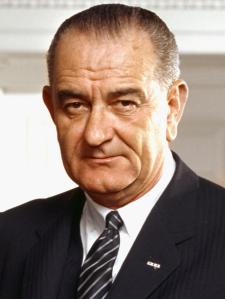
A similar link was created by LBJ in enacting the medicare program. LBJ effectively permanently changed health care in the United States and effectively amended the constitution by structuring it as a permanent entitlement.  Of Medicare he said:

And through this new law, Mr. President [referring to Harry Truman], every citizen will be able, in his productive years when he is earning, to insure himself against the ravages of illness in his old age.

These changes in the financial structure of America have wrought permanent change in the power balance among and between all wage
President Johnson

earners and all former wage earning retirees.  These were created without having engaged in the rigorousness of amending the constitution to enshrine those fundamental changes as the province of the federal  government.  As contemplated by FDR and LBJ, these programs admit to little control by the present generation of taxpayers while the beneficiaries, retirees, still live (vote) and in the meantime each new generation become beneficiaries themselves by just paying their taxes.  Therefore, the working citizenry are bound, semi-permanently, to pay the bills of retirees until they too impose this burden upon the working generation behind them.  Not constitutional perhaps, but certainly permanent.

In his last paragraph, Romano glowingly quotes from Jefferson’s letter to Samuel Kercheval in 1816.  Romano quotes Jefferson as supporting the idea that a constitution should not be beyond amendment and that each generation should be accorded the deference to handle its own affairs.  Romano, without even acknowledging the lack of amendments supporting his view of the extraordinary increase in federal power in recent years,  concludes his recitation of Jefferson’s observation with the term, “Amen.”  One could take from this quotation, and it’s rather emphatic adoption, that Romano thought the Kercheval letter an example of excellent insight and public spiritedness.  I suspect that Romano agrees with only a narrow slice of Jefferson’s ideas because most of the letter contains insights of great comfort to the Partiers.  For instance, Jefferson rails against a generation of leaders who would bind a succeeding generation with “perpetual debt” exhorting each  generation creating a debt to work as hard as necessary to discharge it.   Social Security, Medicare, Medicare Part D and Obamacare are all examples of permanent entitlements which resemble the permanent debt so decried by Jefferson.  And these entitlements by design will never to be “paid off.”  In fact in the Kercheval letter Jefferson expressed his private belief that amendments should be made every twenty years or so to permit each generation, “. . . a right to choose for itself the form of government it believes most promotive of its own happiness, . . . .”  This is exactly the opposite of the burdens represented by these entitlements, as well as the $13.5 Trillion national debt itself, which have been bequeathed upon the current and future generations.  Is Romano even aware of the irony of using Jefferson’s letter as support for his view of a malleable constitution?

Finally and most importantly for Partiers to remember is another section from the Kercheval letter.  Jefferson clearly values the “republican” spirit of the people over the republican form of government which the constitution created.  Said the third president,

Where then is our republicanism to be found? Not in our constitution certainly, but merely in the spirit of our people. That would oblige even a despot to govern us republicanly. Owing to this spirit, and to nothing in the form of our constitution, all things have gone well. But this fact, so triumphantly misquoted by the enemies of reformation, is not the fruit of our constitution, but has prevailed in spite of it. Our functionaries have done well, because generally honest men. If any were not so, they feared to show it.

It is this spirit which Jefferson believes defends the concept of liberty and limited government.  And whether the Partiers are consciously aware of it or not, it is the revival of this spirit which will defend our liberties.  Partiers would no doubt prefer it if “a return” to the Constitution were possible which, once accomplished, would permit them to rest easy with their liberties.  Unfortunately, as Jefferson believed, this will never be the case.  The price of freedom is constant vigilance.  It is of this Tea Party-type constitutional spirit rather than of the explicit terms of an ancient document which the current crop of politicians ought to be concerned as the primary threat to political business as usual.

Why Do You Need To Love Your Neighbor?

September 2, 2010

Last Saturday my beautiful wife and I attended Glenn Beck’s “Restoring Honor” rally at the Lincoln Memorial. 

8/28 Rally at 10:01 EDT

Although nonjoiners by nature we decided to attend the rally when it was first announced in order to demonstrate our support for and draw strength from the gathering and the message.  The message, as we understand it is indirectly political but primarily moral and spiritual.    And finally we wanted to prompt open and honest dialogues about the importance of liberty to the moral and spiritual realities of everyday life.  

By taking public and tangible action we chose to accept the slings and arrows of being labelled racists, homophobes, hatemongers and idiots.  While it is true that there are few who know us who will easily believe that we are any of those things, new acquaintances and passing acquaintances are another matter.  We have acted and will continue to act openly, despite the danger of overt hostility and villification, in order to challenge people to examine the validity and the counter productivity of such marginalizing labels and to create the possibility of at least some open dialogue with those who may be willing to give us the benefit of the doubt.     

When we decided to attend we did not realize that this would be held on the 47th Anniversary of MLK’s “I Have a Dream” speech although there was obviously a connection based upon the venue, the Lincoln Memorial. Shortly before the event, complaints were lodged about the fact that the date for the event coincided with that of Dr. King’s speech and there were calls for rally to be rescheduled.  What did I think about that?  Certainly I meant no disrespect to the memory and legacy of MLK by attending this rally.  In fact, I also believe that a group with a message such as ours, peaceful and loving, would have been welcomed by him especially since his niece, Alveda King, a civil rights advocate in her own right, was to join us at the mall.  I even went so far as to review the famous “I Have a Dream” speech to see in advance whether what we were doing could be misconstrued.  It’s well worth the 17 minutes to watch it.   

Apparently the fact that the rally would be held on the “I Have a Dream” anniversary and the fact that Glenn Beck is outspoken in his ideas for reforming the government into a form more like it’s original one caused Al Sharpton to respond with the idea that Beck was attempting to coopt the legacy of King’s speech.  He explicitly charged that the Beck ideas of a limited federal government directly contravened MLK’s own views, as stated in his speech, that the federal government was the instrument necessary to protect the rights of blacks.  Says Sharpton:

http://www.youtube.com/watch?v=pHJqaICiS-U  

Of course, as Sharpton contends, there is reference in MLK’s speech to George Wallace’s seeking to invoke the “interposition” and “nullification” concepts of state’s rights, but I challenge you to watch the brilliance of the entire speech and not conclude that the speech was primarily directed at changing the hearts of both blacks and whites.  The blacks towards a commitment to non-violence and the whites to a commitment to fair and equal treatment of all people in their day to day lives.  Whether at lunch counters or at motels or hotels, what he invoked was the dignity which each person has the right to expect from every other person, regardless of color or any other attribute.  King’s language, his “symphony of brotherhood” evokes a magnificent and uplifting idea of humanity.  The image of children of former slaves and former slaveowners sitting down together evokes an inspiring idea of a new day.  I suppose it is possible that the statement that blacks would not be satisfied until “justice rolls down like waters and righteousness like a mighty stream” could be understood to mean that he was asking the writing of new laws.  He could have been, I suppose, only calling for the creation of causes of action on behalf of blacks to sue for discrimination.  He could could have further intended this statement to call only for the empowerment of the justice department to punish racial wrongdoers.  However, no one who understands how lawyers use the teeth of the law can very well believe that this action would have satisfied King or the oppressed for whom he was speaking.  King’s language, invoking the idea of a symphony and seeking a time when “justice rolls [. . . ] and righteousness flows” was clearly a call upon the entire American people to change, not just the ones who could otherwise be threaten with suit or prosecution.  Each molecule of the water he called upon had to act individually but also as a part of larger body of water moving in the same direction toards the same end.  It can be interpreted, I truly believe, only as a call to action by us all.  A call upon people to banish the unjust ideas held within their own hearts and minds and to act as if they had been bathed in the cleansing power of God.    

Dr. Alveda King, a keynote speaker at the event, had this to say beforehand.

As readers of this blog know, I am of the opinion that a clash of worldviews has led us to the point we find ourselves in this country — at knifepoint over everything.  Like Alveda King, I believe that we need to have a place to start the discussion.  If we continue to refuse to listen to one another, or to villify everyone who disagrees with us in order to stop listening to them, we’ll never reach accommodation.  Backlash and counterbacklash ad infinitum will be inevitable.  This country simply won’t survive as the land of the free and the home of the brave.

What I heard from the stage on Saturday was a call to return to a God-centered country.  Not a theocracy, which is God rule through the men and women on top, but a call to God ruling His people through a liberty-loving, reformed populace.  Unlike the progressives (yes, I’m making a political comment here) I believe in allowing people to exercise their God-given right to liberty but that right comes with God-imposed responsibilities.  These include treating others everyday with dignity, respect and justice.  Can agnostics and atheists and non-Jew non-Christians be accommodated and respected in a country with a citizenry of an overwhelming Judeo Christian focus?  I have no doubt.  Why?  A commitment to the stated values of an unseen but personally experienced God requires this.  He requires that in addition to loving Him, that you love your neighbor as yourself.  Doesn’t this love require treating everyone as you would have them treat you?  Both the New and Old Testaments require this:  Matt 22: 37-39; Leviticus 19: 18 and 34; and Deuteronomy 10: 19.  Would not then a commitment to honor and truth in our own lives not solve the problems which Al Sharpton points out?  Of course it would.  Was this God focus not the source of the brotherhood being invoked by Dr. King?  Yes and in such a nation, a nation where the people can once again be trusted with the power to run their own lives, we will all be blessed.   

If MLK was seeking lawmaking and not soul making when he came to the Lincoln Memorial on August 28, 1963 he certainly chose an imperfect and counterproductive device.  Manmade laws cannot replace the obligation of abiding by the God made law of treating one another with dignity and respect.  Such laws as man makes for the control of his brother will in many ways be imperfect and at times be used by lawyers and others to inflict great harms.  It is the way of such things.  After all, in a courtroom it is not the truth but the proof (among other things) which prevails.  When Dr. King stood on the steps of the Lincoln Memorial, was he merely looking to men on the other end of the mall in the capitol building to act or was he looking to everyone to act in brotherhood towards one another?  If you watched the MLK speech which I embedded above, I think you know the answer.  And, whether he wanted manmade laws or not, Dr. King, the man of God, was certainly calling upon the spirit of God in every man’s (and woman’s of course) heart to reach out to his neighbor and love him.  Dr. King reached me again on August 28, 2010.  Thanks to Glenn Beck and Alveda King and 500,000 brothers and sisters.  Have faith.

UPDATE: CROSSWINDS AT GROUND ZERO

August 18, 2010

Speaking of Nancy Pelosi, she has now weighed in on an aspect of locating the mosque at Ground Zero.  The implication of her statement is that bigots who are trying to stir up other bigots should be investigated and that thoughtful non-bigots like herself should remain unconcerned with the affront.  It’s one thing to be aware that there is nothing which can or should be done through the law to prevent this provocative action.  It is quite another to wonder about “who is funding” this “issue.”  It is a legitmate and newsworthy story which really doesn’t need a lot of “funding” if an active press, much of it New York based, pursues it.  Also, what the heck is this Treasure Island that she talking about  that is so much more newsworthy? 

I’m pretty sure that if this mosque ever gets located at Ground Zero she’ll be blaming the groundswell of anger on the people who are angry hoping for anti-Islamic violence which she can tear up about and use to justify some sort of restrictive legislative action!!!!  What of her former concern about stirring up a climate in which “violence occurs?” She is just plain out of touch with reality as well as flyover Americans.

CROSSWINDS AT GROUND ZERO

August 16, 2010

It is really interesting to see the media and politicians pontificating about  the issue of “permitting” observant Muslims to build a mosque at Ground Zero.  The positions create crosswinds on the part of the political/media class which cause some of them to contort their thoughts in nearly unrecognizable ways.  Let’s examine some of the issues presented.

The first thing to do is to boil down the legal issue.  Can we “not permit” the building of the mosque at Ground Zero?  The legal question is how can the building of a mosque be prevented in a world where owners generally have the right to use their own property as they see fit.  In this instance, of course, private property will be utilized by a religious sect for non-violent religious purposes.  Do we even have to get to the idea that the bill of rights prohibits legal impediments against the free exercise of religion when somebody is using their own property for any lawful purpose?  Although the religious purposes to which the property will be used are well known, the fact is that the use is religious only adds strength to the legal right of owners to use  their property for their own purposes.  This, according to the Republicans I know, is as clear a right as any right guaranteed to us in this country.  The use of this property as a mosque violates no law which the state or city of New York have enacted.  It poses no direct threat to public health or safety.  Hence, to me, the organizers appear to have the clear legal right to establish a mosque on their land even though others are offended. 

Notwithstanding the obvious legal rights of the owners, a Republican candidate for governor, Rick Lazio, opposes use of the property for the stated religious purpose.  What gives, are Republicans advocates of property rights or not?  Or is this just another issue of electoral politics trumping principle?  By what legal authority does Lazio advocate the state of New York investigate the “funding sources” for purchase of the property and construction of the mosque?  What is he hoping to find?  Is he suggesting that there is probable cause to believe that the mosque will be used as a staging ground for terrorists?  Or, is he suggesting that the so-called “victory” mosque should be stopped solely because it’s location hurts the feelings of New Yorkers because the 9-11 terrorists were unanimously Islamic and they cloaked their terror in a religious veil?  Does the fact of bruised feelings raise issues limiting the rights of property ownership, religious rights or the free speech rights of the mosque site owners?  I think not, the organizers are within their legal rights to build it and worship in it unless American law changes.  Do we really want those changes at a fundamental level?  Regardless of what Lazio says, aren’t we all better off respecting the rights of Muslims to do this even if we think it’s a poke in the eye?  What rights  will we be giving away if we insist that the Muslims have no right to build their mosque?  But, you say, this is a special situation.  Does that change fundamental constitutional rights? I don’t think so.  But if she spoke up, Speaker Pelosi and her ilk may have a different opinion as to the extent of the rights of the Muslims to build their mosque or at least she would if she were being consistent.  Let me explain.

What could be motivating Muslims to spend $100 Million to build a mosque on a site where they know American feelings will be terribly hurt and their anger stoked?  This is the real emotional belly of this matter, isn’t it?  Could locating the “victory” mosque at Ground Zero be seen by some as a tangible sign that Islam has triumphed over the Great Satan?  Do Americans have the right to take such a perceived motivation, whether intended or not, as an affront to themselves, their country and to the victims of 9-11?  Are Americans required to accept at face value the protestations of the organizers that the mosque’s location means no such insult and is in fact an outreach of brotherhood?  Does the fact that this perceived insult hurts American feelings create a potential for anger and hence indirectly increase the possibility for violence?  Is it fair to say that because this insult appears in the eye of the beholder, after all the organizers having eschewed such an intent, that the beholders are bigoted to take it as such?  Can Americans, who don’t even believe in the concept of face, believe that they will lose face by allowing Muslims to build at Ground Zero?  Of course, just because an insult is implied and not stated are you not within your own rights to be offended?  Says Ms. Pelosi, however, about the creation of a previous climate of violence:

What sort of responsibility do you think Ms. Pelosi would have in mind if the “victory” mosque creates an atmosphere of violence notwithstanding the protestations of the builders?  Or, do you think she might be among the first to blame the people acting violently rather than the builders of the mosque?  The climate of violence leading to the murder of Harvey Milk by another gay man causing Ms. Pelosi to briefly tear up on camera would, I believe, pale in comparison to the climate created by the mosque being built at Ground Zero.  I think that the would be builders know this very well but refuse to acknowledge the legitimate concerns of New Yorkers and Americans at the implications of  building a mosque at Ground Zero.  Ms. Pelosi’s silence on this powder keg issue, where she was previously so outspoken against those using villifying language in the health care debate, speaks volumes.     

Another interesting take is the Republican candidate for the governorship of New York, Carl Paladino, who has suggested that the state use it’s power of eminent domain to condemn the land for “public use.”  Of course, former Supreme Court Justice Stevens, author of the majority opinion, might not want the private property rights of these Muslims to be invaded by the state but in Kelo v. City of New London he established the precedent allowing private property to be taken from one owner and given to another if the city will benefit financially.  After all, this lower Manhattan property is highly valuable for commercial and therefore taxable uses which would benefit the city much more than a mosque at the site.  Such commercial use would generate higher sales tax receipts and probably much higher income taxes for the city.  If this is not done the property will essentially be taken off the tax rolls by reason of the establishment of a “church” at the site.  Why not condemn and then sell the property for commercial and therefore taxable purposes?  If the people of New York want to prevent this mosque being built on “hallowed ground” a few bucks ought to do the trick and the US Supreme Court has led the way with its ruling in Kelo v. City of New London.  This is a result which the rather left of center justices who supplied the bulk of the votes in favor of the city of New London most likely would not have desired but, I imagine, would fall within the letter of their law.  It is also interesting that a Republican candidate for governor, a lawyer – real estate developer, would want the government more involved in decisions concerning the uses to which private property may be put. 

And then there is President Obama, chief magistrate of the entire country weighing in on what is no more than a local land use issue.  Reminds me a little bit of the silly Republican intervention in the case of  Terri Schiavo.  You remember that the Congress intervened in this case which was certainly an issue of personal importance to the family and a case providing 24/7 media coverage but not an issue rising to the level of being addressed in the national legislature.  Of course, the intervention of the president in favor of the building of the mosque contradicts the very same arguments made by fellow progressive Congressmen Frank, Waxman and Wexler Congress during the Schiavo affair that the matter does not rise to the level requiring congressional action.   

And then there’s the extremely strange charge of bigotry leveled by the media against Ground Zero mosque opponents.  How can the people who oppose the mosque on offensiveness grounds be legitimately called bigots?  First it must be decided that a reasonable person would never possibly find the mosque’s creation at Ground Zero offensive.  If anyone answers this question in the affirmative I think that they should forfeit their right to call themselves thinking human beings.  A large majority of those Americans polled believe that the mosque should not be located at Ground Zero.  Such a majority of Americans are unreasonable?  I don’t think so.  Hence, the twisting of the idea of bigotry and racism to fit this scenario is just another shopworn effort by media pundits to cast the rest of us as ignorant, unthinking boobs in need of leadership by the anointed.  Flatly arrogant?  I think so.  

In any event, there are two trains headed in opposite directions on the same track.  One train has the clear legal right of way.  The other has the hearts of the people riding on it.  This is a very dangerous situation and I believe it to be a calculated effort by those who seek to build the Mosque in order to provoke us.  In effect they are self selecting themselves as enemies or at least as those who would give aid and comfort to our enemies.  Our politicians are not helping the situation, stirring up passions by suggesting that we can legally avoid this use of the land without fundamentally changing the nature and extent of our own liberty.  Fortunately, in the same Fox News poll finding that 64% think it wrong to build a mosque at Ground Zero, the majority also realize that the Muslims who own the property have a right to build it there.  If we can simply accept the pain of “permitting” a mosque to be located at Ground Zero, this too shall pass.  Ignore the politicians and the media, the rest of us are grown ups.

The Supreme Court Legislates From The Bench, Again

July 8, 2010

Notwithstanding what you know or believe you know, it is the application of the Supreme Court’s so-called “incorporation doctrine” and not the 2nd Amendment which was the focus of the case striking down Chicago’s gun ban.  In McDonald v. City of Chicago the Supreme Court decides that state governments may not deny you, as represented in the case by Otis McDonald, the right to own and have a hand gun in your own home.  This is only an extension of the 2009 case, District of Columbia v. Heller, in which the Court held that the individual right to own a gun is protected against federal infringement.  

Otis McDonald

It is surprising to most that once Heller was decided that McDonald even needed to be addressed.  However surprising, the Bill of Rights was not originally intended to apply to the states but was designed only to restrain the power of the federal government.  The Supreme Court recognized this fact in 1833 in a case holding that the City of Baltimore could take private property without compensation to the owner which would otherwise have violated the Fifth Amendment’s takings clause, to wit:  “. . . nor shall private property be taken for public use, without just compensation.”  The need for the Court to decide whether the 2nd Amendment, once found applicable to the federal government, also applies to the states seems a non-question to most Americans.  That this issue would even need to be addressed by the Supreme Court seems odd and anachronistic in a world in which the federal government is universally considered the master and the states the servants.  This is their emotional reaction even though many are intellectually aware that the First Amendment provides,

Congress shall make no law respecting an establishment of religion . . .” etc.  [Emphasis added.]

We the people have just not followed the arcane legal basis of the evolution of the Bill of Rights into being generally applicable to the states as well as to the federal government.  There’s been no popular press coverage of this legal issue.  It has happened almost silently as far as the public is concerned.

There are four different opinions in McDonald written by the nine justices and they cross reference things they agree with in one another’s opinions.  Therefore, there are more than four opinions held by the nine.  Wow, huh?  So much disagreement over such a fundamental issue of our constitutional fabric of which the public is almost totally unaware.  How can this be?  What happened that there is still such a broad divergence of opinion on the Supreme Court in 2010?   Why hasn’t this been solved yet after about 220 years.  What has changed? Why aren’t we all on the same page about this by now? 

This is why.  The “what happened” is the adoption of the Fourteenth Amendment in 1868, passed in order to protect former slaves from the actions of the seceding states in the wake of the Civil War.  The Fourteenth Amendment explicitly modified the thirteen previous amendments and the power sharing envisioned by the rest of the constitution when it provided:

No State shall make or enforce any law which shall abridge the privileges or immunities of citizens of the United States; nor shall any State deprive any person of life, liberty, or property, without due process of law; nor deny to any person within its jurisdiction the equal protection of the laws.

We’ve been struggling for 132 years with the ramifications of these words.  How do they apply and what do they restrict?  Do these words amount to a “fairness” requirement for life in the US with the federal courts acting as umpires?  How does the 14th Amendment’s protection for the privileges and immunities of US citizens as well as the due process and equal protection of law interact with the “rights” of US citizens some of which are protected in the Bill of Rights?  What are privileges and immunities anyway?  How does the 14th Amendment dovetail with the first eight amendments and especially the Ninth which provides as follows:  

The enumeration in the Constitution, of certain rights, shall not be construed to deny or disparage others retained by the people.

The broad language of the 14th Amendment is subject to expansive interpretation by federal courts when they are asked to provide protection against actions of the states.  Into the breach, to remedy the lack of specificity of the Fourteenth Amendment, the Supreme Court has thrust a doctrine which correlates the due process requirements of the 14th Amendment with the protections provided by the Bill of Rights.  The so-called “incorporation doctrine” effectively grafts (incorporates) most of the individual rights protected by the Bill of Rights into the 14th Amendment, a doctrine which is then used to restrict the ability of the states to manage their own affairs.  As such the ‘incorporation doctrine’ has effectively been used to limit the power of the states since at least 1933.  It is the use of this doctrine in this manner which has been decried by many as federal courts “legislating from the bench.”

I find myself in substantial agreement with Justice Stevens dissenting opinion in McDonald.  This is odd since it is people philosophically aligned with me who complain most bitterly about federal courts “legislating from the bench.”  We do not usually agree with Justice Stevens.   Stevens in his dissent argues for restricting the scope of the 14th Amendment in a principled fashion without reliance on the fact that certain individual rights have been protected by the Bill of Rights, to wit:  

The question we should be answering in this case is whether the Constitution “guarantees individuals a fundamental right,” enforceable against the States, “to possess a functional, personal firearm, including a handgun, within the home. That is a different—and more difficult—inquiry than asking if the Fourteenth Amendment “incorporates” the Second Amendment

Showing the partisan divide of the Court while writing for the plurality Justice Alito spurns Stevens’s outreach to reconsideration of decades of poorly reasoned precedents calling his dissenting opinion “eloquent” but, with a nearly visible sneer, stating :

As we have explained, the Court, for the past half-century, has moved away from th[is] . . . approach. If we were now to accept Justice Stevens’ theory across the board, decades of decisions would be undermined. We assume that this is not what is proposed. What is urged instead, it appears, is that this theory be revived solely for the individual right that Heller recognized, . . .  [Emphasis added.]

Alito may be correct as to duplicitous motive behind the Stevens dissenting opinion.  Such a motive is made more likely because Stevens is now retiring from the Court and will not be voting to reconsider earlier precedents on the basis stated in that dissent.  (Among hundreds, subjects of reconsideration would be cases involving school prayer, abortion rights, rights of homosexuals, and even the rights of free expression of high school students).  I am not naive but it seems unfortunate to me that a non-partisan outreach to reconsideration of decades of questionable decisions could not have been accepted at face value and honored for what might have been.