Archive for the ‘Debunking Economic “Common Knowledge”’ category

Something Perverse About Aid to Africa And Perhaps in America Too

January 10, 2013

Europeans and Americans sacrifice in order to make the lives of poor Africans better. That’s a picture we all have in our minds about the practice of altruism. Could this ever be anything other than good? Why is it that we focus on the “sacrifices” of Europeans and Americans” rather than upon the lives of Africans whom we seek to make better? What does this say about Americans and Europeans and what does it say about Africans?

First of all have a look at this Der Spiegel interview with African economist James Shikwati.

http://www.spiegel.de/international/spiegel/spiegel-interview-with-african-economics-expert-for-god-s-sake-please-stop-the-aid-a-363663.html

The reality of aid to Africa says something both good and bad about Europeans and Americans. First, it says that Americans and Europeans are willing to live less well than they could in order to provide a better life to Africans. We are virtuous, willing to sacrifice, that’s good right? Yes, that’s good but the other thing which it says about us is that we don’t really care about the real world effect our aid has upon the Africans whom we seek to help. We focus on the sacrifice which we are willing to make which makes us good persons in our own minds without focusing upon the real world effects of this sacrifice. In order to link our sacrifice to actual good outcomes of the Africans whom we seek to help we would actually have to do a good bit of personal work and this is where we fall down. We will give our money but we won’t give our consistent time and attention in order to see that our money is used in a way which improves African outcomes. We care more about how we feel having made a sacrifice than we care about how the Africans feel after being “helped” by us. We outsource the job of taking care of our neighbors, the Africans. We’re still good people, aren’t we, even if our aid dollars do some real damage to the people who we supposedly want to help by our sacrifice? I’m not so sure. Like the Hippocratic oath taken by doctors, shouldn’t we first seek to do no harm.

But what does this situation say about Africans? Why do they accept the aid if it actually harms them? It says that the Africans who suffer are not the same Africans who have a voice in the acceptance and allocation of aid. Some Africans, of course, are better off by reason of aid, the people in charge, and some people are not better off, the followers and people who lose jobs and who don’t really receive much, if any, benefit from that “aid” anyway. Remember the good intentions of our intervention in Somalia, to see that our aid got to the people and not to the warlords. It says that Africans are not any different than Americans. Those in charge seek to maintain the status quo and those who are not in charge don’t really know how to change that.

I think that this also says something about our recent national election. Americans seem to have voted for a nation where the poor population is helped by the government. I believe that the majority of people who voted for the current Democratic President really want the country to be a place where national sacrifice is somehow connected to bettering conditions for the Americans who are now in poverty or otherwise disadvantaged. The problem is that as a population we really don’t understand how the economy works for us all as an integral whole. We divorce jobs from entrepreneurs. We divorce success from incentive. We divorce work from money. We don’t understand (or apparently even care about) the concept, actually the law, of unintended consequences. We just have no hard headed education in economics even though we are regularly asked to vote about what economic policies to enact through our government. We vote our emotions. We don’t connect good outcomes with good intentions because we don’t understand how and the price of doing so is too high, personal study. We prefer to rely on people we “trust” to study these issues for us and tell us what to think. Can you blame a good hearted people, sorely lacking in economic understanding, for voting for the highest minded altruistic soundbite? Can you blame us for voting to take money from some selfish “rich” or “ultra-rich” people “who don’t really need the money” even though they are not quite sure how, exactly, this will improve the lot of the poor and disadvantaged? What has been a problem for Africa for decades, unintended consequences, will undoubtedly have a similar effect on us here in the U.S. in the wake of the 2012 election. Good intentions are not the same as sound economics. I’m afraid we’ll be finding out how this works and in fact are even now experiencing this reality. I pray that we will learn from our mistakes and make better decisions, as individuals when deciding where to send our aid, and as a population when deciding who to elect, in the future.

Happy New Year.

THE REAL MEANING OF BANKRUPTCY

August 20, 2012

I think that bankruptcy must be a misunderstood concept. In the Joe Soptic commercial (the commercial about how Bain Capital and Romney closed Soptic’s steel plant after siphoning out all of the money leading to the death of Soptic’s wife) bankruptcy and the idea of plant closing are conflated by focusing on the plant being “loaded up with debt” causing the plant to shut down. A permanent plant closing should be based upon whether the plant has value as a going concern, not whether the owner has accumulated debt. In other words, if a plant can produce and sell its products at a profit, there should be a mechanism for capturing this value. This is bankruptcy. Under bankruptcy rules the insolvency of the owner will not end its economic life of the plant but merely transfer ownership. What bankruptcy essentially does is shift ownership of assets, like factories, from an insolvent debtor to the debtor’s creditors or to others who buy the business from the bankruptcy court. This is the very idea of bankruptcy including the oft heard term ‘Chapter 11.’ When the value of a business as an ongoing concern exceeds the value of the same business when sold for its constituent parts, bankruptcy allows an orderly transfer of the underlying business in a way which protects its value for the benefit of the owner’s creditors. What happened with Soptic’s plant was that it was closed because it was no longer economically viable even if it is true that excessive debt was incurred by the company owner’s, including Bain, in the years leading up to the end.

As an example, see what happened to GM after its pre-packaged bankruptcy. GM went through bankruptcy and is now making “record” profits. It is once again number one in the world. But how can this be possible, the old owners of GM stock lost all of their equity, their stock certificates became worthless. Well, creditors like the US government* got 61% of new GM for about $50 Billion advanced. The unions got 17.5% for $20 Billion owed by old GM to their medical care trust fund. The bondholders got 10% for the $27 Billion that they loaned. Other creditors, including the people injured by GM products manufactured by the old GM got a percentage as well but they lost any right to sue the GM which emerged from bankruptcy. This is what bankruptcy is about. There was a small difference, though, between GM and other Chapter 11 bankruptcies. Notwithstanding the GM bankruptcy its union contracts remained intact. Contracts of any type can be broken or modified by the bankruptcy judge if it is in the best interest of the new company. The “loser” with the broken contract becomes a creditor of the old company, as with the $20 Billion owed to the UAW’s health care trust. But in this case, the union contracts were left intact to follow the new GM. And in fact, in 2011, the GM union contracts were even extended by agreement with the management of new GM, including the US government. But, even if the GM bankruptcy was unfair to bondholders and overly generous to the old GM’s unions, the effect of bankruptcy was that the new owners replaced the old owners and the company continued as a going concern. And that’s what I’m talking about.

*Of course, there was a enormous bailout from the US government involved in GM’s bankruptcy. Bailouts are unusual, notwithstanding President Obama’s campaign touting of the GM model, and such bailouts are really unnecessary in most cases. Other buyers were interested in GM but not in its union contracts. If businesses are economically viable after the bankruptcy judge eliminates burdensome contracts and debts, they can continue. In the GM bankruptcy it was the unions which were bailed out (the collective bargaining contracts were hardly touched) but the equity of the stockholders was destroyed. New GM was created to ‘buy’ the business of old GM but with collective bargaining agreements in place to carry on the business. And so it goes.

Gas Prices and Flat Earthers

March 17, 2012

I’ll bet that you’ve noticed that oil prices and gas prices have been increasing lately. The president and his Republican potential opponents have noticed too. Not surprisingly the president and the Republicans disagree about solutions. The president proposes a bold-sounding “all of the above” strategy which involves government intervention on multiple levels and a free hand for government to pick economic winners and losers. The Republicans on the other hand generally propose a much greater role for the free market in their strategies although they are also far from eschewing all government intervention in the free market. In response to the Republicans’ free market arguments the president suggests that the free market strategies are as mythical and fallacious as the idea of a flat earth.* Hear he is (yes it’s a pun).

The president’s “all of the above” strategy includes loans and guarantees for solar companies like Solyndra and the latest bankrupt, Beacon Power Corp. He likes wind power, as provided by the windmills his policies subsidize which are produced by his buddies like Jeff Immelt at General Electric. He also likes the Chevy Volt, which made by Government Motors, which is now subsidized by a $10,000 federal tax credit and which has been purchased in quantity only by his friend Jeff Immellt at General Electric.

If you haven’t heard of it I would like to introduce you to a discipline called public choice theory or public policy economics. It deals with political choices made about economic matters when it appears that the “market fails.” Rather than actually describing it for you, I’d like to leave it to Dr. Mark Pennington to talk about public choice theory and the idea that the manner in which politicians and voters engage in public policy decision-making often results in outcomes which are counter-productive.

The president’s “all of the above” strategy is nothing other than embracing the idea that the government should deeply involve itself in economics and markets in ways which will definitely affect outcomes for us all. He, of course, believes, that the free market in energy has ‘failed’ or is at least in the process of ‘failing.’ He also apparently believed this even before the recent spate of gasoline price rises.** Following his heart he has tried his hand at passing carbon trading (cap and trade), fostering green “start ups” like the aforementioned Solyndra and getting on the bandwagon for the electric car. He may very well believe in what he says he believes in, but even if the government is right that the market has in some ways failed, public choice theory asks the next logical question, why should we believe that the government should effectively take over all or a majority of the decision-making about this issue? At least one outcome, probably the highest probability outcome, is that government will only end up spreading the costs of these policies among all citizens and inhabitants and focusing the benefits of the government’s action upon those who are supporters of the politically powerful, like the CEO of Solyndra and Jeff Immelt and the union members of GM whose pension plans are still being funded while the common stockholders of GM lost their entire investment.

Let’s go a bit farther about the president’s idea of flat earthers. Flat earthers saw that the ground around them appeared to be flat, hence they reasoned that that flatness continued on ad infinitum. Was this rational? Yes. Was it correct? No.

The president and his ilk believe in macroeconomic planning. They know that people can make plans, like plans for a house, and that those plans usually work out, more or less. So, is it rational for them to believe that they can make a plan to achieve what is best for everyone in the country? I’d give them a very questionable yes on this only because not to do so would be too cynical even for me. Are they right about it though? No. Why are they wrong? There are several reasons. The first and easiest to understand is that the world is simply too complex to effectively plan for, because it has at its most simply understood level six billion moving parts. Beyond the sheer complexity of macroeconomic planning, how does Dr. Pennington see the effectiveness of government intervention in economic issues versus private decision-making?

I hope you’ve found the idea of public policy theory at least interesting if not wholly persuasive. The rest of Dr. Pennington’s talk at the Adam Smith conference in 2010 is on Youtube and I hope you’ll take a few minutes to become more familiar with these common sense theories.

*I do agree that there is a limited amount which the president can do to alter the pricing structure of gas at the pump for the near term. Interestingly, however, while the president as a candidate argued that what was necessary was a long term energy strategy to wean us off foreign sources of oil and increase use of green energy alternatives. at almost every turn this has meant that he has acted to slow down the development and exploitation of existing and newly discovered sources of hydrocarbon supply. Unfortunately (or it could be fortunately for the deficit) it appears that much of the potential for future exploitation and development is under government land or water over which the government has supervision and stands to make money. It is also curious that the president while at the same time touting his green energy strategy also touts the fact that he the US is actually producing more of its own energy resources than at any time in the last eight years due I might add to nothing of his doing. In fact his go slow strategy will only bear its own bitter fruit over the next half decade.

**Of course, Pres. Obama’s energy secretary Chu has previously been on record saying that he wants U.S. gasoline prices to increase until they reach those paid by the citizens of Western European nations, currently about $10 a gallon. In fact, the President himself has said that he doesn’t mind increasing gas prices, he just doesn’t want them to increase “too fast.”

Unemployment Compensation and Economic Growth

January 19, 2012

We have often heard lately from former House Speaker Pelosi, Presidential spokesman Jay Carney, and even the Secretary of Agriculture Tom Vilsack, that subsidizing consumption is economically creative and will create economic growth. How can that be you ask, paying people not to work seems inherently unproductive? Dr. Milton Friedman once responded to a questioner who asked a related question concerning taxes; he was asked whether high tax rates don’t force producers to find more and better ways to produce goods and services and isn’t that the value of high tax rates, to “spread the wealth?”

This is what Friedman had to say:

In other words, if you increase consumption without increasing production, the American people are not, in fact, better off. When you pay people who don’t produce things people want to buy at an affordable price, you do not make the country better off. You may indeed make some individuals better off, and in a short run this may even be desirable, but in anything other than the very short run, this is a net negative for the country. Is this not crystal clear?

THE DANGER OF ECONOMIC “COMMON KNOWLEDGE”

August 16, 2011

This post will begin a series of posts addressing the economic “common knowledge” of the American voter. The American voter has, particularly over the last 70 years, been asked to cast votes which require an education on basic economic matters. The level of education and interest which most voters have on matters of economics is frighteningly low. This leads to a public which can be easily manipulated to their own detriment. People don’t need to be Ph.D.’s in economics in order to vote intelligently but they must have a basic knowledge of how the economy works. They must know two things above and beyond all others. First, all resources are scarce and therefore cannot be put to every use imaginable. Second, never forget the TANSTAAFL rule. [There Ain’t No Such Thing As A Free Lunch, somebody always has to pay.] I will start this series by debunking, with the help of professor Mark Skousen, the profound myth that consumer spending makes up 70% of all spending in the United States in any given year.

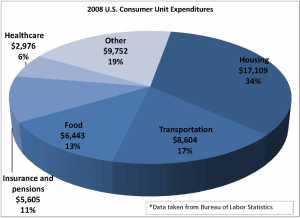
The single most ubiquitous macro-economic “fact” known to most people in this country is that consumer spending is the most important element of the U.S. economy because it makes up 70% of all U.S. spending. Armed with this unimpeachable knowledge and intuitively knowing that economic activity is good for everyone, the average U.S. voter embraces the idea that spending money on consumption is an

Average Family Consumption 2008

economic virtue. In keeping with their own personal “common sense,” they embrace the idea that the best macro-economic policies for the government to follow are those which cause consumption to increase. This policy provides both goods and jobs for everybody and let the good times roll!!!! Nancy Pelosi, Chris Matthews and Jay Carney are but a few of those in the media and high government service who have recently articulated this idea in public. Here is Jay Carney ‘schooling’ a Wall Street Journal reporter on this subject:

But what if this “fact” is not actually true but only true because of the way a statistic, the GDP, is calculated? How would this change our preferred policies?

Let’s first deal with the “fact.” Ph.D. economist and professor, Mark Skousen, has made this analysis:

[P]ersonal consumption expenditures represent 70 percent of gross domestic product, but journalists should know from Econ 101 that GDP only measures the value of final output. It deliberately leaves out a big chunk of the economy — intermediate production or goods-in-process at the commodity, manufacturing, and wholesale stages — to avoid double counting. I calculated total spending (sales or receipts) in the economy at all stages to be more than double GDP (using gross business receipts compiled annually by the IRS). By this measure — which I have dubbed gross domestic expenditures, or GDE — consumption represents only about 30 percent of the economy, while business investment (including intermediate output) represents over 50 percent.

Skousen, Mark. Consumer Spending Doesn’t Drive the Economy, Investment Does. Retrieved August 15, 2011 from http://www.mskousen.com/2010/05/consumer-spending-doesn%E2%80%99t-drive-the-economy-investment-does/.

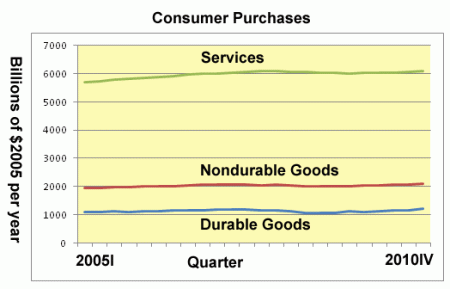
Let’s look at the economic statistics. The following graph is courtesy of the San Jose State University Department of Economics website (http://www.applet-magic.com/) which shows the relatively stable amount of consumption spending occurring in the economy during boom times and lean times.

U.S. Consumption 2005-2010

Whoa, that may blow a few minds so let’s see what this means. This means that subsidizing consumption is not actually the most important thing to American pocketbooks. The most important thing in the economic world is facilitating exchanges or trades of all kinds, including investments. This is because each trade leads to increases in the total of perceived value held by Americans because with each trade the parties believe that they have each gotten more than they parted with or the trade would not have occurred.

What public policies does this suggest? First, and most important, it suggests that government should adopt as few policies as possible which create incentive or disincentives for any particular type of economic trade over others. The more decisions and options which the American people themselves have without the government’s factoring into the equation, the more transactions and trades they will engage in overall. Following this prescription will lead, over time, to an increase in absolute number of trades among Americans and by definition an increase in the perceived value which exists in the economy overall. Over time this will allow the energy and creativity of Americans to be used in ways which create for themselves the world they want to see. If they are left to their own devices, they will work harder and longer to achieve their vision, it is human nature. This, in turn, will provide lift to all boats. That is what public policies on economic matters ought to do. But, pursuant to the TANSTAAFL rule, who will pay for this sort of freedom? The government and those who derive their sustenance from the government will pay, because the government will become less and less relevant to the economy and hence will lose some of the resources it now collects for itself. And who thinks this would be a bad thing?

BREAKING NEWS:
Secretary of Agriculture Vilsack was also touting Food Stamps as stimulus this morning on TV. Hey guys, why not just send every man, woman and child a check for a million dollars, on condition that they agree to spend it within one month, and $1.84 million in economic activity will be stimulated? If this transfer payment is such a good boon for the economy because people spend it immediately, let’s not stop with food stamps. Why not???? Man, these guys are so smart.