THE DANGER OF ECONOMIC “COMMON KNOWLEDGE”
This post will begin a series of posts addressing the economic “common knowledge” of the American voter. The American voter has, particularly over the last 70 years, been asked to cast votes which require an education on basic economic matters. The level of education and interest which most voters have on matters of economics is frighteningly low. This leads to a public which can be easily manipulated to their own detriment. People don’t need to be Ph.D.’s in economics in order to vote intelligently but they must have a basic knowledge of how the economy works. They must know two things above and beyond all others. First, all resources are scarce and therefore cannot be put to every use imaginable. Second, never forget the TANSTAAFL rule. [There Ain’t No Such Thing As A Free Lunch, somebody always has to pay.] I will start this series by debunking, with the help of professor Mark Skousen, the profound myth that consumer spending makes up 70% of all spending in the United States in any given year.
The single most ubiquitous macro-economic “fact” known to most people in this country is that consumer spending is the most important element of the U.S. economy because it makes up 70% of all U.S. spending. Armed with this unimpeachable knowledge and intuitively knowing that economic activity is good for everyone, the average U.S. voter embraces the idea that spending money on consumption is an
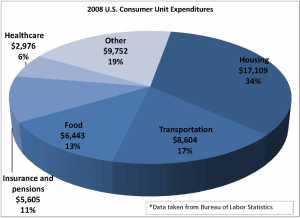
Average Family Consumption 2008
But what if this “fact” is not actually true but only true because of the way a statistic, the GDP, is calculated? How would this change our preferred policies?
Let’s first deal with the “fact.” Ph.D. economist and professor, Mark Skousen, has made this analysis:
[P]ersonal consumption expenditures represent 70 percent of gross domestic product, but journalists should know from Econ 101 that GDP only measures the value of final output. It deliberately leaves out a big chunk of the economy — intermediate production or goods-in-process at the commodity, manufacturing, and wholesale stages — to avoid double counting. I calculated total spending (sales or receipts) in the economy at all stages to be more than double GDP (using gross business receipts compiled annually by the IRS). By this measure — which I have dubbed gross domestic expenditures, or GDE — consumption represents only about 30 percent of the economy, while business investment (including intermediate output) represents over 50 percent.
Skousen, Mark. Consumer Spending Doesn’t Drive the Economy, Investment Does. Retrieved August 15, 2011 from http://www.mskousen.com/2010/05/consumer-spending-doesn%E2%80%99t-drive-the-economy-investment-does/.
Let’s look at the economic statistics. The following graph is courtesy of the San Jose State University Department of Economics website (http://www.applet-magic.com/) which shows the relatively stable amount of consumption spending occurring in the economy during boom times and lean times.
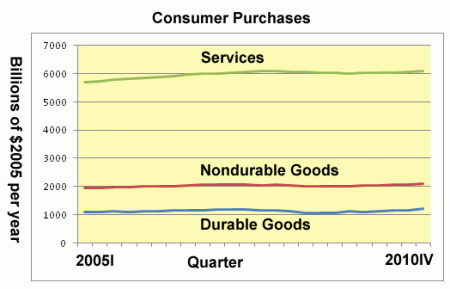
U.S. Consumption 2005-2010
Whoa, that may blow a few minds so let’s see what this means. This means that subsidizing consumption is not actually the most important thing to American pocketbooks. The most important thing in the economic world is facilitating exchanges or trades of all kinds, including investments. This is because each trade leads to increases in the total of perceived value held by Americans because with each trade the parties believe that they have each gotten more than they parted with or the trade would not have occurred.
What public policies does this suggest? First, and most important, it suggests that government should adopt as few policies as possible which create incentive or disincentives for any particular type of economic trade over others. The more decisions and options which the American people themselves have without the government’s factoring into the equation, the more transactions and trades they will engage in overall. Following this prescription will lead, over time, to an increase in absolute number of trades among Americans and by definition an increase in the perceived value which exists in the economy overall. Over time this will allow the energy and creativity of Americans to be used in ways which create for themselves the world they want to see. If they are left to their own devices, they will work harder and longer to achieve their vision, it is human nature. This, in turn, will provide lift to all boats. That is what public policies on economic matters ought to do. But, pursuant to the TANSTAAFL rule, who will pay for this sort of freedom? The government and those who derive their sustenance from the government will pay, because the government will become less and less relevant to the economy and hence will lose some of the resources it now collects for itself. And who thinks this would be a bad thing?
BREAKING NEWS:
Secretary of Agriculture Vilsack was also touting Food Stamps as stimulus this morning on TV. Hey guys, why not just send every man, woman and child a check for a million dollars, on condition that they agree to spend it within one month, and $1.84 million in economic activity will be stimulated? If this transfer payment is such a good boon for the economy because people spend it immediately, let’s not stop with food stamps. Why not???? Man, these guys are so smart.
 Short and Sweet Blog