Archive for July 2011

THE RUSE OF BLAMING IDEOLOGY

July 31, 2011

Last Monday the President of the United States blamed the debt ceiling impasse on the so-called Tea Party Caucus in the House of Representatives. Said Mr. Obama in his nationwide prime time televised address, they can be compared to a scattering of others before them who “held fast to rigid ideologies and who refused to listen to those who disagreed.” Here’s the segment of Mr. Obama’s address from which this quote was taken.

The Tea Party members, for their part, seem to be refusing to go along with a debt limit increase when the quid pro quo is Mr. Obama’s promise that there will be cuts, trust me. The Tea Party apparently asks for promised cuts and also Congressional approval of a balanced budget constitutional amendment which does not become law until it is adopted by 3/4 of the states.

In the view of the President, the rigid ones, the Tea Partyers, won’t be remembered for their ideological stand for less debt or a balanced budget amendment. Instead, according to Mr. Obama, the ones we should and do remember are those, supposedly like him I guess, who “put country above self . . . .” and who “. . . set personal grievances aside for the greater good.” This is nonsensical. The Tea Party has no animosity towards anyone. Most of the Tea Partyers are not even interested in being re-elected if they don’t achieve this goal. They want to balance the books. Plain and simple, their goal is to put this country on track to live within it’s means.

The public is apparently mad at the Tea Party. The public is, according to the polls, clamoring for a “compromise” which I think means simply that they want to go back to life as usual. Stop messing with the credit markets. A plague on both your houses. Stop threatening us with fewer benefits or more taxes. Just stop, stop, stop.

The people calling for compromise now are the same ones as those who called for compromise when Bill Clinton faced down a Republican Congress back in 1995. Clinton faced a Congress which wanted a significant change in the business of government as usual. This Congress, the first Republican Congress in 40 years, passed budgets with significantly lower budget deficits and no tax cuts. President Clinton, however, vetoed several of the budgets they passed and shut down the government before the Congress gave him what he liked. The ones we remember, President Obama says, are those who set aside pride and party to “form a more perfect union.” Mr. Clinton is, however, now widely revered and Mr. Gingrich, the leader of that Congress, is still largely reviled.

If the current situation is a replay of 1995 the Tea Party insurgents are playing the role of the fiscally conservative Republicans who came to Washington to cut the budget that year. The 1995 insurgents were pilloried in the press as being too extreme and in seeking to balance the budget on the backs of the poor. They just wanted to cut too much. Mr. Clinton shut down the government rather than give in to the Republican congress. In 1995 the people called for compromise, they just wanted to be left alone. And they got it and 16 years later we’re much worse off than we were then.

I think that President Clinton beat the 1995 Congress because we the people knew that the Congress was calling for something like austerity. Something like a balanced budget. Something which would change our cushy lives. We the people have reached the same point today only the Congress is divided. And the Tea Party holds a significant power base in only one chamber. We the people, however, want to go back to what we had before. We don’t want to be bothered by budget cuts and other revenue enhancements.

In 2011 when we answer our phones to talk to pollsters we say we want compromise. We act superior and tell them that we just want the politicians to act like adults!!! But we know, in our hearts, that what we really want is just business as usual. We’re happy to shoot the messenger. We wish to eat drink and be merry for tomorrow we may die!!! In the present case, as it was in 1995, the money we are spending will be paid back, after we die, by our children and grandchildren. We don’t want to cut the budget today or over the next eight years or ever for that matter. We avoid this because it will hurt. That is the bottom line. We the People aren’t really weary of the ‘ideological warfare’ between spenders and savers, we just don’t want to cut up the credit card just yet. We erroneously thought that we were willing to cut up the card when we elected fiscally concerned members in November of 1994 as well as in November of 2010. Now, when it comes to the pointy end of the spear or the sharp edge of the budget axe, we really just prefer not to change.

Unfortunately, either a minority like the Tea Party is going to need to hang tough and make us fix this although they’ll be acting in a throroughly undemocratic way. Or alternatively things will change when someone comes from the outside, like the rating agencies, and forces us to change. But we won’t believe that they will do it until they do do it. Until then we will continue to believe that we can be rich by collecting the printed dollar bills dropped from airplanes and helicopters. In fact if gold itself, all of a sudden, became as commonplace as paper, we couldn’t get rich by picking that up off the ground either. We will only stop when we have no ability to fool ourselves and stop looking to others to pay our bills. This, I think, is the meaning of what the rating agencies are telling us. They, the agencies, are just losing confidence in our willingness to be grown ups, and by that I mean somebody willing to cut back on their current expenses in order to pay the debts they incurred for goods and services previously provided. In the end we’ll get what we deserve unless we decide to support this strange ideology which believes that we need to pay our own bills now and stop putting the hard things off.

SHEILA JACKSON LEE AND INTOLERANCE

July 15, 2011

This is what Rep. Sheila Jackson Lee (D – Tex) says about Republicans who disagree that raising the borrowing limit of the federal government is a good idea no strings attached. To my mind she labels it as outright racism.

Is she in disagreement with Hillary Clinton on the right to debate and disagree with an administration? While it is possibly true that Hillary was overstating her own opinion while stating that we all, as Americans, have a right to disagree with any administration, to wit:

I could use the word hypocritical in relation to Lee’s outburst but as I’ve said in an earlier post, just because a person acts hypocritically does not make her wrong. Unfortunately, other than pointing out the idea that the forces against raising the debt limit have aligned during the term of President Obama as never before, she provides no detail about her reasoning. Therefore, it is hard to assess the correctness of her charge as a matter of fact. Without more we’re left with a charge unsupported by any evidence other than half the race of the current president. I wonder what Rep. West (R -FL) would have to say about the charge of racism in regard to his own vehement opposition to the president’s proposed policy regarding the debt ceiling?

Left in the air is a salient question. Why would people choose to disagree with a president over a budget issue solely in relation to the president’s race? I just can’t see it no matter how hard I try. Perhaps if Rep. Lee provided more background, like Rep. Clyburn did when he went after Sarah Palin in the wake of the Arizona shooting in January, we’d have more to go on. As it is though I am unable to determine whether there is an issue of different worldviews in this matter, as was the case with Clyburn’s charge which I addressed here, or whether this is just an instance of a powerful federal politician harshly speaking out against political opponents. In the last analysis it appears to me that Lee may very well just be in disagreement with Hillary Clinton on a fundamental issue of rights. She may disagree that all Americans have the right to disagree and debate with a black president if the history of their group (a group of nearly all white Republicans) somehow makes them suspect of having done so purely on racial grounds.

In an interesting twist, given her own race, it is theoretically possible that Rep. Lee is agreeing with the president solely on the basis of identity politics and therefore is actually the pot calling the kettle black (relax, this is just a saying not a negative comment on Lee’s or Obama’s race). Without more information it’s hard to know what the truth is on the matter. It is not hard, however, to label Lee’s position, stated as it was on the floor of the House of Representatives, as intolerant!!!! In fact in the future, every time I hear a charge of racism being made without the necessary groundwork having been laid by the person levelling the charge, my response will be an equally impassioned – “your intolerance is showing!!!!” How is that for a progressive comeback?

TIME MAGAZINE – JULY 4, 2011: Does It Still Matter?

July 12, 2011

Cover of Time Magazine, July 4, 2011

Eight months ago in “America’s Holy Writ” I responded to an Andrew Romano article published in Newsweek magazine. I actually suggested that Tea Partyers read the Romano article because, to an extent, it’s criticisms were on target.

Timed for release on the Fourth of July, Time Magazine has now unleashed it’s managing editor, Richard Stengel, upon those unworthy few who would defend the ideas originally embodied in the constitution. The title of the piece, “Does It Still Matter” could equally apply to the piece itself.

I’d like to take a moment to reply to Stengel even though I don’t recommend his article as I did Romano’s. Stengel doesn’t even give the Tea Partyers a fair hearing, preferring to caricature most of their ideas rather than trying to argue against them. This is most unfortunate since I had high hopes for an article written by a man characterizing himself as having run “the National Constitution Center in Philadelphia.” This is legitimate background and the article therefore promised to be an even better and more informed read than Romano’s.

Let me first set out a principle which, to me, debunks the entire premise of Stengel’s piece which is never mentioned by Stengel. The US Constitution forms the sole legal basis for the existence of the federal government and the role of that government in our lives. To me, that makes it seem kind of important and not at all irrelevant. But for the existence of the constitution, the exercise by the federal government of any power over the American people or even over the states would be, very simply, illegal. The constitution cannot be irrelevant until either the federal government no longer exists or the constitution is replaced by something else legitimating federal power. Stengel never really admits his true agenda. He assumes without stating that the constitution is merely an ancient symbol which “unites” us rather than a legal instrument from which any and all federal power flows.

Stengel’s very first paragraph telegraphs what he is going to do. He starts by listing a few modern developments of which the drafters could not have been aware and in so doing suggests that the framers of the constitution would be unable to make any sense of these developments under their little ol’ constitution, to wit: World War II, DNA, Sexting, Television, Miniskirts, Collateralized debt obligations, Computers, Antibiotics and Lady Gaga. His first direct assault is on the father of the country, George Washington. Says he, Washington was ignorant of powered flight therefore suggesting that drones over Libya and the use of GPS to aim missiles would raise questions of war and peace which would just be beyond him. Stengel implies that familiarity with old style cannon balls could never have prepared Washington for the knotty issues raised by technology. Without taking a breath he follows the idea of Washington’s dullness with the idea that the framers didn’t know about health insurance or even “germ theory.” His suggestion, Congress’s power to regulate interstate commerce can be used to force each of us to buy health insurance and, although mystified by the product, the use of this power in this way would have pleased the framers. Finally but still only in his first paragraph, Stengel suggests that Thomas Jefferson’s repulsive conduct of owning and sexually using his slaves would certainly invalidate all of his ideas about small government because it (his conduct) would likely have colored Jefferson’s view of the half black Barack Obama as President of the United States. That’s a lot of work for a single paragraph.

In his second paragraph he follows with a sop to the old guys lauding their attempts to protect democratic freedoms (of course he never mentions that these “freedoms” appear nowhere in the original constitution but were adopted later by the first congress as a double-check against misuse of federal power, these freedoms are otherwise known as the Bill of Rights). He then assassinates the characters of the founders for their “slaves as 3/5’s of a person compromise” without even mentioning the reason for that compromise. He continues with an indictment of the constitution for male only suffrage and finally winds up his second paragraph calling them “kind of crazy” to reach a compromise providing that each state, large or small, would have two senators.

Most of you already know this but for those who don’t, the 3/5’s compromise enabled the northern states to limit the representation of the southern ones in the House of Representatives to the number of their white inhabitants plus 3/5’s of their slaves. This was an indelicate compromise to be sure, but it was one which forced the south to accept fewer representatives in return for the north’s grudging agreement to allow the south to keep their slaves. Without this compromise the southern states would simply not have joined the union. A slave owning country or several countries would have remained. As to the idea of women’s suffrage, Stengel doesn’t mention that the franchise was left to the states and was not even addressed in the constititution. Finally Stengel avoids mentioning any of the reasons which underlay the apportionment of the senate at two senators per state. Does he not recall that the senate was the body in which the power of the states themselves was to be protected? Each state had an equal interest in seeing that it’s sovereignty was not impaired by an overly active federal government and therefore equal representation was appropriate. Further, to have apportioned the senate by population would have allowed states with the larger populations a larger voice and hence more of an incentive to take advantage of the smaller states, as such, when passing measures affecting the powers of the states. The role of a elected chamber based upon population was already played by the house of representatives and a second body, like the senate, would have been wholly unnecessary if the interests to be represented in that body were the same as those represented in the house. If the states were not perceived as in need of protection from a potentially intrusive federal govenment there would have been no reason for a second body in the legislature at all, much less one with two senators per state. In his “kind of crazy” remark the former “director” of the “Constitution Center in Philadelphia” indicates that he is unwilling to understand or even give voice to the rather delicately balanced structure of the constitutional government which was needed to address the interests of every group whose consent to be governed by the new federal government was needed.

After taking down the foresight and prudence of the founders Stengel heads out after the Tea Partyers, those who are supposedly fanatical about the wisdom of the founders. He correctly draws the battle lines between the “original intent” group and the “liberal legal scholars” who analyze the text to find the “elasticity” they believe the framers intended. However, after drawing these battle lines, Stengel inexplicably omits any reference to the source of the debate. Adoption of The tenth amendment, one of those ‘bill of rights’ amendments he previously thought so highly of for protecting our civil and political rights, was required as a condition of ratification of the constitution by several of the states. He simply references the existence and general terms of this debate over intent and leaves it at that. In handling the issue this way he creates a rough equivalence between the two contenders. the expansive camp and the restricted camp without addressing the merits. The tenth amendment as passed by the first congress and enacted by the states has much to say about which of the contending parties in the debate has it right because it provides that:

The powers not delegated to the United States by the Constitution, nor prohibited by it to the States, are reserved to the States respectively, or to the people.

The intent behind the enactment of the tenth amendment is actually contained in the Preamble to the Bill of Rights, to wit:

THE Conventions of a number of the States, having at the time of their adopting the Constitution, expressed a desire, in order to prevent misconstruction or abuse of its powers, that further declaratory and restrictive clauses should be added: And as extending the ground of public confidence in the Government, will best ensure the beneficent ends of its institution.

How did this history simply slip his mind, having been director of the “Constitutional Center?” Is it even relevant to him?

Without reference to the tenth amendment or it’s history, Stengel goes through the debates on several of the current issues currently requiring constitutional interpretation, i.e.: the dividing line between the war power of Congress and the power of the President as commander in chief of the military; the effect of the 14th Amendment’s acknowledgement that the debt of the US shall not be questioned on the debate as to whether it is even necessary to raise the debt limit; the question of whether the adoption of Obamacare is a form of regulation of commerce as contemplated by the constitution; and, finally, the question of whether the 14th Amendment’s extension of citizenship by birth in the US which was intended to confer citizenship upon former slaves should equally apply to make citizens of so-called ‘anchor babies.’

Stengel reaches some predictable results given his view of the constitution as a symbol rather than as a legal document to be construed according to the intentions of it’s drafters. Rather than intended to be stretched out of all recognizable form, the original constitution was intended to be subject to amendment as circumstances warranted and the people willed. What seems to irk Stengel and his crowd is, however, how high the bar for amendment was set by the founders. He prefers extensions of federal power by “analyzing” the language of the constitution in order to find the elasticity supposedly placed there by framers, a group still smarting from an oppressive British government which knew few boundaries to its power in the American colonies. His preference for looking at the constitition as a symbol rather than as a legal document subject to amendment is clear when he says:

We can pat ourselves on the back about the past 223 years, but we cannot let the constitution become an obstacle to a future with a sensible health care system, a globalized economy, an evolving sense of civil and political rights

Strangely, however, at the end of the piece Stengel quotes Judge Learned Hand, to wit: “Liberty lies in the hearts of men and women; when it dies there, no constitution, no law, no court can even do much to help it.” Is Stengel suggesting by use of this quote that the desire for liberty has died in the American breast? For myself, I prefer the words of a related thought expressed by Thomas Jefferson in a letter to Sam Kercheval in 1816:

Where then is our republicanism to be found? Not in our constitution certainly, but merely in the spirit of our people. That would oblige even a despot to govern us republicanly. Owing to this spirit, and to nothing in the form of our constitution, all things have gone well. But this fact, so triumphantly misquoted by the enemies of reformation, is not the fruit of our constitution, but has prevailed in spite of it. Our functionaries have done well, because generally honest men. If any were not so, they feared to show it.

I agree with Thomas Jefferson in the sentiment stated. Unlike Stengel and apparently Hand, I don’t feel that yearning for freedom is dead in America. In fact, I believe that it is this yearning for liberty from the government’s intrusion in our daily lives which has given birth to the Tea Party. The Tea Party was not born out of a nostalgia for a dusty old document or for men who wore wigs or for those who held other men as slaves. The Tea Party embodies the voice of those people who stongly desire to govern their own affairs without either help from or control by the federal government and who are willing to engage in political battle in order to achieve that end.
RAISING TAXES VS. BUDGET CUTS

July 1, 2011

As I write this the Debt Ceiling talks are on life support. The president has become involved in order to revive the talks. Although the nominal focus of the talks is upon raising the borrowing limit, the nuts and bolts actually concern budgetary reform.

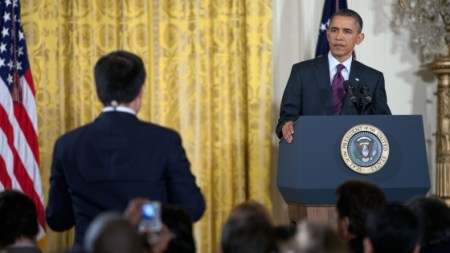
A few days ago Republican talk participants withdrew. The withdrawal was apparently caused by the insistence of Democratic members on raising taxes. The president met with congressional leaders from both sides. At his press conference Wednesday he chastised the Republicans for being unwilling to raise taxes on some, including jet owners, in order to pay for things like student loans and other high priority federal government programs.

June 29 Press Conference (Courtesy WhiteHouse.gov)

Just before the 2008 Democratic landslide election it was Fox News’ resident liberal, Juan Williams, who said, and I paraphrase, if the Democrats win this election in the numbers it appears that they will (and they did) there is one thing that won’t matter — the deficit. How prescient was Williams? The question is, though, do the deficit and the federal debt really matter?

To answer this question you must first understand what a dollar is. We all know that a dollar is a unit of value. It is the unit which we use to facilitate our economy. How does this work in practice? It is only paper after all. It works because on every dollar bill there is the legend, “This note is legal tender for all debts, public and private.” In that phrase is the value. By federal law you use the dollar as the means of paying your debts. But what if the transaction doesn’t involve dollars at all, though, what is the role of the dollar then? How is the dollar involved?

Let me give you an example, what if you and I agree to trade my Kawasaki dirt bike for your 1994 Ford Thunderbird. After the transaction, under IRS rules, the the party which received the vehicle with the greater market value in dollars must report that as a gain on his Form 1040 and pay income taxes denominated in dollars on the gain. But let’s suppose that one of us backs out of the exchange, what happens then? The one wishing to perform takes the other one to court. In the typical court proceeding the judge will not order the physical exchange to occur but will issue an order that the party refusing to perform must pay the performing party the difference in market value between the two vehicles plus, in many instances, attorneys fees, all of which are reckoned in dollars. Hence, even in situations not involving dollars per se, the dollar is ever present.

What then backs our dollars? Where do they come from? Is it just a big secret or a fiction we all agree on or does it really have something to do with the real world?

FDIC "Teller Sign"


Our dollars, at least the greater part of them which are in banks, are backed by the full faith and credit of the USA through a federal agency called the FDIC. FDIC provides deposit insurance to bank depositors. This insurance says that if the bank goes bust that the vast majority of dollar deposits will be made good by the federal government. If the bank doesn’t have the money then the FDIC will stand good for their debt to you which is represented by your deposit in the bank (up to $250,000 per depositor).

Where does the FDIC get it’s money? It gets the money first from premium payments by banks and when reserves from those premium revenues fall short the FDIC can draw on the borrowing power of the USA and if the borrowing power of the USA falls short the Federal Reserve Bank will simply print the money (although the Fed will receive a federal bond in the amount of the cash created like it did during QE and QE2) and the FDIC will in turn give it to the disappointed depositors. Problem solved?

As our president is finding out, however, the ability to print bonds and dollars does not mean that you have unlimited wealth. You cannot print them at will and in any amounts you wish without consequence. The government may have access to dollars (through an increase in the national debt limit which is simply the ability to print more bonds) but the actual value is not in the ability to print bonds and inject the dollars into the system. That process is clearly limited only by the availability of paper and ink. The real value of the dollar relies in a very real sense on the resolve and dependableness of the USA to make the hard choice of choosing to pay it’s creditors first out of it’s income and consume only what is left. A reputation for dependability in seeing that creditors are paid is what gives the dollar it’s value.

In seeking to raise the debt limit the government is not showing the world we are as dependable as we have always been. We are not seeking to pay our creditors out of our income. We seek to borrow some more in order to pay our creditors back. In seeking to raise the debt limit today the government is really just putting off the day when the dependability of the USA will really be tested. And ideally for this government, that ultimate test will happen only after the current crop of debt-increasing politicians has left office. Now, after a bit, we get to the real point of this post.

How is it possible that passing a resolution to create more federal debt, basically just printing more greenbacks, indicates that the US is a dependable nation? It simply doesn’t. It shows nothing but a devil may care attitude towards being dependable and hence towards the value of the dollar itself.

Well then, how is it that the US can show that it is a dependable nation? How do we demonstrate that the value of the dollar should be relied upon now and in the future because it is backed by our full faith and credit? We must do something which is hard. We must show that we can endure the pain of taking responsbility for the debt. We must make what the president calls the “hard choices.”

Showing dependability cannot be achieved to any great extent by extending the depreciation schedules for jet plane owners, or by “making the tax code more progressive” or by taking itemized deductions away from all those who make $250,000 or more. Raising taxes, while possibly being helpful in reducing the debt, will actually be counterproductive to the idea that the majority of people in this country have the resolve to do something hard. It will demonstrate that a majority are not interested in giving but are interested only in taking!!!!

That the top 10 per cent of income earners in the US already pay around 70% of all US personal income taxes is well known. What is not so well known is that a trememdous part of the US government’s budget is made up of “transfer payments.” Transfer payments are payments which are made without the government getting anything valuable (except a vote I guess) in return. Federal transfer payments make up these percentages of the total federal budget: 20% in social security payments; 21 % in medicare, medicaid and CHIP payments; and, 14% in safety net programs.

If we do not show a willingness to fundamentally change ourselves by rejecting the idea that the federal budget should predominately be a vehicle for transfer payments, we will simply not show that we are willing to accept hard choices. We will give evidence that we are a people who want someone else to pay our bills and are not, therefore, very dependable at all except in our wants. We will show that we are willing to raise the taxes of a few in order to pay the bills of the many. Perhaps raising taxes, an outcome apparently desired by the president, will help balance the books in the short run however it will do nothing about the long run problem of a country which is interested in living at the expense of someone else. Unless we show that we, as a people, reject the belief that our federal government is mainly a vehicle for transfer payments, we will prove that our full faith and credit is just not worth very much and the dollar will eventually be valued accordingly.

A cynic might say, ‘what other decision would one expect from a form of government which has no effective protection for the property right of the minority in their own income?’ This nation has been exceptional so far and I fervently hope that it will remain so by debunking this voice of the cynic. In fact our country must debunk the cynic or risk allowing the entire idea of self-government to perish along with the value of the dollar.

Happy July 4.