Archive for April 2011

TRY A LITTLE IRONY

April 24, 2011

The Treasury Secretary and other government officials began a full court press in January in order to get the Congress to raise the debt limit on the US national debt. As you know, without counting social security IOU’s, the debt stands now at $14.3 Billion. The interesting argument Obama operatives are using is that increasing the debt limit will somehow show that we are serious about paying our debts. With their adult and serious faces on Obama’s entourage says that passing a “clean” debt increase will assure our creditors that they will be paid. Apparently our creditors will be satisfied even though they are being paid mostly with money manufactured out of thin air by the Fed through its QE2 program. What does this mean for finding real lenders after QE2 is over? Here is what White House Chief economic advisor, Austan Goolsbee, said on ABC in January:

The pressure has continued to mount on the so-called Tea Party Freshmen in the House to raise the debt ceiling without any quid pro quo process to constrain out of control spending. Supposedly, according to the pundits and Obama accolytes, issues of spending are better left to the political process of passing a budget. Of course this wasn’t so easy for FY 2011’s budget which the Democrats, even with overwhelming majorities in both houses in 2010, failed to do.

Does this strike anyone else as ironic or even extremely ironic? Is it not at least a bit incongruous that the administration which ramped up spending to astronomical levels and which lost a mid-term election at least in part because of fiscal issues, is now pointing at the Tea Party Freshmen as lacking concern for the country, now defined as a seriousness about honoring our debt obligations. That the administration has gone out in full campaign mode to advocate a policy of nearly unlimited borrowing in order to “calm” the markets about our debtworthiness also seems a little ironic to me. Remember the old but tried wisdom of George Washington when addressing the issue of debt repayment: “To contract new debts is not the way to pay old ones.” – Letter to James Welch, April 7, 1799. I suppose times and financial fashions have changed in two centuries.

Exactly who is more interested in paying this money back with something of value? Is it the Tea Party Freshmen who came to office on the idea that they would rein in out of control federal government spending? Or is it the administration which is poised to borrow yet another $1.7 or so over the next 12 months? Who will bondholders believe has their best interests in mind even if there is an interruption in the operation of the printing press? Is it administration which is looking to “borrow” the principal and interest from the Fed to pay the maturing debt along with much more to “invest” in domestic priorities or is it those people looking to try to keep the government’s spending within it’s means? Think of yourself as a bank, to which of these two would you rather loan money?

The Administration has tried to frame this debate in political rather than in economic terms. They know that if they can successfully make the Republicans look like politicians seeking a political victory, particularly at the country’s expense, rather than as deficit hawks looking after the public treasury, that they may be able to avoid having to make substantial cuts to the FY 2012 budget. This will provide them a political victory because it will demoralize Tea Party types since their substantial victories in the fall will have counted for little. The Democrats hope the Partiers will either stay home or vote third parties in 2012.

Furthermore, the Democrats are setting up a scenario that even if the Republicans take this issue to the limit and are actually successful in making big inroads in spending but the economy heads into a double dip either because of this or for any other reason before the election, it is the Democrats who will win politically in 2012 and the president will very likely be re-elected with a mandate to spend even more borrowed money to avoid further economic catastrophes. It is quite the political gambit and it looks to me like it may work. Strangely the adminstration in power will be in a position where they can argue that the deficit hawks caused the problem and the problem wouldn’t have happened if the government had “stayed the course” of continued high deficit spending. As a member of the chorus, Treasury Secretary Geithner said in a recent warning to the Republicans concerning using the debt limit vote to force constraint on spending:

(Lawmakers) will say there’s leverage in it, we can advance it. But that would be deeply irresponsible and they will own the risk.

It won’t happen in the end, but if they take it too close to the edge, they will own responsibility for that miscalculation.

Clearly Geithner is saying that Republican lawmakers are intentionally running the risk of economic catastrophe to even take the issue to the brink in order to force spending cuts because they supposedly “. . . understand that you can’t take any risk the world starts to think the United States won’t meet its obligations.”

“There’s no conceivable way that this city, this government can court that basic risk,” Geithner said.

Obama’s argument is: don’t worry about the soaring debt, what you really need to worry about is the possibility that somebody will put a stop to large scale deficit spending upon which our “prosperity” strangely depends. Here is the vice president making the case explicitly:

This is a “Catch 22.” If we keep borrowing to pay for failed ‘stimulus’ we go bankrupt. And according to Biden, if we don’t keep borrowing and spending like crazy, we go bankrupt. The irony is that we go bankrupt either way. For my part I’d rather go bankrupt from being pennywise than pound foolish. I’d rather do with less now and set the stage for future prosperity than leave a growth-defeating debt for future generations to cope with. I hope it’s not just me who feels this way.

MAY 15 UPDATE: Secretary Geithner has now been forced to sadly ‘predict’ that the failure to quickly pass an increase in the debt ceiling will have the effect of creating a “double dip” recession. See: http://nationaljournal.com/economy/geithner-predicts-double-dip-if-congress-fails-to-lift-debt-ceiling-20110514 .
UPPER MIDDLE CLASS NOW THE “ENEMY”

April 14, 2011

I define the upper middle class as those people who have high incomes but who, if they stopped work, would have to substantially reduce their lifestyles. They may have capital gains and dividend income as well, but the bulk of their income comes as a result of their own work and effort. This is the basis on which I distinguish between the upper middle class and the truly wealthy. ”] The truly wealthy, as opposed to the upper middle class, have high incomes but need not work whatsoever to earn them. Their lifestyles are simply not dependent on their own efforts. President Obama sees the distinction between the upper middle class and the truly wealthy but for some inexplicable reason singles out the upper middle class for the harshest treatment in his “austerity budget” priorities. The new Obama plan gores the devil out of the upper middle class while doing little to affect the lifestyles of the truly wealthy. Both the Ryan and the Simpson-Bowles Deficit Commission priorities do substantially less to single out the upper middle class for special tax “punishment.”

Derek Thompson, of the Atlantic, has posted a comparison of the three deficit reduction plans on the table. Thompson compares the highlights of the taxing policies of the three plans, Congressman Ryan’s, President Obama’s and the Simpson-Bowles Deficit Reduction Commission’s. This is what Thompson says about the three:

Tax Reform

White House: Let Bush tax cuts expire for “the wealthy.” Limit itemized deductions for the wealthiest 2% of Americans to reduce the deficit by $320 billion over ten years. Convene a panel on tax reform. (Another part of the speech calls for “tax reform to cut about $1 trillion in spending from the tax code,” that is $1 trillion in tax expenditure cuts.)

Paul Ryan: Extend the Bush tax cuts and enact tax reform. Repeal $800 billion in tax increases imposed by Affordable Care Act simpler, less burdensome tax code for households and small businesses. Consolidate and lowers tax rates for individuals so that the top rate comes down from 35 to 25 percent and pay for it by sweeping out deductions and exemptions. Lower corporate tax rate from 35 percent to 25 percent and pay for it by sweeping out tax expenditures.

Deficit Commission: Enact comprehensive tax reform. Consolidate and lower individual income rates to 12%, 22%, and 28%. Eliminate most tax expenditures that don’t protect the low-income. Tax capital gains and dividends as normal income. Lower corporate income rate to 28%, eliminate most deductions, and move to a territorial tax system, which would not tax profits made by U.S. multinationals overseas.

As you can see, of the three only the Deficit Commission’s plan returns the taxes on Capital Gains to the Reagan era status of treating them like earned incomes. As such the plan proposed by the least politically potent of the three, the Deficit Commission, would actually get at the wealthy by having them pay their income taxes as if they earned those incomes by their own blood, sweat and tears instead of through dividends and capital gains. Remember what candidate Obama once said about this issue and “fairness”:

Apparently the President has changed his mind since his election as to what is fair. He chooses in his own plan to maintain the current gross tax rate advantage for the truly wealthy vis-a-vis the upper middle class. Even stranger, by both raising the tax rate on those in the upper two percent of income earners and eliminating many, if not all, of the itemized tax deductions, the President has singled out the upper middle class to pay much more in tax, not the truly wealthy like his friend Warren Buffet. This is because, other than the charitable contribution deduction, few of the truly wealthy claim the benefit of the other itemized tax deductions. The truly wealthy are likely to own their own homes outright so the deductibility of mortgage interest is of no concern. In addition to the increased tax effect, removing the mortgage interest deduction will actually cause the expensive homes of the upper middle class to lose market value since prospective buyers will be even less interested in owning them. Furthermore, in order to claim other so-called itemized deductions those expenses must exceed 7% of their Adjusted Gross Income. The truly wealthy are much less likely to meet the threshold of 7% to claim medical care deductions or other lesser known deductions subject to the 7% cap than those making at the lower ranges of the $250,000 limit.

The people getting the shaft under Obama’s priorities are the ones who go to work everyday, often at 5:00 a.m. to run their businesses, check on their hospitalized patients or otherwise work for a living. They’re the ones climbing the ladder, they are not at the top yet. They are motivated and personally involved in providing goods and services as well as jobs in the real world. Why would Obama single out those who are climbing the ladder to subject them to the heaviest burden of taxation? Is it truly just politics or is it his ideology? At the next press conference won’t somebody, like Charlie Gibson who did so at a democratic presidential debate, ask him about why this is? Ask him why he’s backed off his campaign rhetoric concerning Capital Gains tax fairness. Of course, this would only be possible if there ever is another news conference with real journalists in attendance!!!

HERE COMES THE PREDICTABLE PRESIDENT

April 13, 2011

It is widely believed that the Obama “budget plan” to be announced today will call for an increase in tax rates on the “wealthy.” Wow, what a difference four months makes. As readers of this blog know there are two forms of income received by the “wealthy.” Ordinary income, obtained through personal work and effort and “capital gains and dividend” income, obtained through investments. A fellow blogger, Chad Aldeman of “The Quick and the Ed Blog,” has analyzed the effective tax rates of US top 400 income earners for 2007. This is what he reports:

. . . . [T]hat the super rich have been paying smaller and smaller portions of their incomes to taxes*. The chart below shows the effective tax rate for the richest 400 American filers from 1992 and 2007. The blue line represents the highest income tax bracket, the red line is the tax rate on long-term capital gains, and the orange line is the average tax rate that the richest 400 filers actually paid.

There are two important things to note from this chart. The first, and most visually apparent, is that the tax rates of the rich are far more closely linked to the capital gains taxes than income taxes. Salaries and wages, the source of income taxed at the blue line, represented only 6.5 percent of these filers’ income. Nearly two-thirds of their income comes from capital gains, and this is why you see a much tighter coupling between the orange and red lines.

As provided by the Tax Foundation, taxfoundation.org, in 2008 the total Adjusted Gross Income for all filers with incomes above $380,000 (the top 1%) was $1.685 Trillion dollars. These people already pay about $392 Billion in income tax. Therefore, even if we took 100% of all the money earned by everyone in the top 1% of filers, we would still have a deficit of about $400 Billion for FY2011. As with the effective rate figures for the top 400 income earners in the chart above, the effective income tax rate for the top 1% is far below the 35% maximum rate. In fact it was 23.27% for the entire top 1% in 2007. This is less than halfway between the capital gains/dividend tax rate of 15% and the top income tax rate of 35%. In fact it is only 40% of the way.

What these facts mean, I believe, is that we need to look at increasing the capital gains tax rate (as well as limiting the exclusion from taxation for municipal bond interest) as a means for increasing the government’s take. There is a lot of room here for higher taxes, don’t you think? This is especially true when you understand that higher wage earners pay, in addition to income tax, 12% social security tax on the first $110,000 of earned income and 3% medicare tax on everything they earn from personal work. On the other hand, the capital gain/dividend crowd, the truly wealthy, pay 0% in either “entitlement” category.

I wonder what President Obama is going say about taxes. Maybe he’ll go for goring the capital gains/dividend crowd by 5% more, from 15% to 20%. Well, La Dee Dah. How about proposing that this preferred tax rate rise to it’s Reagan era level of 28%? Or might this proposal hurt Obama sponsors like Mrs. Heinz Kerry, Mr. Soros, Mr. Buffet, Mr. Gates, or even Mr. Gore? Therefore, I doubt very much that Mr. Obama will suggest that the capital gains tax rate should rise to more than the Clinton era’s level of 20%. This, it should be noted, is in stark contrast to the words of candidate Obama who declared that increasing capital gains tax rates was a “fairness” issue. I, of course, would advocate heavy congressional scrutiny of any proposal to increase anyone’s taxes to make sure the increase is not self defeating for the country, however, if we are going to consider raising taxes on the wealthy, let’s consider more than a single aspect of the “taxing the wealthy” issue.

DEAL-MAKING BETWEEN GOVERNMENT AND BUSINESS

April 1, 2011

I have a question. Is it easier to make a living by competing against other hard nosed competitors for the success of having the best and most economical product or by forming “partnerships” with the federal government furthering the government’s purposes in exchange for a share of the pie guaranteed by government power? The latter has the additional advantage of raising the prestige of the corporate power players. I think I know the answer. Let’s see how it works in real life.

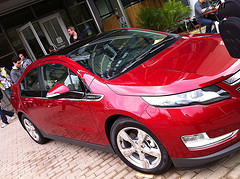
Did you hear how many Chevy Volts have been sold by GM dealers in the last three months? It seems to be about a thousand or so and this is with a very generous federal government subsidy of $7500 per vehicle. Did you also hear recently that GE’s Jeff Immelt has agreed to purchase either 25,000 or 50,000 GM hybrid products over the next two years, including Volts.

Chevy Volt courtesy Swirlspice

That’s quite a jumpstart for a car that seems to be having some trouble getting into people’s garages. Perhaps the trouble for consumers is the price tag of over $40,000. Perhaps even more important than the premium price tag is the fact that Consumer Reports found a few significant problems with the Volt when they tested it and published their review. In any case it is undisputable that the public has yet to catch on to the benefits of owning a Volt.

Enter GE, stage right. The GE purchase from GM (government motors) is a big deal for all concerned. I wonder why it happened? Maybe GM has given GE real special pricing (like 30 or 40% off) or maybe something else has happened? Is it possible that GM and GE are now secret partners of some kind? Or is GE just somehow dumber than the ordinary consumer spending his own money and reading Consumer Reports. Or is GE’s Immelt perhaps just way smarter than those consumers who resist the $7500 tax incentive, after all GE’s Immelt was recently named Chairman of Mr. Obama’s Economic Advisory Board. From this vantage point at the top of Washington’s business heap, I’m sure Immelt sees information which tells him that the price of oil is going up (but uh oh, on the other hand, what will happen to the economics of this purchase if the price of electricity goes up along with the price of oil)? It’s hard to figure what real economic benefits GE receives for making this nearly $2 Billion purchase and GE isn’t letting us in on Immelt’s thoughts.

Is it possible, though, that the real source of the impetus for this purchase lies in the fact that GM and GE are both closely connected with federal government–otherwise known as the source of all power and largesse in the universe, and that these two behemoths of industry have found this to be a compelling interest they have in common?

Are GE and GM cooperating because they are being operated as subsidiaries of the federal government? Remember GM is still owned to a large extent by the feds. Remember also that GE is real big into green energy technologies. GE is in the business of making wind generators. They also make all sorts of high tech electrical devices as well as the lowly lightbulb and are positioned to rake in vast profits in any federal subsidy or mandate program designed to support the green energy industry. Such mandates and subsidies might even be designed by the government to target products in which GE has the advantage. It is also true, as you may recall NBC, the formerly GE owned network, constantly beat the political (public education) drum for green energy. Are these things just coincidences?
Can this be the interest which both of these giant companies have in common?

Remember Mr. Obama’s “business friendly” statement during his state of the union address:

Clean energy breakthroughs will only translate into clean energy jobs if businesses know there will be a market for what they’re selling.

In Washingtonese this means that if the public is forced or induced to buy GE’s products, this will encourage and profit GE to make those products. In this way the government can create an unlimited market for “inventions” whether the public would willingly buy them with their own money or not. This statement had to be music to the ears of GE and Jeff Imelt, it’s CEO, since you may know that in the last five years the stock price of GE has fallen over 40% and was at one point in 2009 down over 70%. In that regard, it seems that President Obama at his State of the Union addressv was preaching to his choir, Immelt and GE.

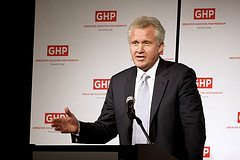
Jeff Immelt, CEO of GE

Even before the President’s speech, but after the 2010 midterm election victory by Republicans, Immelt publicly suggested that he would be willing to use the economic clout of GE to support other companys’ high tech inventions when he said:

Business backing for new technology such as advanced autos is going to be more important as government spending wanes.

What use does a business like GE have for “backing [the] new technology” of other companies for the technology’s own sake? Aren’t corporations like GE in business to make profits for their own shareholders? Can it be true that Immelt and other corporate power players are just adding to their own prestige as deal-makers with stockholders’ money? Or is it possible that their main motivation is to lay the groundwork for important future “public private partnerships” where the government can lay the competition low through it’s regulatory and taxing power?

Whether this is just synergy in business or corporatism Mussolini-style is not unambiguously clear but it does bear close watching. In view of the price tag and the report by Consumer Reports, one should look skeptically at the idea that GE acted because it found the Volt a compellingly efficient piece of equipment rather than because it saw the opportunity to make a deal with the current interventionist administration.