The Car’s In The Ditch!!
Oh no, our “car’s in the ditch!!!” Until the recent election we heard variation upon variation on this refrain: (1) the previous administration drove this “car in the ditch”; (2) we need to fundamentally transform the US in order to get the car out of the ditch; and, (3) the opposition needs to stop complaining about the necessary repairs and get in the back seat. In light of the results of the election I am apparently not alone in feeling frustration at the singers of this song.
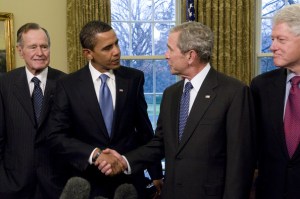
Presidents Obama, Clinton, Bush I and Bush II
The pertinent questions as I see them are these. What are the basic economic fundamentals which represent the “road” upon which our national car drives? How did our past presidents, particularly Bush, drive “the car” into the ditch? Does “getting out” of the ditch require different style of driving than keeping the car on the road in the first place? How does the current government’s driving measure up?
I think the fundamental question about an economy is whether it allows and facilitates the creation lots of wealth for ourselves and others? When the economy, the GDP, grows Americans seem to feel that we all become wealthier to a greater or lesser extent. At least, based on their public statements, politicians seem to agree. In order to seem in step they are constantly talking about whether the economy is in recession or is “growing.” From this agreement between the public and the politicians, I conclude that I am right and that the policies which allow Americans to create more wealth are the basic economic fundamentals of our country.
What do we mean when we talk about wealth? How is wealth created? According to businessdictionary.com wealth is ‘any tangible or intangible thing which makes a person, family or group better off.’ Seems like a good common-sense definition to me. What we create through our own efforts is wealth. When we trade our wealth with others trying to make ourselves and our family better off we create even more wealth. Why is it that more wealth is created when exchanges are made? Why isn’t an exchange just a “zero sum game” where people have just traded things of the equal value? The conclusion that trading creates wealth in addition to that which existed before is based upon a fact of human nature which is that two people will not trade unless they both expect to be better off, richer, after the trade than beforehand. Likewise, when fewer transactions occur, less wealth exists because people keep what they have. The more that people exchange their wealth with others, the more total wealth we have as a nation of individuals. Therefore, any policy which increases trading among us leads to creation of yet more wealth. Policies which depress the number of trades, on the other hand, lead to a static or negative trend in wealth. We might call them, those policies, negative fundamentals. An important fundamental of the economy then, it seems clear to me, is whether government policies encourage or discourage the creation and trading of wealth.
All economies which are referred to as “advanced economies” have pursued economic growth based upon specialization, the so-called ‘division of labor. ‘ This way of doing business maximizes wealth because it increases the production of all things. Individuals will usually spend their time producing things which they are most expert at producing. Wealth will not be maximized by a person learning to do many things kind of well. He will maximize the value of his work by learning to do one thing very well and then trading with others to get the other things that he wants. If he specializes and people are interested in transactions with him, he will generally be much better off than if he had learned to do a lot of things only marginally well. It is a fundamental of a system of specialization that it causes large numbers of transactions because no one can subsist or create everything he needs and wants by his own efforts.
What causes people to stop or slow down their normal trading activities in a division of labor style economy? Why would people ever stop trading when they know that trading makes them wealthier? There are at least three conditions which will cause people to stop trading. The first is when people believe that what they have to trade will be worth more tomorrow than it is today. The second is that they believe that what they want to trade for will cost them less tomorrow than it does today. The third condition which will stop trading is when the public believes that they need to conserve the things they have today in order to protect themselves and their families tomorrow.
Enter the dollar bill. It is small, it is transportable and it is protected by the government. It is generally assumed by people that the dollar bill will have the same or nearly the same value tomorrow as it does today and therefore it acts as a reliable store of the value of the many trades which people make. The dollar bill has been a “store of value” for the people of US for the last 100 years and for the world for the last 65. Having a reliable and durable store of value is indispensable to the specialization economy.
Okay we know all this. Is it possible that there is a relationship between the perceived future value of the dollar and the reduced value of the current transactions we see in the economy? This is a difficult proposition to believe because if inflation is perceived as a threat in our economy, and I believe it is, people should be trading like crazy to avoid the future price rises. Why then aren’t they trading? Are there other perceptions affecting their desire to enter into current transactions? Yes. As indicated above, the public believes that they need to conserve the things they have today in order to protect themselves and their families from what, the shape of which they are not quite sure about, may happen tomorrow.
Therefore, the fundamental feature of the current economy is the uncertainty and outright pessimism about the economic present and future. FDR’s famous line in somewhat similar times was, “All we have to fear is fear itself.” Did Bush or his fellow former presidents do something or several somethings wrong on the economy in order to cause this uncertainty and even profound pessimism?
Historically George W. Bush took office at the end of an almost ten year expansion. The American economy officially entered recession (a period of reduced transactions) in March 2001. To use the current economic analogy, one or more previous driver(s) had driven the car off of the road before George the Second took the wheel. Then, less than 8 months after Bush took office, our country was devastatingly attacked by al Qaeda operatives on 911. The realization of significant risks to our country, which had not been anticipated by the population before, suddenly dawned upon them. The cost of defense and security precautions skyrocketed as a result of this change in status. Bush was widely mocked when, in response to the misgivings of the people, he went to the American people and asked that they return to business and leisure as usual. (Apparently FDR and Bush were not accorded the same credit for their insight.) Bush, and FDR before him, were interested in either increasing or at least sustaining the level of transactions in the US economy. In his view, not unreasonably, this would protect our prosperity and deny al Qaeda their goal. He also lowered taxes for 100% of taxpayers in the country. After a few months of economic problems things got better, economically at least, and remained so until nearly the end of Bush’s second term, 2007-8.
Why did things at first improve and then head south on Bush’s watch? With the tax cuts and the lack of attacks on the homeland things improved in part because of what Bush asked the country to do, go about their normal business. He was abetted in preciptating the ‘good times’ by a Fed which kept interest rates, including mortgage rates, down. In large part the good times in the middle of the Bush administration represented a lot of housing transactions, it represented consumption fueled by increases in the ‘equity’ apparently held by individual home owners and it was further abetted by consumer borrowing spurred on by low interest rates. The Fed didn’t take away the punch bowl at the party this time.
Then things turned down, why? First and I believe foremost, there was the financial storm. This was caused by the squandering of vast quantities of money on building unnecessary and luxurious housing for people who could barely afford to pay for it as well as profligate spending on other consumer goods which went to fill all our houses. The resulting cascade of unpaid loans and credit cards, foreclosures and short sales caused a problem with our financial system which was actually made much worse for the economy by arcane financial derivatives and the bundling of mortgages for sale in the general investment market. Everything, it turned out, was tied together in a neat bundle and when one knot went everything went. When people couldn’t pay for what they had purchased, the stuff just hit the fan with both real and psychological effects.
In addition to the negative effect of the sub prime meltdown on the mortgage market, previously built homes overhang the market. This situtation makes it questionable whether homes already in private hands with loans in good standing will hold their value much less appreciate. Where have all of the TV advertisements gone which used to ask people to use the equity in their homes as checking accounts?
Add to this dicey circumstance the recognition of the potential for economic devastation represented by $4.00 a gallon gasoline. The $4.00 a gallon shock took everyone by surprise back in 2008. Now the American people are well aware of the nascent crisis in Iran (and the Persian Gulf) and the fact that the government shut down oil exploration in the Gulf of Mexico. Everybody knows that these, along with the falling value of the dollar, could drive up gasoline and other energy costs for both the short and middle term. Take all this together with a few moves by the government in the recent past showing even more interest than usual in picking economic winners and losers and the end result is that people are feeling defenseless and economically vulnerable and in no mood to spend money. In that regard some of our leaders dramatize, by their own words, these and other reasons for concern. First, the President.
And then the ever popular Robert Gibbs, White House Press Secretary.
And Vice President Joe Biden.
And Treasury Secretary Tim Geithner.
And Fed Chairman Bernanke.
And what of the effect on the economy of the debt which consumers have already built up over the last twenty years. Does this have an effect on what consumers do in the here and now? It has had some effect, I believe. Over the previous seven quarters, according to a Fed report issued in August, the amount of consumer debt has fallen 6.5%. This reduction, whatever the underlying causes, has a two fold effect. It means that the consumer has less income to buy things since that part of their income is being used to repay debt for previous purchases. It also means that the consumer wasn’t interested in securing additional debt for buying new things. Overall, a reduction in transactions.
In sum then, what do we know about the fundamental state of our economy in terms of the likelihood of increasing transactions? We know that housing value (a house is the largest asset held by most consumers) is likely to stay static or recede in the short and perhaps medium term which means people are going to have to save more for retirement. We know that as recently as 2010 when the House passed the Cap and Trade bill, Washington politicians were interested in continuing to hector the public about their energy usage. We know that some aspects of social security and medicare are on the chopping block. We know that the public has had a taste of what $4.00 a gallon gasoline was like and didn’t like it. We know that the income taxes of nearly everyone who has enough income to buy big ticket items without adding to their debt (like John Kerry and his new yacht) is going to be targeted for a significant tax rate hike either now or at the latest, ‘when things get better.’ We know that the bill for the vast amount of wealth destroyed by the sub-prime mortgage mess is still trying to find a place to land permanently and the public is smart enough to figure out that it might just decide to land squarely on their bank accounts and retirement accounts. Does anyone (other than John Kerry) feel rich? Even he doesn’t feel rich enough to promptly pay his yacht tax in Massachusetts.
Given all of the uncertainty and difficulty hanging over the people of this country are you still wondering why people are not buying big new things or investing in new equipment and business or borrowing more money to consume consume consume? What is being done to improve the economic fundamentals, to increase people’s interest in trading?
Here’s what one American, an Obama fan no less, thinks about the situation.
Regardless of which of these problems is the fault Bush & Co. and which is the fault of others, I’m not surprised that we’re not climbing out of the ditch yet. When we add to the mix the immense increases in Federal borrowing to “avoid a depression” the bill for “business as usual” seems high indeed. The people look on the mess and are very afraid. Can you blame them for trying to save for a rainy day?
Explore posts in the same categories: Political Economy Short and Sweet Blog
November 18, 2010 at 3:02 am
Great blog!
Well expressed and meaningful to me.
I know I am VERY uncertain about our childrens’ future. A weak economy leaves us as an open and inviting target for economic as well as other attacks on our security.