Archive for November 2010

Buffet: RAISE MY ‘CAPITAL GAINS’ TAXES?

November 24, 2010

Warren Buffet is a nice man.  He wants to do what’s right.  His partial solution to the current situation is to substantially raise taxes on the wealthy.  In fact, Buffet says that the rich have never had it so good.  What is he saying exactly?  Who is he talking about? Why is he saying it?  Here he is having his say in a recent interview with Christiane Amanpour of ABC News:

In his interview with Ms. Amanpour Buffet says something which sounds to me like the Bush tax cuts for the $250,000 a year crowd should be allowed to expire.  Is this really what he means?  How could he be misinterpreted?  Were his comments edited or just sloppy?  Here is what Buffet has also recently said about the fairness of capital gains and dividend taxes for the rich in relation to his view of the taxes paid presidential candidate Romney:

How do these two comments fit together?  Is Buffet’s point that allowing the tax rate on capital gains to rise from it’s present 15% would be a good thing for the economy?  Would he allow it to rise to it’s Clinton era rate of 20% or increase it even more? Or does he really wish to see an increase in the rate of tax paid upon earned income for those earning more than $250,000?  Curiously, if the latter, I would have expected him to define what he means by his use of the term “high end?”  He doesn’t seem to even have in his mind a line of demarcation between the middle class and the “high end” based upon the amount of earned income they receive.  In fact, in his Amanpour interview he appears to refer to the “high end,” not as the people who earn very good salaries, but as people like himself, investors.  A doctor making $350,000 a year with a spouse, two kids, a mortgage, a huge student loan and the specter of Obamacare bearing down on her has much more in common with Buffet’s cleaning lady than she does with billionaire Buffet.  Buffet is too nice a man, I’m sure, to try to  speak for her saying that as a matter of fairness they are both wealthy and should have their taxes raised substantially.  On the other hand, why is he allowing the impression that he is in favor of taxing earned incomes above $250,000?  That is clearly how his words are spun.  If he means that taxes on the type of income which is currently taxed at only 15% should be raised substantially, why doesn’t he just outright say that capital gains taxes should be raised?  This confuses me.  It may just be the editing on the part of ABC News and Christiane Amanpour or it may be sneakiness on the part of Buffet who, as an investor, will be better off if the budget deficit shrinks due to the efforts of others not of his class?  I’m just not sure.   

If Buffet is saying that “investment” income should be re-evaluated in terms of justifying it’s tax advantaged status, then I agree with him wholeheartedly.  In fact I think that re-evaluating taxes in terms of what increases wealth for our citizens and tax revenue for our country is long overdue.  The tinkering which has occurred over the years is just a political process of benefiting your political friends and hurting your political enemies and should be stopped.  Policies which raise all boats in this country should be the policies which are adopted.   

To this end the vast disparity between the 15% tax rate on capital gains and the 35% (soon to be 39.6%) rate paid on earned income, without even considering the over 15.3% in payroll taxes paid by those who personally work for their money, needs to be justified in Congress in the full light of day.  All of the mathematical power of econometrics and all of the common sense of Austrian economics should be brought to bear to measure and justify the benefits of continuing the policy of reduced tax rates on particular types of income, particularly as it concerns capital gains. 

For instance, questions should be asked and answered such as should we limit capital gains tax rates to those who invest in start up businesses which end up employing Americans, being viable and profitable?  How should we view investments made in IPO’s (initial public offerings) for capital gains tax rates?  How about just speculation in the stock market in established companies, does it do anything for the economy as a whole, in terms of spurring economic growth?  How about speculation in commodities?  All sorts of questions come to mind and should be debated.  We should see the truth emerge through the careful questioning of witnesses under oath as to just what is good for the economy and what is just a giveaway to the rich?’  I think that such hearings might even be a C-Span extravaganza.  I would be particularly interested in what side of the issue legislators like “yacht tax dodger” Sen. Kerry would be on.

Also, is there or should there be an issue of fairness in income taxation or is it only about economic incentives and tax revenues.  It shouldn’t be all about who has the big bucks and can buy influence at the top, should it?  Well, you may recall that candidate Obama considered it an issue of fairness to raise the tax rates on  capital gains.  He considered it important to be fair even if increasing capital gains tax rates actually decreased the amount of taxes collected based on that tax.  Said candidate Obama:

I haven’t heard anything on this issue from now-President Obama during his first two years in office.  Perhaps I am naive but why is it that Mr. Obama, after becoming President, no longer considers taxing high wage earning individuals at rates more than double that of billionaire investors like Buffet to be an issue of fairness?  Is there an economic reason which escaped candidate Obama and is now clear to President Obama?  Has he studied up on economics since the 2008 election?  Or is it just an example of politics as usual?

At some point in the ancient past reduced tax rates on capital gains were apparently justified on the basis of some social and economic benefits to society.  Between 1913 and 1921 the rate paid by those earning income from work and those earning by investing their fortunes, was identical.  From ’21 to ’34, the capital gains tax rate was capped at 12.5%.  Then, in 1934 FDR changed the rules allowing a percentage of any capital gains to be excluded from taxes altogether, adjusting the percentage excluded based upon the holding period of the asset.  The rules changed again in 1942 capping capital gains taxes at 25% for those whose tax rates were very high and reducing the necessary holding period to claim this benefit to a single term of six months.  There have been oh so many variations of the capital gains tax rate since 1942 ending with the current rule setting a maximum rate of 15%.  This is not the end, though, since this rate is set to rise to 20% with the expiration of the Bush tax cuts on December 31.  Interestingly in the 80’s Reagan ended the special tax treatment for capital gains altogether.  [How could this have been a Republican idea given how the current crop of Republicans is being reviled for “protecting the rich” while threatening the middle class?]

According to Charlie Gibson’s figures, the econometrics of capital gain taxes show that lowering the rates increases the total revenue from capital gains taxes.  How important is it that we get the maximum revenue from capital gains taxes?  Buffet, in his Amampour interview, seems to say that the theory of capital gains taxes being good for the economy as a whole “hasn’t worked out that way” for about the last ten years and that the American people ought to catch on to the rich man’s ruse.  Perhaps the President, who relies so heavily on the Oracle of Omaha, ought to catch on too.  I fully support having an open debate about whether Buffet is right and let the chips fall where they may.

It appears that a political bargain has already been struck maintaining special tax treatment for capital gains and dividends.  And all without a whimper from Congress which apparently prefers to posture about the “threshold for wealthiness” and identifying who deserves to pay the highest rate while the already ultra-wealthy maintain their advantage versus those who work for a living.  Where should the real class warfare be?  Is it that the rich are setting groups of wage earners against one another in order to avoid debating about retaining their capital gains and dividend tax benefits?  Why has Charlie Gibson stopped casting light on this issue?  Go figure?

The Car’s In The Ditch!!

November 16, 2010

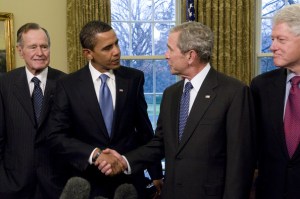
Oh no, our “car’s in the ditch!!!”   Until the recent election we heard variation upon variation on this refrain: (1) the previous administration drove this “car in the ditch”; (2) we need to fundamentally transform the US in order to get the car out of the ditch; and, (3) the opposition needs to stop complaining about the necessary repairs and get in the back seat.  In light of the results of the election I am apparently not alone in feeling frustration at the singers of this song.  

Presidents Obama, Clinton, Bush I and Bush II

The pertinent questions as I see them are these.  What are the basic economic fundamentals which represent the “road” upon which our national car drives?  How did our past presidents, particularly Bush, drive “the car” into the ditch?  Does “getting out” of the ditch require different style of driving than keeping the car on the road in the first place?  How does the current government’s driving measure up?  

I think the fundamental question about an economy is whether it allows and facilitates the creation lots of wealth for ourselves and others?  When the economy, the GDP, grows Americans seem to feel that we all become wealthier to a greater or lesser extent.  At least, based on their public statements, politicians seem to agree.  In order to seem in step they are constantly talking about  whether the economy is in recession or is “growing.”  From this agreement between the public and the politicians, I conclude that I am right and that the policies which allow Americans to create more wealth are the basic economic fundamentals of our country.    

What do we mean when we talk about wealth?  How is wealth created?  According to businessdictionary.com wealth is ‘any tangible or intangible thing which makes a person, family or group better off.’  Seems like a good common-sense definition to me.  What we create through our own efforts is wealth.  When we trade our wealth with others trying to make ourselves and our family better off we create even more wealth.  Why is it that more wealth is created when exchanges are made?  Why isn’t an exchange just a “zero sum game” where people have just traded things of the equal value?  The conclusion that trading creates wealth in addition to that which existed before is based upon a fact of human nature which is that two people will not trade  unless they both expect to be better off, richer, after the trade than beforehand.  Likewise, when fewer transactions occur, less wealth exists because people keep what they have.  The more that people exchange their wealth with others, the more total wealth we have as a nation of individuals.  Therefore, any policy which increases trading among us leads to creation of yet more wealth.  Policies which depress the number of trades, on the other hand, lead to a static or negative trend in wealth.  We might call them, those policies, negative fundamentals.  An important fundamental of the economy then, it seems clear to me, is whether government policies encourage or discourage the creation and trading of wealth.  

All economies which are referred to as “advanced economies” have pursued economic growth based upon specialization, the so-called ‘division of labor. ‘  This way of doing business maximizes wealth because it increases the production of all things.  Individuals will usually spend their time producing things which they are most expert at producing.  Wealth will not be maximized by a person learning to do many things kind of well.  He will maximize the value of his work by learning to do one thing very well and then trading with others to get the other things that he wants.  If he specializes and people are interested in transactions with him, he will generally be much better off than if he had learned to do a lot of things only marginally well.  It is a fundamental of a system of specialization that it causes large numbers of transactions because no one can subsist or create everything he needs and wants by his own efforts.  

What causes people to stop or slow down their normal trading activities in a division of labor style economy?  Why would people ever stop trading when they know that trading makes them wealthier?   There are at least three conditions which will cause people to stop trading.  The first is when people believe that what they have to trade will be worth more tomorrow than it is today.  The second is that they believe that what they want to trade for will cost them less tomorrow than it does today.  The third condition which will stop trading is when the public believes that they need to conserve the things they have today in order to protect themselves and their families tomorrow.  

Enter the dollar bill.  It is small, it is transportable and it is protected by the government.  It is generally assumed by people that the dollar bill will have the same or nearly the same value tomorrow as it does today and therefore it acts as a reliable store of the value of the many trades which people make.  The dollar bill has been a “store of value” for the people of US for the last 100 years and for the world for the last 65.  Having a reliable and durable store of value is indispensable to the specialization economy.

Okay we know all this.  Is it possible that there is a relationship between the perceived future value of the dollar and the reduced value of the current transactions we see in the economy?  This is a difficult proposition to believe because if inflation is perceived as a threat in our economy, and I believe it is, people should be trading like crazy to avoid the future price rises.  Why then aren’t they trading?  Are there other perceptions affecting their desire to enter into current transactions?  Yes.  As indicated above, the public believes that they need to conserve the things they have today in order to protect themselves and their families from what, the shape of which they are not quite sure about, may happen tomorrow.          

Therefore, the fundamental feature of the current economy is the uncertainty and outright pessimism about the economic present and future.  FDR’s famous line in somewhat similar times was, “All we have to fear is fear itself.”  Did Bush or his fellow former presidents do something or several somethings wrong on the economy in order to cause this uncertainty and even profound pessimism? 

 Historically George W. Bush took office at the end of an almost ten year expansion.  The American economy officially entered recession (a period of reduced transactions) in March 2001.  To use the current economic analogy, one or more previous driver(s) had driven the car off of the road before George the Second took the wheel.  Then, less than 8 months after Bush took office, our country was devastatingly attacked by al Qaeda operatives on 911.  The realization of significant risks to our country, which had not been anticipated by the population before, suddenly dawned upon them.  The cost of defense and security precautions skyrocketed as a result of this change in status.  Bush was widely mocked when, in response to the misgivings of the people, he went to the American people and asked that they return to business and leisure as usual.  (Apparently FDR and Bush were not accorded the same credit for their insight.)  Bush, and FDR before him, were interested in either increasing or at least sustaining  the level of transactions in the US economy.  In his view, not unreasonably, this would protect our prosperity and deny al Qaeda their goal.  He also lowered taxes for 100% of taxpayers in the country.  After a few months of economic problems things got better, economically at least, and remained so until nearly the end of Bush’s second term, 2007-8.

Why did things at first improve and then head south on Bush’s watch?  With the tax cuts and the lack of attacks on the homeland things improved in part because of what Bush asked the country to do, go about their normal business.  He was abetted in preciptating the ‘good times’ by a Fed which kept interest rates, including mortgage rates, down.  In large part the good times in the middle of the Bush administration represented a lot of housing transactions, it represented consumption fueled by increases in the ‘equity’ apparently held by individual home owners and it was further abetted by consumer borrowing spurred on by low interest rates.  The Fed didn’t take away the punch bowl at the party this time. 

Then things turned down, why? First and I believe foremost, there was the financial storm.  This was caused by the squandering of vast quantities of money on building unnecessary and luxurious housing for people who could barely afford to pay for it as well as profligate spending on other consumer goods which went to fill all our houses.  The resulting cascade of unpaid loans and credit cards, foreclosures and short sales caused a problem with our financial system which was actually made much worse for the economy by arcane financial derivatives and the bundling of mortgages for sale in the general investment market.  Everything, it turned out, was tied together in a neat bundle and when one knot went everything went.  When people couldn’t pay for what they had purchased, the stuff just hit the fan with both real and psychological effects.

In addition to the negative effect of the sub prime meltdown on the mortgage market, previously built homes overhang the market.  This situtation makes it questionable whether homes already in private hands with loans in good standing will hold their value much less appreciate.  Where have all of the TV advertisements gone which used to ask people to use the equity in their homes as checking accounts?  

Add to this dicey circumstance the recognition of the potential for economic devastation represented by $4.00 a gallon gasoline.  The $4.00 a gallon shock took everyone by surprise back in 2008.  Now the American people are well aware of the nascent crisis in Iran (and the Persian Gulf) and the fact that the government shut down oil exploration in the Gulf of Mexico.  Everybody knows that these, along with the falling value of the dollar, could drive up gasoline and other energy costs for both the short and middle term.   Take all this together with a few moves by the government in the recent past showing even more interest than usual in picking economic winners and losers and the end result is that people are feeling defenseless and economically vulnerable and in no mood to spend money.  In that regard some of our leaders dramatize, by their own words, these and other reasons for concern.  First, the President.

And then the ever popular Robert Gibbs, White House Press Secretary.

And Vice President Joe Biden.

And Treasury Secretary Tim Geithner.

And Fed Chairman Bernanke.

And what of the effect on the economy of the debt which consumers have already built up over the last twenty years.  Does this have an effect on what consumers do in the here and now?  It has had some effect, I believe.  Over the previous seven quarters, according to a Fed report issued in August, the amount of consumer debt has fallen 6.5%.   This reduction, whatever the underlying causes, has a two fold effect.  It means that the consumer has less income to buy things since that part of their income is being used to repay debt for previous purchases.  It also means that the consumer wasn’t interested in securing additional debt for buying new things.  Overall, a reduction in transactions.

In sum then, what do we know about the fundamental state of our economy in terms of the likelihood of increasing transactions?  We know that housing value (a house is the largest asset held by most consumers) is likely to stay static or recede in the short and perhaps medium term which means people are going to have to save more for retirement.  We know that as recently as 2010 when the House passed the Cap and Trade bill, Washington politicians were interested in continuing to hector the public about their energy usage.   We know that some aspects of social security and medicare are on the chopping block.  We know that the public has had a taste of what $4.00 a gallon gasoline was like and didn’t like it.  We know that the income taxes of nearly everyone who has enough income to buy big ticket items without adding to their debt (like John Kerry and his new yacht) is going to be targeted for a significant tax rate hike either now or at the latest, ‘when things get better.’  We know that the bill for the vast amount of wealth destroyed by the sub-prime mortgage mess is still trying to find a place to land permanently and the public is smart enough to figure out that it might just decide to land squarely on their bank accounts and retirement accounts.  Does anyone (other than John Kerry) feel rich?  Even he doesn’t feel rich enough to promptly pay his yacht tax in Massachusetts.  

Given all of the uncertainty and difficulty hanging over the people of this country are you still wondering why people are not buying big new things or investing in new equipment and business or borrowing more money to consume consume consume?  What is being done to improve the economic fundamentals, to increase people’s interest in trading? 

Here’s what one American, an Obama fan no less, thinks about the situation.

Regardless of which of these problems is the fault Bush & Co. and which is the fault of others,  I’m not surprised that we’re not climbing out of the ditch yet.   When we add to the mix the immense increases in Federal borrowing to “avoid a depression” the bill for “business as usual” seems high indeed.  The people look on the mess and are very afraid.  Can you blame them for trying to save for a rainy day?

What’s Important To The American People

November 9, 2010

Have you heard?  We recently had an election.  Although there is disagreement about what the electorate meant by voting as it did, the results are in.  Approximately 25% of the Democratic delegation of the house of representatives was voted out of office.  The Democrats went from a previous 257 – 178 majority to about a 243 – 192 minority.  Likewise of the formerly Democratic senate seats up for election  31% were turned over to the the Republicans.  A number of other Democratic seats in both the house and senate were narrowly retained, mainly in blue states.  Seems like a pretty big “statement” to me but I admit to a a point of view about such things.

The question of why the election turned out this way is, as all political questions are, an open one since the people vote for a whom and are not required to have a valid reason for why they did so.  Is this dramatic swing at least possibly the result of what the Democrats did in ramming through a permanent health care entitlement, a far-reaching financial reform bill and passing a hugely wasteful stimulus bill resulting in spending even more money more quickly than the previous group of drunken sailors?  There are at least two possibilities to choose from.  First, this historic election result could have been caused by a public unnerved and possibly unhappy by the passage of these three major bills which were enacted with virtually no input or support from the opposition party?  Second, this historic result could have been a mere blip on the screen caused solely by a punitive impulse on the part of an electorate understandably impatient for a turnaround in the economy even though the cause of the bad economy was solely the policies of the preceding government?  Which is it?

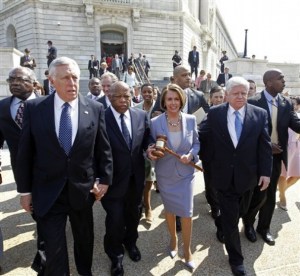
Speaker Pelosi and the Democrats

One of my favorite political characters already answered this question for herself last Thursday.  After a day or two she finished mulling the meaning of the vote.   Concluded the Speaker, the election represented a mere immature tantrum by the people. Therefore she decided to throw her hat in the ring for leader of the now minority house Democrats.  In a democratically delivered Twitter announcement soon to be former Speaker Pelosi explains her view this way:

Our work is far from finished, . . . .  As a result of Tuesday’s election, the role of Democrats in the 112th Congress will change, but our commitment to serving the American people will not. We have no intention of allowing our great achievements to be rolled back.

Wow, she, in her broad minded and ever forgiving way, will continue to take the part of the immature and tantrum-throwing American people who just put her out of her speakership.  She is really nice, isn’t she?  She wants to be minority leader so she can continue to “serve” the American people.  Her way of doing this is, apparently, to dig in with her Democratic brethren in order to protect  their “vision” of what is best for the immature American people.  She labels these bills, presumably mostly the health care bill, as “our great achievements.”  And according to her, she’s up for the fight to keep it.

Healthcare, once implemented, cannot be undone.  Ms. Pelosi knows this.  The use of the inertia of legislation is what Ms. Pelosi is seeking.  As her “reforms” are implemented insurance policies will be changed.  Insurance companies will go out of business because the model for that business, which requires that the insurers be allowed to design their own policies and choose the people whom they will insure, will pass into history.  People will drop or otherwise alter their coverages waiting for the government to pick them up.  It’s like a bell which cannot be unrung.  When you undertake such a massive and permanent political change in the country and you fail to obtain the the consent of not just a bare majority but of a large majority of the governed to implement it, what is the difference between that and acting the tyrant.  The will of many has not just been ignored but has been permanently thwarted by the kind of activist government represented by Ms. Pelosi’s ‘achievement’ and her intention to engage in guerilla war to protect it. 

But what if she is wrong about the message.  What if an actual majority of the electorate really was sending the message that they want to undo the health care bill which has already apparently resulted in increases in insurance premiums for at least some of the “people?”  How is it that we can characterize what she will be doing then, if she has indeed misread the results?  Well, in that case she would be deliberately thwarting the will of the very Americans she says she serves, wouldn’t she?  Huh?  And she knew in two days what the will of the people was!!!!! That is an impressive act of analysis on her part. 

I am afraid to say that I believe she takes this position after a two day reflection period solely in order to validate her political agenda and so-called achievements.  But that wouldn’t be a very nice thing for her to do, would it?  That would amount to a punitive reaction on her part, albeit not an immature one I’m sure, against the very people she says she serves.  Her political “skills” got health care enacted when a majority or near majority was wholly unwilling to accept it.  She did not do enough, apparently, to convince them that her idea was a good one, she just caused it to pass through manipulation of the political process.  I suppose that this is understandable given her memorable quote:

But now that it has been passed and, perhaps, rejected, what to do?  How could the people who Ms. Pelosi wants to serve have sent a clearer message at any juncture that they were unhappy with a big government takeover of 16% of the economy?   They appeared at the town hall style meetings with politicians ready to protest and ask hard questions so often that the Democrats stopped having such meetings in public where they could not control the agenda.   They wrote letters, jammed switchboards and did everything they could peacefully do to tell their representatives that they didn’t want it.   They lined the streets near the capitol in D.C. the day it was to be passed asking Congress to desist.  It passed anyway.  Then they voted at the very next election and in historic numbers to “throw the bums out” and as a result many of those who had voted for it will be gone from the next congress.  It appears to me that in order to justify her protection of her achievement and her legacy Pelosi deliberately misinterprets the vote of the electorate as a mere temper tantrum seeking to cloak her naked self interestedness in the mantle of the protector of the people.  That’s like a waitress taking your order and bringing you something  else to eat because “it is better for you” and then charging you for it even though you sent it back.  It’s just a plainly arrogant thing to do.   

This is an object lesson for voters for all time.  Your vote is important.  Elections have consequences.  When you elect people you actually lose all control of them until the next election.  In the meantime all sorts of mischief can be perpetrated, even permanent changes in our way of life.  So be careful not to vote for someone who thinks you’re an idiot because, even when you vote them out, they’ll be convinced they’re smarter and better than you are and should be in control of your life anyway.  It’s as simple as that.  Forewarned is forearmed.

“America’s Holy Writ”

November 1, 2010

Andrew Romano of Newsweek published a thought provoking analysis of the beliefs supposedly held by Tea Party adherents in an essay entitled “America’s Holy Writ.”  While I disagree with much of what he writes, he makes some criticisms which have some validity and reaches some conclusions which are not obviously false and therefore are worthy of  being addressed and rebutted.  Let me first suggest to people who are Tea Partiers and those sympathetic with their ideas that they read Romano’s essay.  Be advised, you will need to disengage your emotions in order to remain open to any valid self criticism which is generated by Romano’s thoughts, but this exercise is worth your time. 

The main point I take from Romano’s essay is that Tea Party patriots are wrong to believe that the Constitution is “. . . a holy instruction manual that was lost, but now, thanks to them, is found.”  In this I believe Romano’s criticism is enough on the mark that it should be the cause of some self examination on the part of Tea Party patriots themselves.  While this initial  criticism has some validity, Romano also fully intends to suggest by his use of the term “holy instruction manual” that Tea Partiers are intent on the creation of some form of Christian theocracy, and in this idea I think he’s utterly wrong.  Although there is some evidence that many Tea Partiers see the constitution as a divinely inspired document, there is no evidence whatever that they seek to use government’s power to control all men and women in the legal application of religious doctrine.  They want more freedom, not less.  Romano should understand that Glenn Beck, the Mormon, would be the first guy under the bus in a Protestant Christian orthodox theocratic nation.  The idea of limited government, espoused by Tea Partiers and Glenn Beck, in the land of the free is the exact opposite of a noxious and invasive exercise of government power to enforce religious conformity.  The Tea Partiers are nearly militant in their quest for freedom, not more orthodoxy and regimentation in health care, energy use or even religious observance. Unwarranted and excessive governmental regulation of their lives is anathema to them.

When Tea Partiers are off base it is when they see themselves as bringing the “constitution” itself back to the country.  It has never left.  What has been lost over two centuries is the spirit underlying the constitution.  The spirit that Americans are capable people who can and should govern themselves and their affairs without directives from Washington.  Why have they conflated these two separate ideas?

I believe that this is the thought process.  It begins with a recognition of the well founded historical fact that the constitution was intended to be a very strictly limited grant of power to the federal government.  The tenth amendment enshrines the principle that the grant is a limited one. 

The powers not delegated to the United States by the Constitution, nor prohibited by it to the States, are reserved to the States respectively, or to the people.

To the extent that some ambiguity or incompleteness existed in the constitution the Partiers believe that the constitution should be interpreted as any agreement (covenant) between people is interpreted.  That is, the constitution should be interpreted in light of the original intendment of the people who adopted it for “themselves and for their posterity.”  The Partiers conclude that in light of the original intent of the constitution as a grant of only limited power, and with the added effect of the adoption of the tenth amendment in the first  year of the republic, that this limited federal government they created would persist until there were constitutional amendments providing the agreement of a supermajority that a more expansive scope was authorized.  Partiers are not unreasonable in believing that the constitution, although being subject to change by consent of the people, must only be changed as provided for in the constitution itself.  It is as simple as that.

Where they err, when they err, it is in believing that the constitution leaves no room to argue that strict limits on federal power per se may have implied powers attached to them. Such specificity is just lacking.  The constitution is short and cannot have physically contained all that was necessarily implied by its words.  In fact, as Romano accurately states, in our first Congress the father of the constitution, James Madison,  successfully objected to a motion

James Madison

seeking to add the word “expressly” to the phrase “powers delegated to the United States” contained in the bill of rights’ tenth amendment.  It should be noted by all, including the Partiers, that within three months of the formation of the first constitutional government, Treasury Secretary Alexander Hamilton proposed the chartering of a “Bank of the United States” for the handling of government business. Provision for neither the bank nor even for any corporate chartering was expressed in the constitution. Nevertheless, by a vote of the Congress, obviously made up of many who had participated in the original federalist debates, the bank was created.  Furthermore, the bank bill was signed (albeit with constitutional reservations) by President George Washington.  Hence, Hamilton had successfully argued to the nation’s first legislature and it’s first president that a “Bank of the United States” was necessarily “implied” by the other financial provisions contained in the constitution.  This is not something new.  Chief Justice, John Marshall, the longest serving Chief Justice in history, observed in his 1819 opinion in McCulloch v. Maryland that in leaving the word “expressly” out of the tenth amendment the framers intended to leave the question of whether a given power was granted to one level of government and denied to another, “. . . to depend on a fair construction of the whole instrument.”  So much for the argument that only those things expressly and minutely provided for in the words of the constitution are authorized to the federal government. 

On the other hand, the Partiers see and are shocked by the fact that over the last six or seven decades fundamental and permanent change has occurred in the course of this country without there having been constitutional amendments adopting these changes.  The Partiers understand that the 16th amendment permits taxation of incomes but they are aware that there is absolutely no constitutional source for the creation of the numerous permanent financial entitlements (the equivalent of perpetual debts) which have so altered the financial landscape of the country and the federal treasury. The framers, Partiers say, would obviously not have permitted such an extension and abuse of the federal government because it is the very antithesis of a limited federal government. Yet no amendment to the constitution permitting permanent entitlements has ever been enacted. Likewise the Partiers are aware that the 14th Amendment gave the Congress the mandate to extend civil rights protection to former slaves and their progeny, but they are thoroughly confused by use of this amendment, solely through Supreme Court edict, to eradicate spiritual and religious demonstrations from non-federal but nevertheless public facilities and properties. They are similarly confused as to how a fair understanding of the enumerated power permitting the federal government to “regulate” interstate commerce has been extended to include federal ‘commandments’ touching upon each and every act of commerce occurring in the entire country. It is mind boggling to Partiers that federal court rulings prohibit individual state actions touching upon gay rights, abortion rights, contraception rights and many more rights without the necessity of creating a consensus and amending the constitution. Certainly the framers of the 14th Amendment did not contemplate direct federal court involvement in any of these issues, especially without adoption of enabling legislation by Congress as contemplated by Section 5 of the 14th Amendment itself. These permament ‘rights’ have, in this way, been shoved down the throats of the people without their even being asked what they think.  They might have said yes, they just were never asked.

Romano believes that Partiers are required to view the constitution in the same way he does, pretty much only as a symbol “that suppl[ies] an overarching sense of unity even in a society otherwise riddled with conflict.” He believes that constitutionality is somehow wrapped up in the arcane sociological reasoning used by the Supreme Court for the last six or seven decades to advance the power of the federal courts and government at the expense of everyone else. His implied argument is that Partiers can argue for restricting the federal government’s power but to do so they must acknowledge the power of the Court to legitimate “under the constitution” the extended scope of the government. This, of course, is a losing proposition for the Partiers because the Supreme Court, under the doctrine of stare decisis, usually treats its precedents as settled law even if, in hindsight, they were clearly wrongly decided. It is probably harder to fundamentally change a Supreme Court precedent than to enact a popular constitutional amendment. Hence, Romano would have us believe that there is no going back except by amending the constitution to put the genie back in the bottle. Of course, the difficulty of amending the constitution and changing enshrined Supreme Court precedent is the very reason that the progressives did not seek to amend it order to gain the extension of federal power they sought.  The constitution was intended to be hard to change and those bearing the burden of changing are very likely to lose.   

If Romano is correct, though, and the constitution is truly only a symbol, then the Supreme Court is the actual source of federal power in our society. This doesn’t seem right to me, does it to you? The Partiers, contrary to Romano, believe that the Constitution is the sole source of real and actual power for the federal government over the American people and the states. If the Partiers are correct constitutionally, then a super majority of the states is needed to create “permanent” rules for the power and conduct of the federal government, i.e. a constitutional amendment. A mere five to four vote of Supreme Court justices is not and should not be enough.

I can only speculate what Romano’s counter argument would be to this idea. I imagine it would be something along the lines of, if not the Supreme Court, then whom should decide? This is an interesting question. It has been answered by the likes of Abraham Lincoln and Andrew Jackson, among others. Lincoln’s government just ignored court decisions which it did not agree with. Lincoln’s government even suspended the right to habeus corpus. Likewise people like Justice Kagan believe that the first amendment’s language, “Congress shall make no law . . . abridging the freedom of speech, . . . ” is insufficiently clear and creates an option for the government to deter speech if the government’s motives (as opposed to the effects) are innocent. Who, then, protects the constitution? THE PEOPLE DO!!!!! And they must and will be heard.

Federal power vis-a-vis both the states and the people has vastly increased in the last century placing control of their government farther and farther away from the people. This is precisely the problem. Fundamental change in the country has been flowing from the top down. Often, if not always, the people haven’t been convinced it is a good idea to massively empower the federal government, they’ve just been forced to accept it as a fact of life.  An activist Supreme Court’s extensive use, beginning in the 1930’s, of the 14th Amendment enacted in 1868 but not used in this way for nearly 70 years, is a part of it.  The New Dealer’s use of the constitution’s power to regulate “interstate commerce” as a license to stick the federal government’s long nose into every aspect of commercial life in this country has eroded the power of citizens to correct their government when it is abusive.  Taken together with other “constitutional trends” these mechanisms have swamped the balance of power created by the constitution with its formerly limited federal government presumption. The elitist idea that constitutional lawyers know the constitution better than the people is a recipe for disaster because it attempts to permanently draw a distinction between what happens under the authority of the federal government and what a majority or at least a substantial minority of the people would have willingly allowed if they had had a voice. In following this constitutional strategy the legal “scholars” are close to defining themselves as tyrants who believe their “scholarship” allows them to control the people even when a large portion of the people refuse their consent to such meddling. This, among other factors, is precisely the reason that ‘jamming’ the permanent health entitlement through Congress without even attempting to amend the constitution to permit it has triggered the Tea Party backlash.

There is still more meat on the bones of how insidious constitutional change has been accomplished.  Rather than amending the constitution to provide for the permanent intergenerational transfer of power that is the social security entitlement, FDR created a link between social security taxes as they were paid and the benefits which could be expected after retirement.  In so doing FDR created a politically permanent system without the benefit of a constitutional amendment or the requirement of a supermajority giving consent.  Said FDR:

Those payroll taxes were placed in there so that no damn politician could ever tamper with this program.

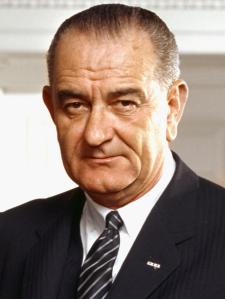
A similar link was created by LBJ in enacting the medicare program. LBJ effectively permanently changed health care in the United States and effectively amended the constitution by structuring it as a permanent entitlement.  Of Medicare he said:

And through this new law, Mr. President [referring to Harry Truman], every citizen will be able, in his productive years when he is earning, to insure himself against the ravages of illness in his old age.

These changes in the financial structure of America have wrought permanent change in the power balance among and between all wage
President Johnson

earners and all former wage earning retirees.  These were created without having engaged in the rigorousness of amending the constitution to enshrine those fundamental changes as the province of the federal  government.  As contemplated by FDR and LBJ, these programs admit to little control by the present generation of taxpayers while the beneficiaries, retirees, still live (vote) and in the meantime each new generation become beneficiaries themselves by just paying their taxes.  Therefore, the working citizenry are bound, semi-permanently, to pay the bills of retirees until they too impose this burden upon the working generation behind them.  Not constitutional perhaps, but certainly permanent.

In his last paragraph, Romano glowingly quotes from Jefferson’s letter to Samuel Kercheval in 1816.  Romano quotes Jefferson as supporting the idea that a constitution should not be beyond amendment and that each generation should be accorded the deference to handle its own affairs.  Romano, without even acknowledging the lack of amendments supporting his view of the extraordinary increase in federal power in recent years,  concludes his recitation of Jefferson’s observation with the term, “Amen.”  One could take from this quotation, and it’s rather emphatic adoption, that Romano thought the Kercheval letter an example of excellent insight and public spiritedness.  I suspect that Romano agrees with only a narrow slice of Jefferson’s ideas because most of the letter contains insights of great comfort to the Partiers.  For instance, Jefferson rails against a generation of leaders who would bind a succeeding generation with “perpetual debt” exhorting each  generation creating a debt to work as hard as necessary to discharge it.   Social Security, Medicare, Medicare Part D and Obamacare are all examples of permanent entitlements which resemble the permanent debt so decried by Jefferson.  And these entitlements by design will never to be “paid off.”  In fact in the Kercheval letter Jefferson expressed his private belief that amendments should be made every twenty years or so to permit each generation, “. . . a right to choose for itself the form of government it believes most promotive of its own happiness, . . . .”  This is exactly the opposite of the burdens represented by these entitlements, as well as the $13.5 Trillion national debt itself, which have been bequeathed upon the current and future generations.  Is Romano even aware of the irony of using Jefferson’s letter as support for his view of a malleable constitution?

Finally and most importantly for Partiers to remember is another section from the Kercheval letter.  Jefferson clearly values the “republican” spirit of the people over the republican form of government which the constitution created.  Said the third president,

Where then is our republicanism to be found? Not in our constitution certainly, but merely in the spirit of our people. That would oblige even a despot to govern us republicanly. Owing to this spirit, and to nothing in the form of our constitution, all things have gone well. But this fact, so triumphantly misquoted by the enemies of reformation, is not the fruit of our constitution, but has prevailed in spite of it. Our functionaries have done well, because generally honest men. If any were not so, they feared to show it.

It is this spirit which Jefferson believes defends the concept of liberty and limited government.  And whether the Partiers are consciously aware of it or not, it is the revival of this spirit which will defend our liberties.  Partiers would no doubt prefer it if “a return” to the Constitution were possible which, once accomplished, would permit them to rest easy with their liberties.  Unfortunately, as Jefferson believed, this will never be the case.  The price of freedom is constant vigilance.  It is of this Tea Party-type constitutional spirit rather than of the explicit terms of an ancient document which the current crop of politicians ought to be concerned as the primary threat to political business as usual.