NANCY, THERE YOU GO AGAIN
More data has arrived on what Progressives believe. Speaker Pelosi recently threw some red meat to her constituents at a meeting of the “Women of Steel,” a group associated with the United Steelworkers Union. In the midst of a diatribe against the Republican job-destroying policies of George W. Bush she made some illuminating and, to me, frightening comments.
Pelosi affirmed her primary economic principle. What is economically beneficial for her political sponsors today is what is “good.” Therefore, her unflinching vision of a progressive America is as a place where “ownership” of property can be directly changed by government 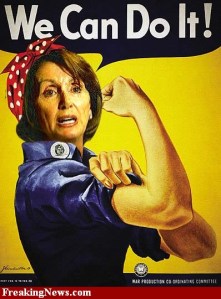 edict. In addition to merely manipulating income tax rates and increasing transfer payments Pelosi now wants to allow political elites to directly transfer after tax ownership of existing property to more deserving people. If anyone had illusions, she has now dropped all pretense to being friendly to economic freedom. She is in favor of any policy which satisfies her vision of “economic justice.”
America, to Pelosi’s mind, is apparently just an unjust place where only some people can produce wealth without the intervention of government to help them. Apparently, according to her, most people, her people, just lack what it takes in order to create wealth on their own. This is wrongheaded and should be deeply insulting to those she seeks to help. In their pride they should reject her and her form of “help.”
Government, in Pelosi-world, can reassign ownership of wealth in order that the little people may have ownership of a bit of it. In this thinking she fundamentally misunderstands the concept of wealth, the process of creating wealth and the underlying nature and effect of involuntarily “transferring ownership” of wealth.
What Pelosi fails to realize or actively discounts is that wealth is a result of a truly creative process on the part of a human being. It happens as a result of the interaction between the abilities, qualities and talents of a human being and the world he or she lives in. It really is just as simple as that. A peson can take a piece of wood of little value as such and make something of more and perhaps much more value from it, like a bow and arrow. Take a quarter pound of ground beef of value as such and spice it up, learning in the process a way to make the best tasting hamburger in the world. Create a new way to use the internet to network people socially. In each of these situations and in innumerable others a human, by interacting with his (or her) world, creates wealth. Bringing into existence a thing of value which did not exist before is a human effort. Owning wealth, when rightly understood, is just the ownership of a thing of value which was created by you. When a human being interacts with the environment and creates a thing he creates wealth and in this country he can have ownership of that thing, that wealth. Hence ownership of wealth is a simple but immensely powerful concept that is inextricably connected with it’s creation and therefore with the consequent improvement of the wealth of society.
It is undoubtedly true that some people are luckier than others. Thomas Edison suggested that invention was 99% perspiration and only 1 % inspiration (both of which are characteristically human). In this he may have been biased in this assessment preferring to attribute his own success to the superioriority of hard work rather than the good fortune of a sharp and creative mind. The antithesis of Edison is a person who perspires and perspires year upon year and yet is never able to create anything perceived to be of real value by others (Van Gogh comes to mind here). Likewise there are also certainly others who perspire little but who are very fortunate in having an insight or talent at wealth creation who perspire little. It is a fact of life as well that some people lack courage or energy or intelligence or imagination or luck and decide to look to others to be told how and when to create things of value, like using someone else’s recipe to cook the world’s greatest hamburger while working at some one else’s fast food joint. But one way or other we all benefit from either our own creation of wealth or the creation of wealth by another person who gave it to us or shared it with us. This is how the world of economic freedom has worked since human beings came to be. Apparently Ms. Pelosi doesn’t like this model one bit. She prefers to focus not on the creation of wealth but upon its distribution and apparently now upon it’s reassignment.
Money (what many people mistakenly take for wealth) accumulates around a wealth creator because when that person owns a piece of wealth he can exchange it for something else. This mechanism applies as much to the wealth represented by an hour of labor creating wealth from interacting with the environment which an employer has created as it does to an invention created alone in a garage. Money is the usual medium of exchange which facilitates this free transfer of wealth. Money is also designed as a store of the value received by the person trading real wealth for it. It allows the seller to retain the value of the sale for an indefinite period of time and this is the reason that it is often mistaken for wealth itself.
What right does Nancy Pelosi have to endorse taking wealth from one person and assigning it to another? How does this action encourage the formation or creation of more wealth? What kind of a country do you have when the ownership of wealth is insecure? Although it is true you can create, by redividing wealth, an egalitarian place where everyone is economically equally well off for a short time, at the same time you also create a place in which people become disinterested in creating new wealth which they cannot own and trade. Is it not clear that this seemingly egalitarian system leads over time to everyone being more rather than less focused on themselves? Doesn’t this system retard the creation of things which have value to others because each thing created is subject to being taken involuntarily by the government to be “shared” with everyone? And wouldn’t such an unhealthy situation tend to become more and more pronounced over time leading to more and more selfishness since people would no longer have to create things that please one another in order to get along? And finally wouldn’t this system result in a less wealthy society?
If your experience of the real world tells you that a wealthier society will come from Ms. Pelosi’s experiment with wealth reassignment, please let me know why and how you see it working in practice.
Explore posts in the same categories: Political Economy Short and Sweet Blog