A Rise in Civil Libertarianism on the Right?
On June 24 Rasumussen reported the following poll results:
Nearly half of American Adults see the government today as a threat to individual rights rather than a protector of those rights.
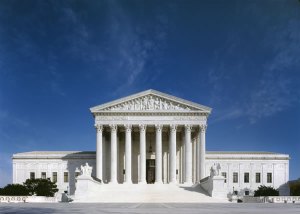
United States Supreme Court
That is, according to Rasmussen, 48% of American adults believe that government is a threat to individual rights.
Additionally, most Americans (52%) say it is more important for the government to protect individual rights than to promote economic growth.
One final and interesting point made by Rasmussen about this poll is the breakdown in opinion between self identified Republicans, Democrats and Independents.
Most Republicans (74%) and unaffiliateds (51%) consider the government to be a threat to individual rights. Most Democrats (64%) regard the government as a protector of rights.
The polling represents a point of view that the more conservative among us are becoming more interested in our civil liberties. To see these poll results in practice before the US Supreme Court we have Thursday’s opinion in Skilling v. United States. Skilling was formerly the CEO of Enron. The justices, in striking down Skilling’s conviction, lined up in a very interesting way. In this so called “right to honest services” case the Court unanimously agreed that, as it applied to Skilling, this criminal statute was too vague and Skilling had been deprived of his constitutional due process rights. The author of the Court’s main opinion, Justice Ruth Bader Ginsburg, is the former general counsel for the ACLU. She concludes for the majority that the “honest services” statute is vague and this vagueness is overcome only in those cases involving bribes or kickbacks. Limited to such cases she finds the law constitutional but, because Skilling had not participated in bribery or kickbacks, the statute was defective as to him.
In a separate opinion Justice Scalia joined by Justice Thomas, certainly the most conservative members of the Court, joined by Justice Kennedy, argues that the reasoning of Justice Ginsburg is insufficiently broad. Justice Scalia concludes that any conviction under this statute would be defective on due process grounds since nowhere in the statute is there a limitation to those cases involving kickbacks and bribery. Hence, Scalia says, the statute is overbroad, ambiguous and fundamentally defective and future opinions should invalidate any convictions under it on this basis.
The juxtaposition of these two opinions and their authoring jurists is fascinating. The so-called conservative would flatly invalidate all convictions under this statute while the former general counsel for the ACLU would uphold convictions in certain circumstances which are unnamed in the statute. Who is the civil libertarian here? Why the divergence? Is there something in the way each of them see the world which makes them break down this way? Are the results of the Rasmussen poll playing out on the stage of the highest court in the land?
Of course you may say that this is just like medieval theologians arguing over how many angels may dance on the head of a pin. Why, you may ask, is this anything more than a simple academic disagreement between extremely intelligent justices? Why is this a civil liberties case?
My answer: the Skilling case is rightly understood as a political rather than a law enforcement case. Why do I believe that the prosecution of Mr. Skilling was political? I think we can all agree that there was considerable pressure on the Bush justice department to convict Skilling as well as Ken Lay and other higher ups at Enron as well as the accountants at Arthur Andersen (another prosecution which failed at the Supreme Court level in 2005) of something, given the high profile of this largest bankruptcy in US history. There simply can’t, in our modern America, be such a thing without criminal charges, can there? Somebody must be made to pay and pay dearly. Our federal government cannot be seen to be passive here because people would start to wonder if the federal government’s “protection” of the public is really all that valuable if there is no criminal violation associated with Enron’s fall. [Note: The justice department publicly began looking at BP for criminal violations associated with the oil leak several weeks ago prior to the agreement by BP, under pressure from the White House, to fund an independently administered $20 Billion compensation fund.]
In the end, the government charged Skilling with both a violation of the “right to honest services” law and insider trading violations. Lacking a strong insider trading case against Skilling, evidence of this fact being conclusive since a local Houston jury acquitted on all nine such counts, the government used it’s “go to” statute, the “right to honest services” law, to “get him.” At trial the government gained a conviction but it did so only through the use of a criminal statute which was, as to Skilling, unconstitutionally vague according to a unanimous Court. From the point of view of the executive branch, however, the justice department was vindicated by a jury which convicted, even though Skilling was eventually let off on a legal loophole. It was plainly just a political prosecution.
The Courts are there to protect us from being crushed under the overbearing weight of the federal government. It is laudable that all of the justices stepped up to agree that Skilling, an unpopular and much villified character, was subjected to prosecution under an unconstitutionally vague law. It is interesting, I think, in light of the Rasmussen poll, that the more conservative justices were willing to go further than the reputed “civil libertarians” to restrict the power of the feds.
[See also: Fox News Judge Andrew Napolitano attacking the Patriot Act as blatantly abominable, unconstitutional and hateful from the stand point of civil liberties.]
Explore posts in the same categories: Uncategorized Short and Sweet Blog